Davos Leaders say AI will create jobs for people who own AI
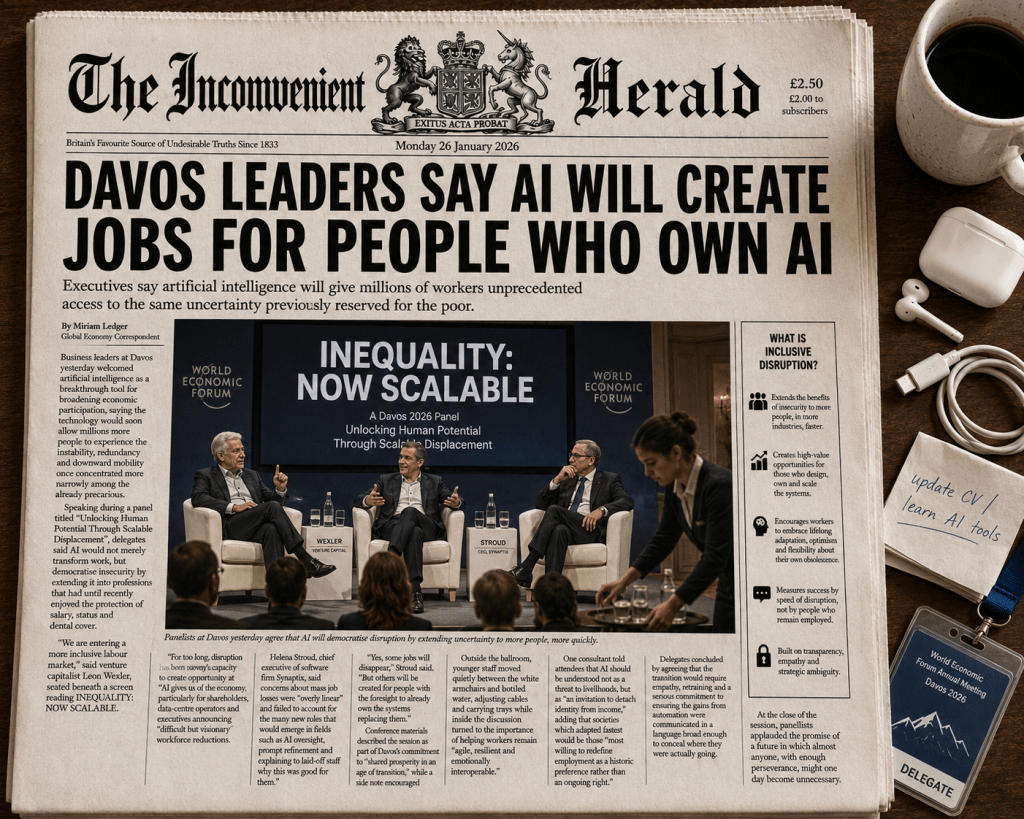
**DAVOS LEADERS SAY AI WILL CREATE JOBS FOR PEOPLE WHO OWN AI**
**Executives say artificial intelligence will give millions of workers unprecedented access to the same uncertainty previously reserved for the poor.**
Business leaders at Davos yesterday welcomed artificial intelligence as a breakthrough tool for broadening economic participation, saying the technology would soon allow millions more people to experience the instability, redundancy and downward mobility once concentrated more narrowly among the already precarious.
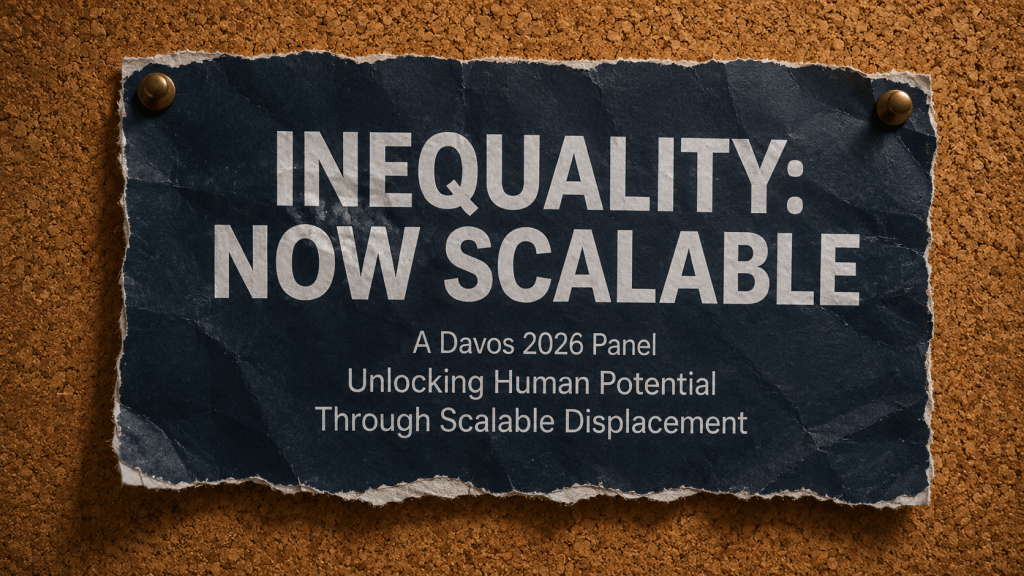
Speaking during a panel titled **Unlocking Human Potential Through Scalable Displacement**, delegates said AI would not merely transform work, but democratise insecurity by extending it into professions that had until recently enjoyed the protection of salary, status and dental cover.
“We are entering a more inclusive labour market,” said venture capitalist Leon Wexler, seated beneath a screen reading **INEQUALITY: NOW SCALABLE**. “For too long, disruption has been unevenly distributed. AI gives us the ability to bring uncertainty to middle management, analysts, creatives and other groups previously insulated from the excitement of replaceability.”
Fellow panellists praised the technology’s capacity to create opportunity at the top end of the economy, particularly for shareholders, data-centre operators and executives announcing “difficult but visionary” workforce reductions.
Helena Stroud, chief executive of software firm Synaptix, said concerns about mass job losses were “overly linear” and failed to account for the many new roles that would emerge in fields such as AI oversight, prompt refinement and explaining to laid-off staff why this was good for them.
“Yes, some jobs will disappear,” Stroud said. “But others will be created for people with the foresight to already own the systems replacing them.”
Conference materials described the session as part of Davos’s commitment to “shared prosperity in an age of transition,” while a side note encouraged delegates to think beyond “legacy measures” such as job security, wage growth and whether people could still pay rent.
Outside the ballroom, younger staff moved quietly between the white armchairs and bottled water, adjusting cables and carrying trays while inside the discussion turned to the importance of helping workers remain “agile, resilient and emotionally interoperable.”
One consultant told attendees that AI should be understood not as a threat to livelihoods, but as “an invitation to detach identity from income,” adding that societies which adapted fastest would be those “most willing to redefine employment as a historic preference rather than an ongoing right.”
Delegates concluded by agreeing that the transition would require empathy, retraining and a serious commitment to ensuring the gains from automation were communicated in a language broad enough to conceal where they were actually going.
At the close of the session, panellists applauded the promise of a future in which almost anyone, with enough perseverance, might one day become unnecessary.

 Yeah Bagel