
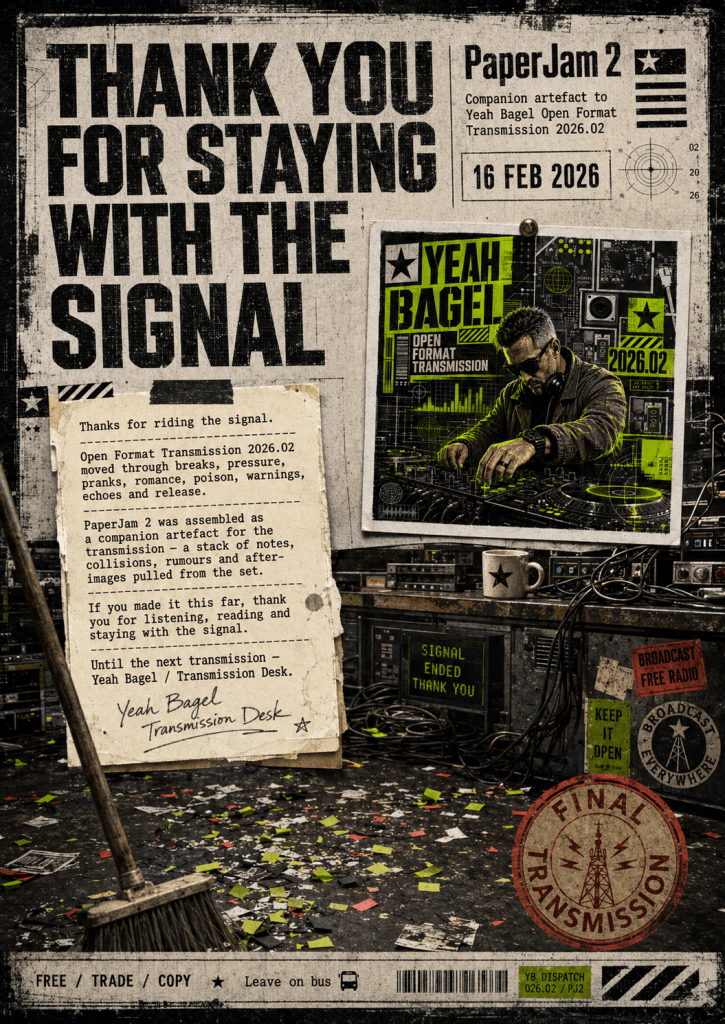
Companion artefact to Yeah Bagel Open Format Transmission 2026.02
Issue date: 16 Feb 2026
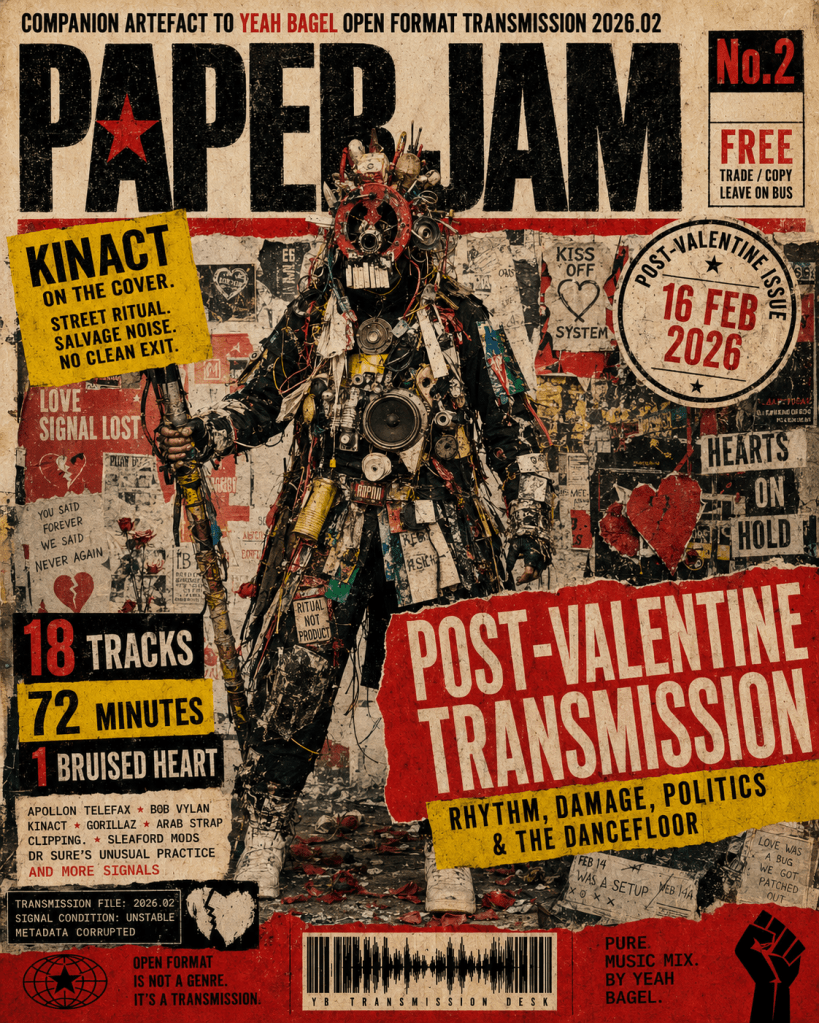
PaperJam 2 is the bruised paper shadow of Yeah Bagel Open Format Transmission 2026.02, a post-Valentine dispatch from the zone where romance, bass pressure, politics, memory, sampling and damaged joy all get fed through the same overheated photocopier. If PaperJam 1 established the zine as an archive object for the Open Format Transmission universe, Issue 2 deepens the mythology: not just a track-by-track guide, but a field guide to emotional misdirection, where page numbers become signal coordinates and every selection is treated as evidence of something larger moving beneath the mix.
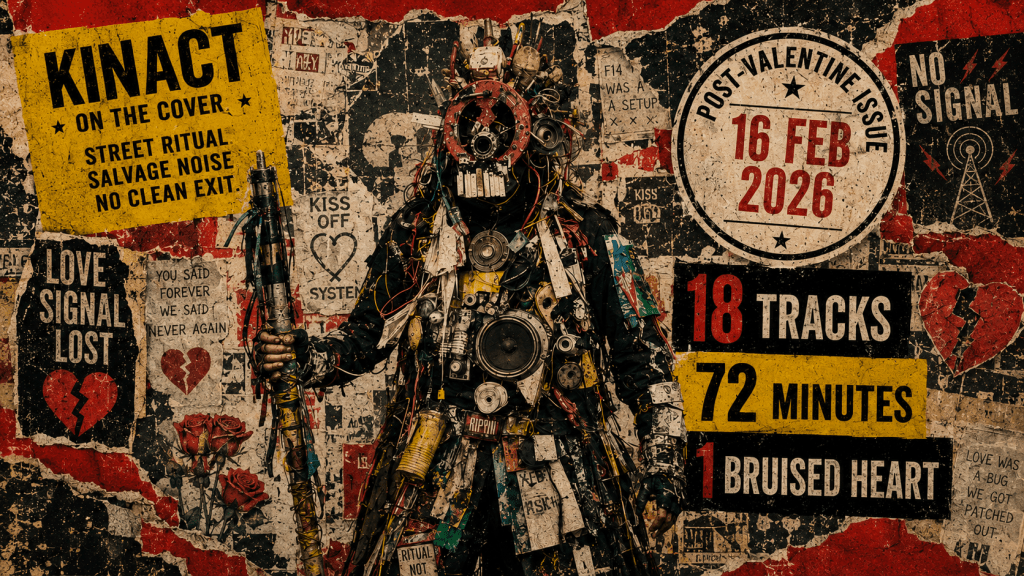
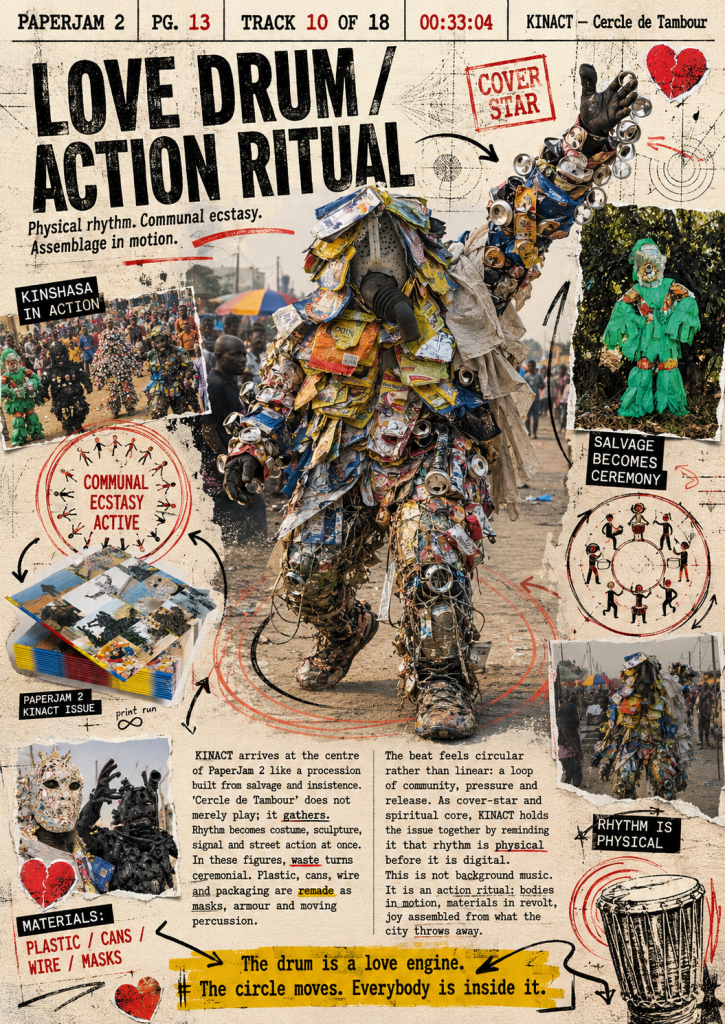
The issue opens with KINACT as cover-star, immediately setting the tone: salvage ritual, street ceremony, movement, recycled materials, and communal rhythm as spiritual machinery. The cover frames the whole transmission as a post-Valentine document, not sentimental but tender in a damaged, stubborn way. Hearts appear throughout, but they are cracked, stamped, misfiled, chemically altered, or fed into machines. Love is not rejected; it is shown after impact, still twitching.
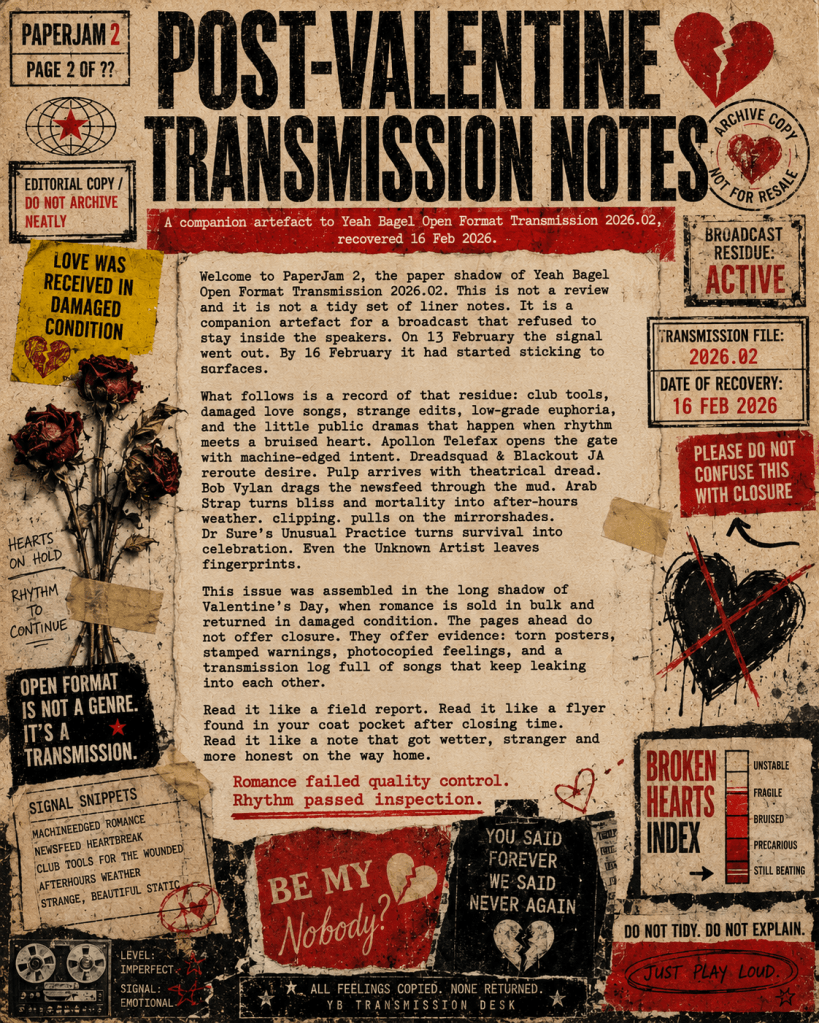
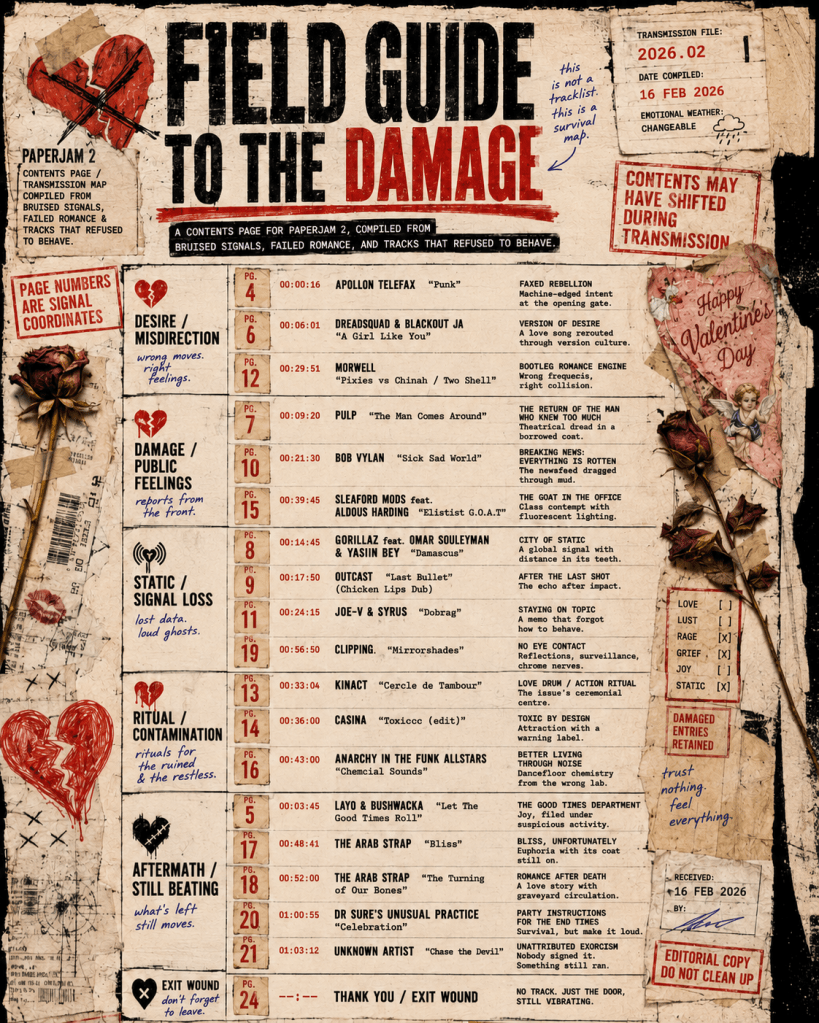
The early pages establish the PaperJam system. Page 2 welcomes the reader into the transmission as a physical object: part fanzine, part dossier, part pirate-radio artefact. Page 3, Field Guide to the Damage, recasts the contents page as a survival map. Tracks are grouped by emotional weather: desire, misdirection, public damage, static, ritual contamination, aftermath and exit wound. It is not a neutral index. It is an annotated damage report.
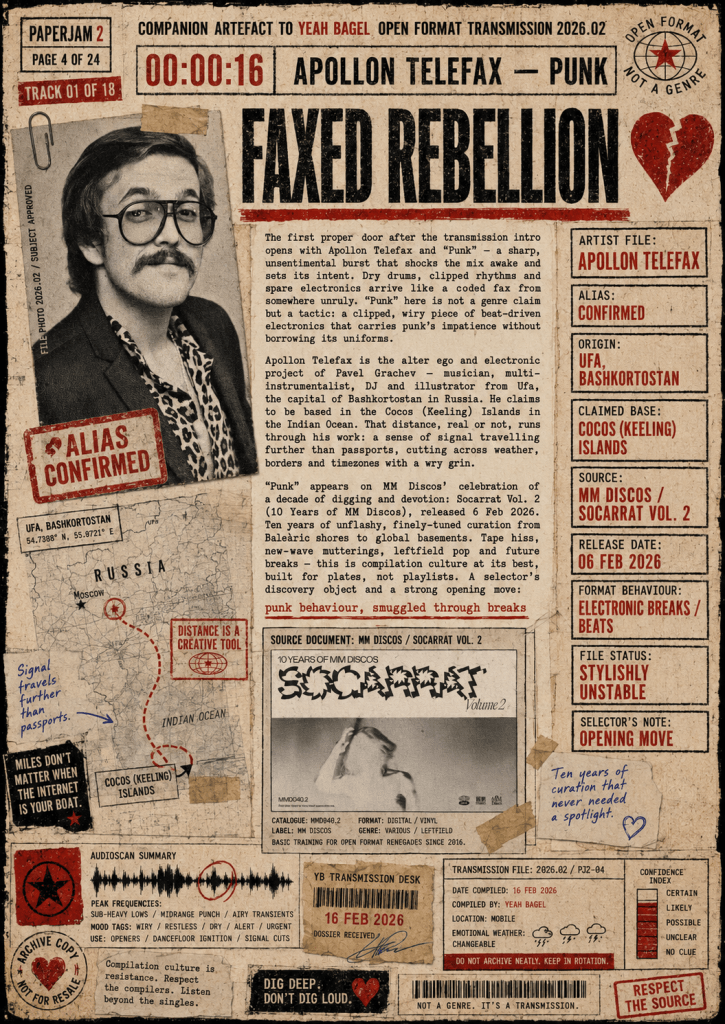
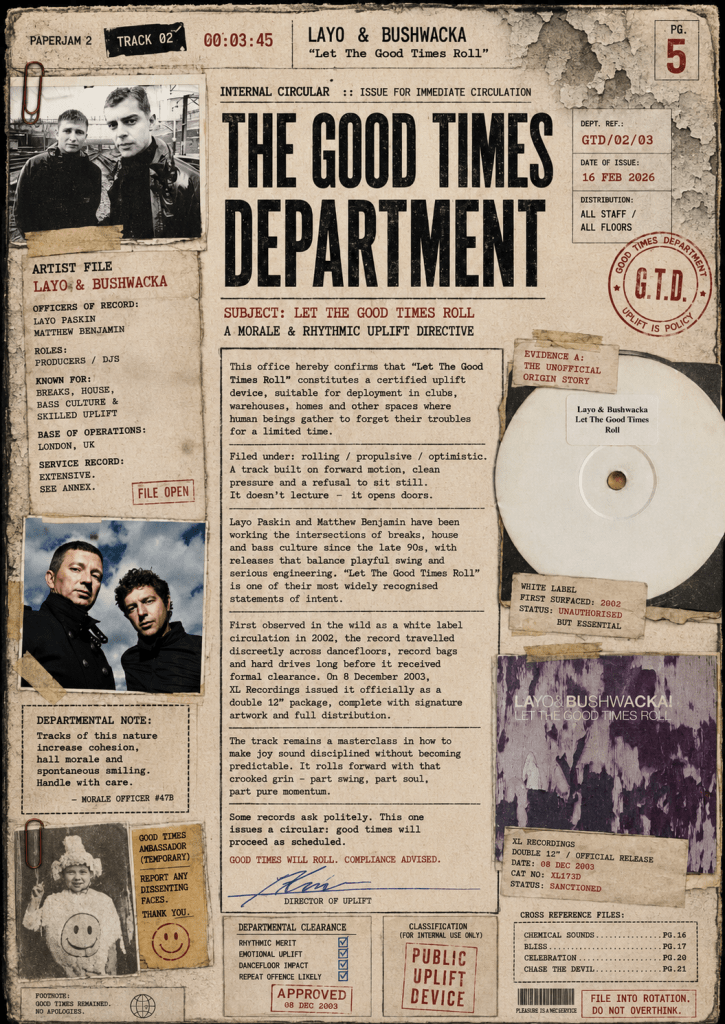
The track pages begin with Apollon Telefax’s “Punk”, where punk is not treated as guitar orthodoxy but as tactic. The page frames Pavel Grachev’s Ufa/Cocos mythology and the Socarrat Vol. 2 context as clipped, beat-driven mischief with intent: “punk behaviour, smuggled through breaks.” Layo & Bushwacka’s “Let The Good Times Roll” follows as bureaucratic dancefloor comedy, a fake institutional document about pleasure being officially mandated. Its 2002 white-label prehistory and 2003 XL release become the evidence trail for a tune that feels like joy being rubber-stamped by a suspicious department.
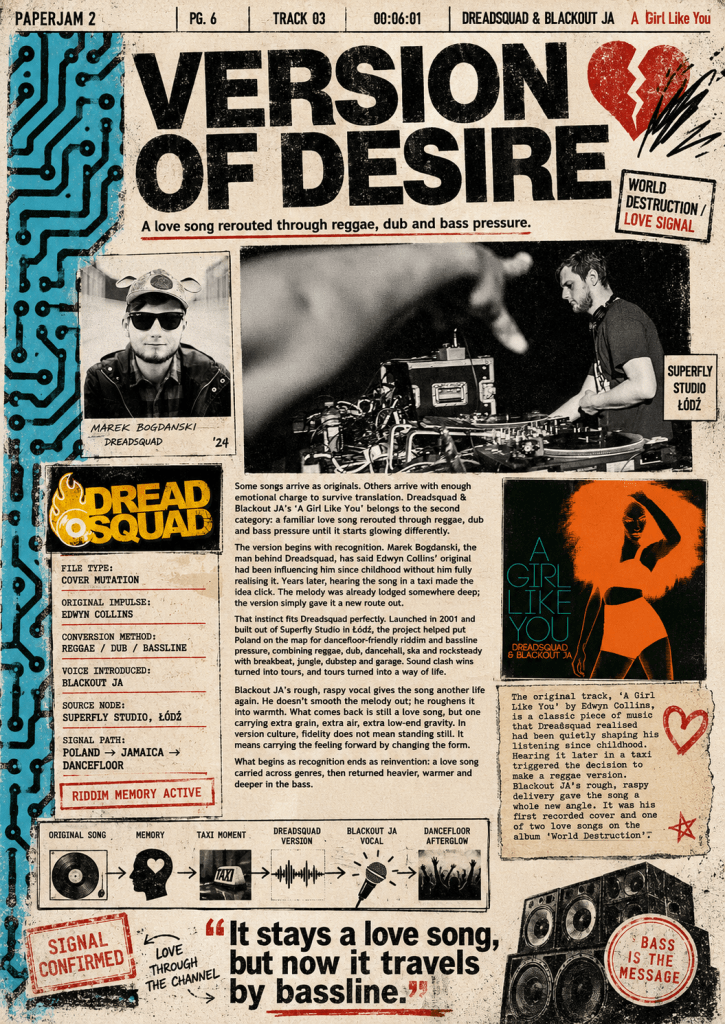
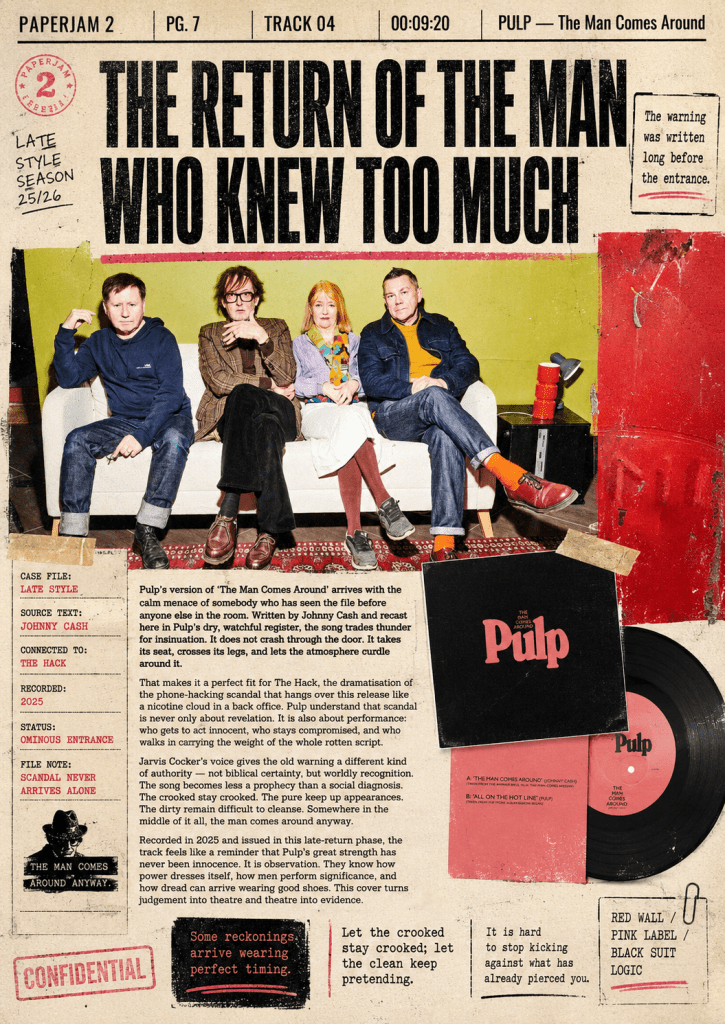
Dreadsquad & Blackout JA’s “A Girl Like You” turns the zine warmer. It treats the Edwyn Collins cover as romance through version culture: a familiar melody rerouted through reggae, dub and bassline logic, made authentic by memory rather than novelty. Then Pulp’s “The Man Comes Around” darkens the room with theatrical English dread, turning a Johnny Cash cover into a late-style entrance: ominous, wry, post-scandal, and haunted by judgement without quoting the source too directly.
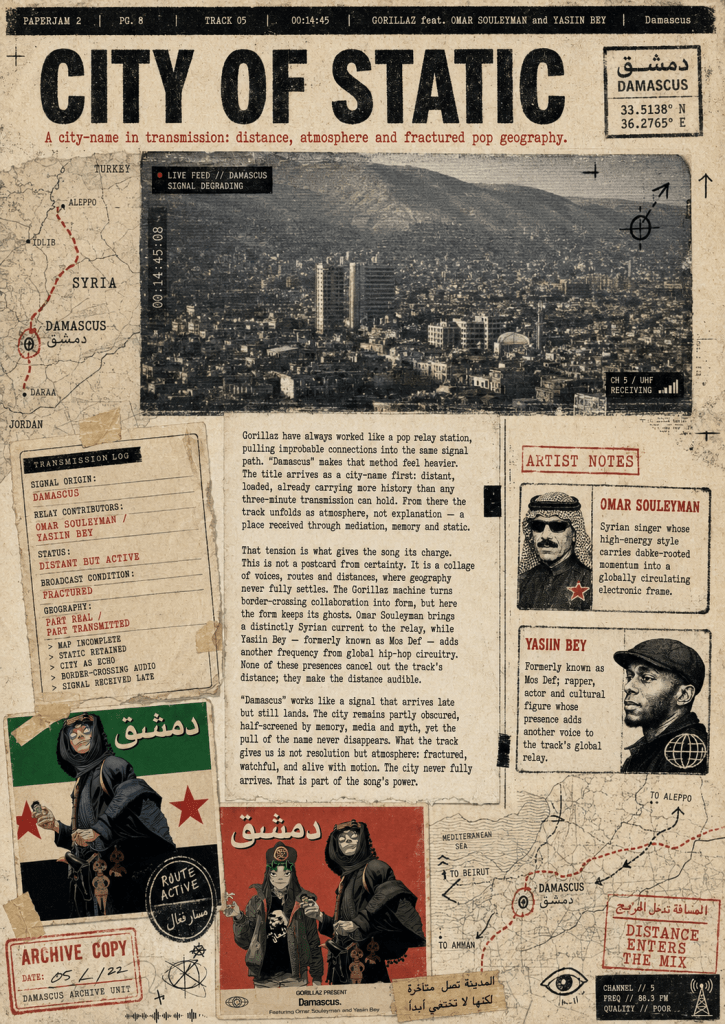
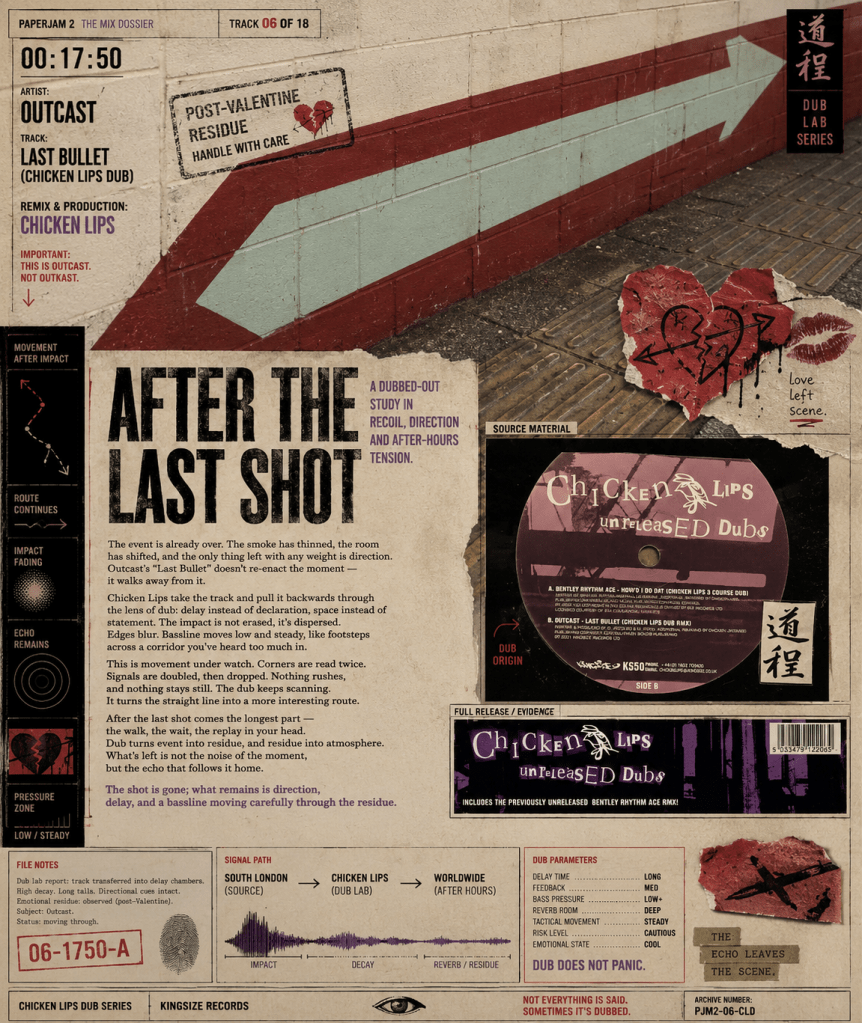
With Gorillaz feat. Omar Souleyman and Yasiin Bey’s “Damascus,” the issue becomes geographical. The page, City of Static, presents Damascus not as a flattened symbol but as a distant signal: real city, pop collage, fractured relay, and mediated memory. Omar Souleyman and Yasiin Bey are handled as distinct transmission nodes, while Gorillaz become the machine through which the signal flickers. Outcast’s “Last Bullet (Chicken Lips Dub)” then shifts into cool-room paranoia. The page insists this is Outcast, not OutKast, and makes the Chicken Lips dub an aftermath corridor: not the shot itself, but the route taken after impact.
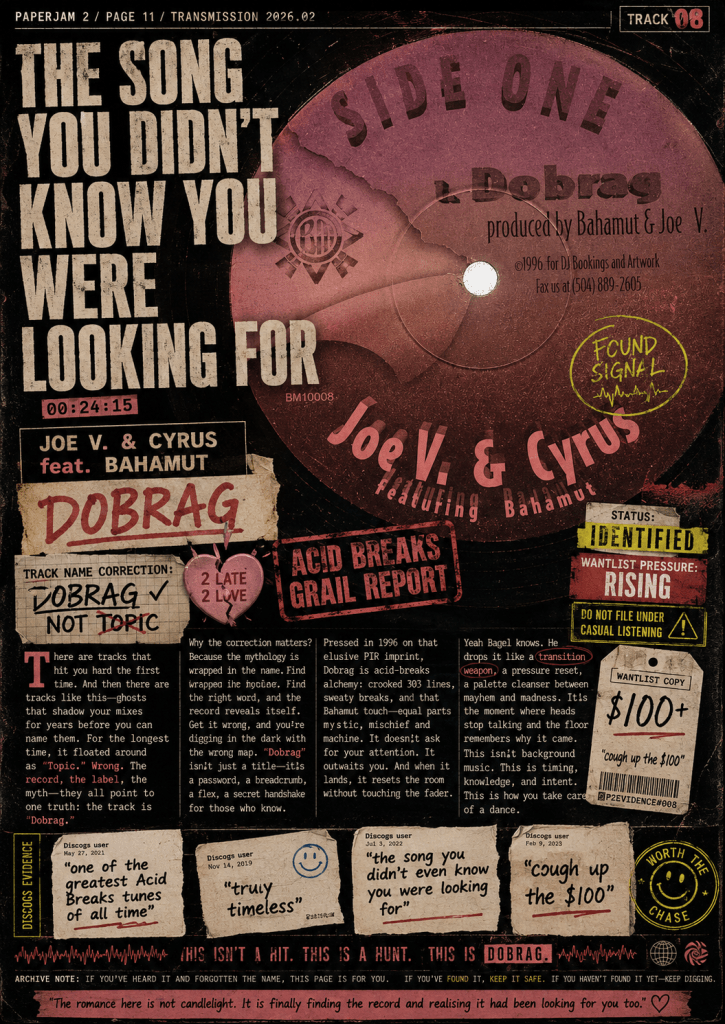
The correction of Track 8 becomes one of the issue’s most satisfying pieces of crate-digger drama. Originally misidentified as “Topic,” Joe V. & Cyrus featuring Bahamut’s “Dobrag” becomes The Song You Didn’t Know You Were Looking For. Built around the dusty Side One label, the page treats the record as acid-breaks grail object, collector fever, late identification and romantic obsession. Discogs testimony becomes folk evidence: “one of the greatest Acid Breaks tunes of all time,” “truly timeless,” “the song you didn’t even know you were looking for.” The page makes the correction itself part of the mythology.
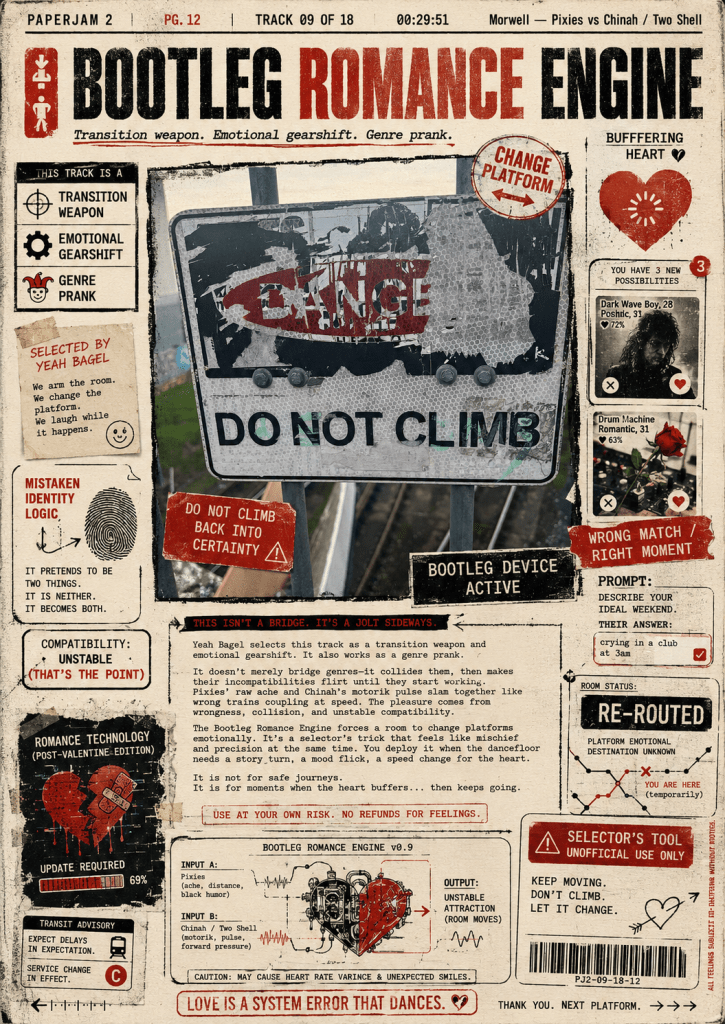
Morwell’s “Pixies vs Chinah / Two Shell” is the issue’s transition prank: Bootleg Romance Engine. It is described as 50% selector weapon, 50% emotional gearshift, 50% genre prank, because the maths is supposed to fail. A “DO NOT CLIMB / CHANGE” sign becomes accidental prophecy for unstable compatibility. Then the issue reaches its ceremonial centre with KINACT’s “Cercle de Tambour”, the cover-star page and spiritual core. Love Drum / Action Ritual frames rhythm as physical before digital: bodies, masks, cans, plastic, wire, salvage, procession, circular energy. The drum is a love engine; everybody is inside it.
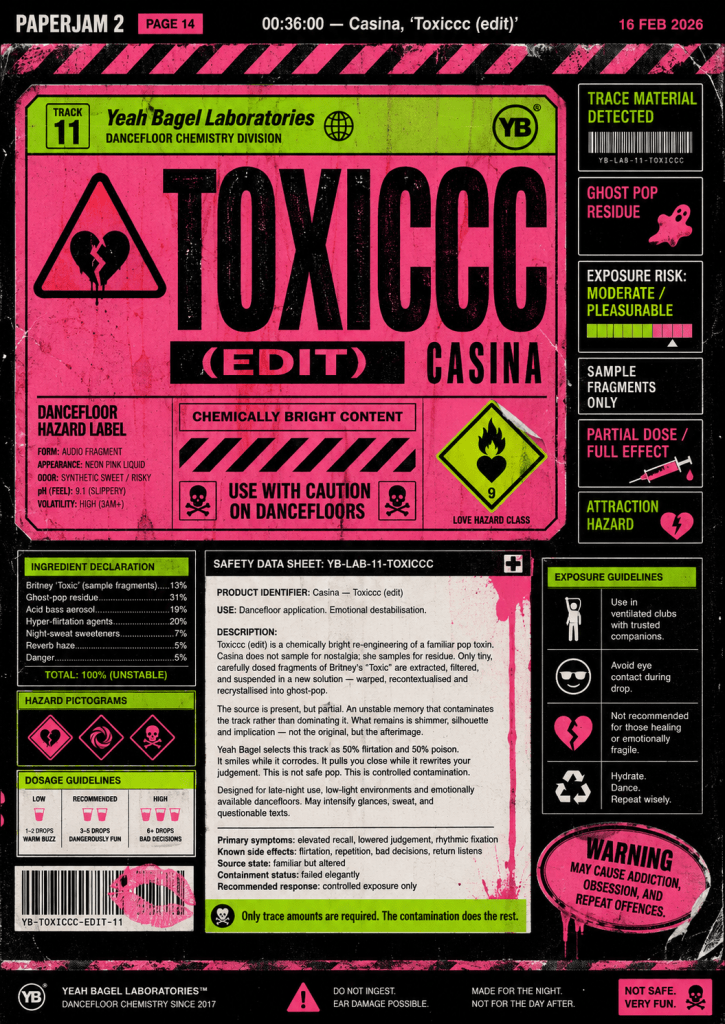
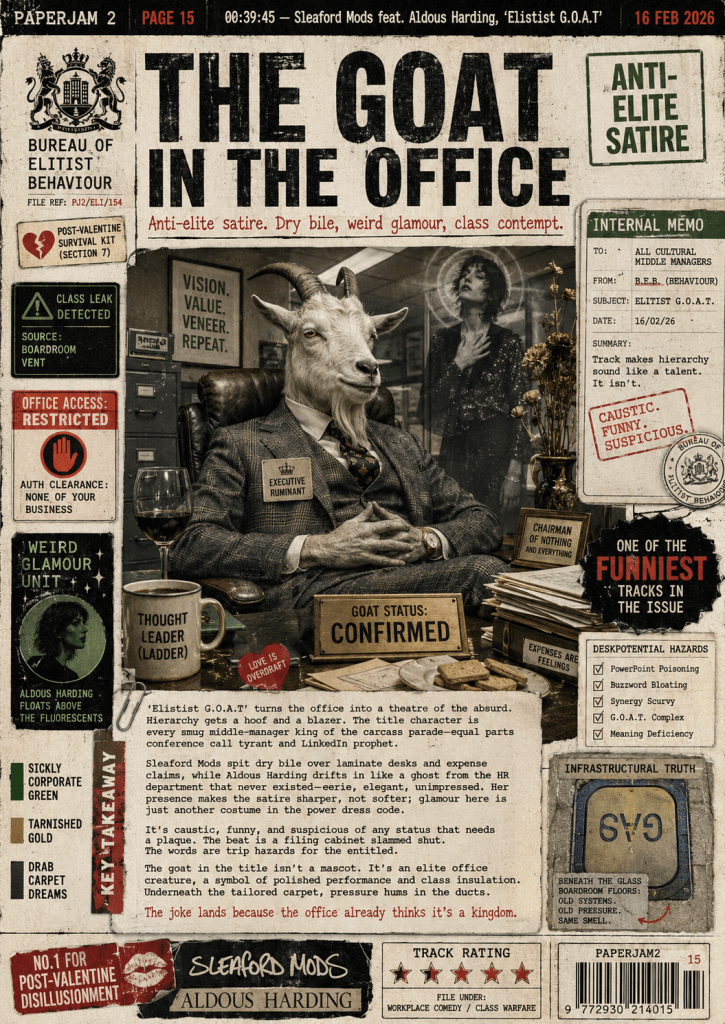
From there the issue turns chemical. Casina’s “Toxiccc (edit)” becomes Toxic by Design, a fake safety-data sheet in acid pink and toxic green. Small Britney fragments are treated as ghost-pop residue: trace material, not tribute. Yeah Bagel’s selection is “50% flirtation and 50% poison,” a controlled contamination designed for late-night use. Sleaford Mods feat. Aldous Harding’s “Elistist G.O.A.T” then detonates as workplace satire. The Goat in the Office is anti-elite bile with weird glamour: a class-contempt comedy staged in fluorescent corporate absurdity, where hierarchy sounds like talent but absolutely is not.
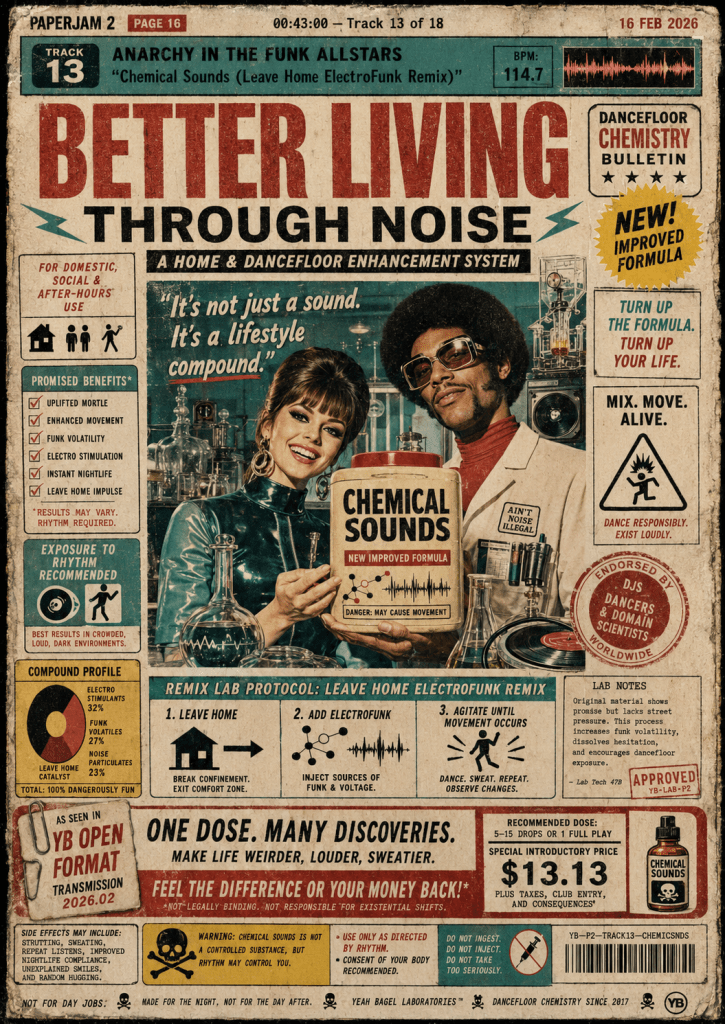
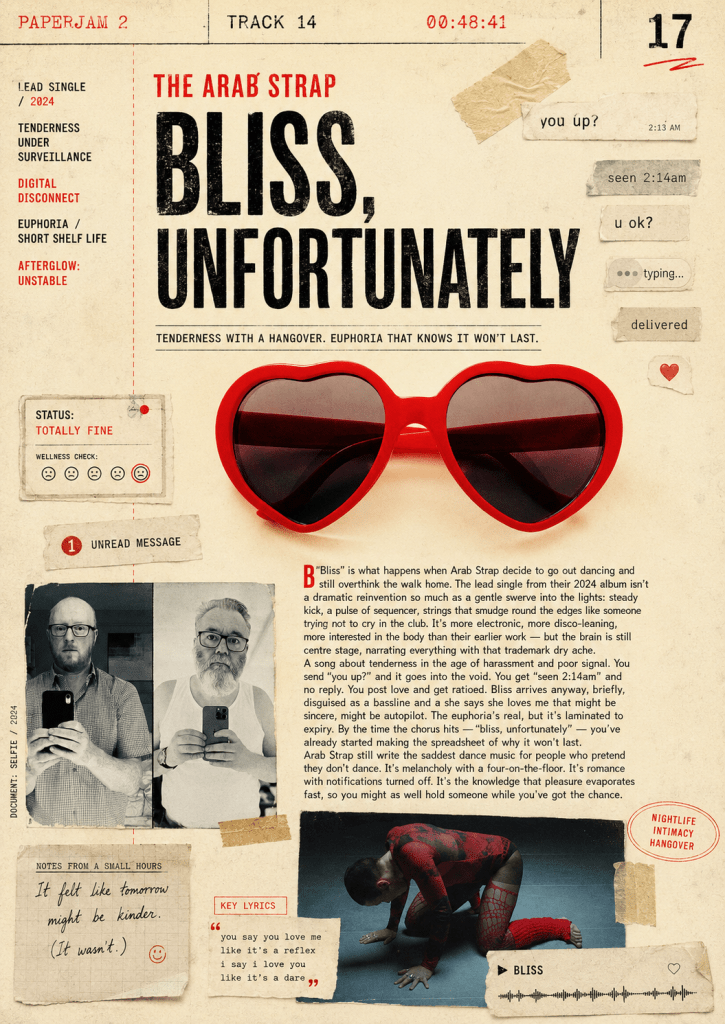
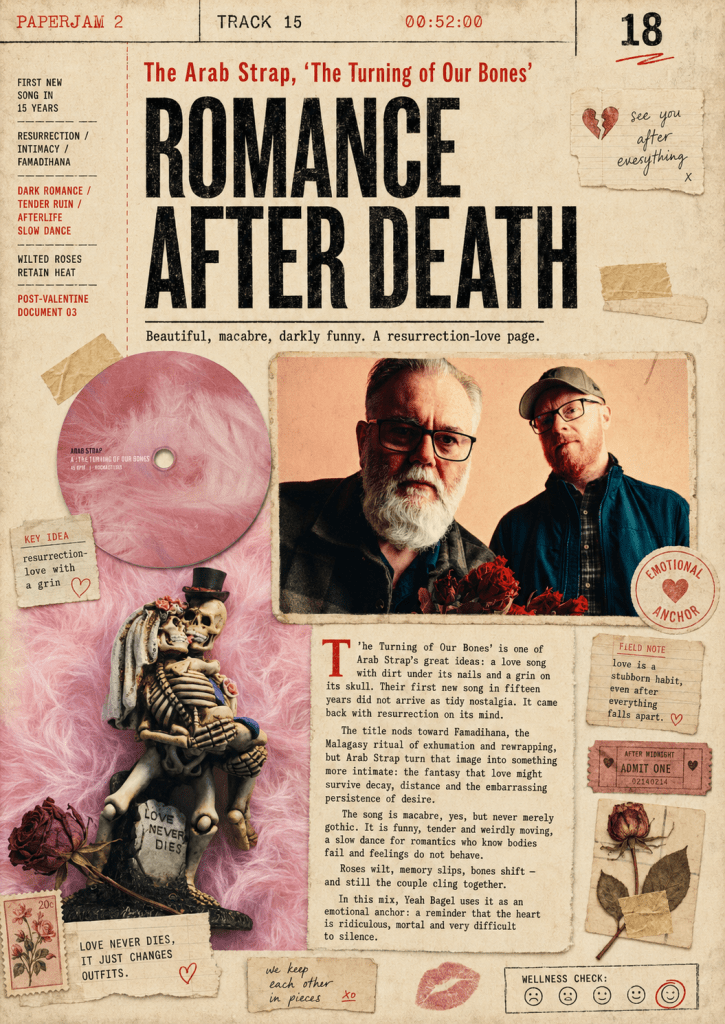
Anarchy in the Funk Allstars’ “Chemcial Sounds (Leave Home ElectroFunk Remix)” keeps the lab comedy going as retro advert: Better Living Through Noise. Here dancefloor chemistry is sold as lifestyle improvement, an unstable compound promising movement, sweat and dubious uplift. The spelling “Chemcial” is retained as signal texture rather than corrected away. Then The Arab Strap arrive with a two-page emotional anchor. “Bliss” becomes Bliss, Unfortunately, euphoria with a hangover, digital disconnect, toxic intimacy and the small cruelty of message threads. “The Turning of Our Bones” follows as Romance After Death, a macabre resurrection-love page linked to Famadihana, intimacy, roses, bones and the idea that love never dies, it just changes outfits.
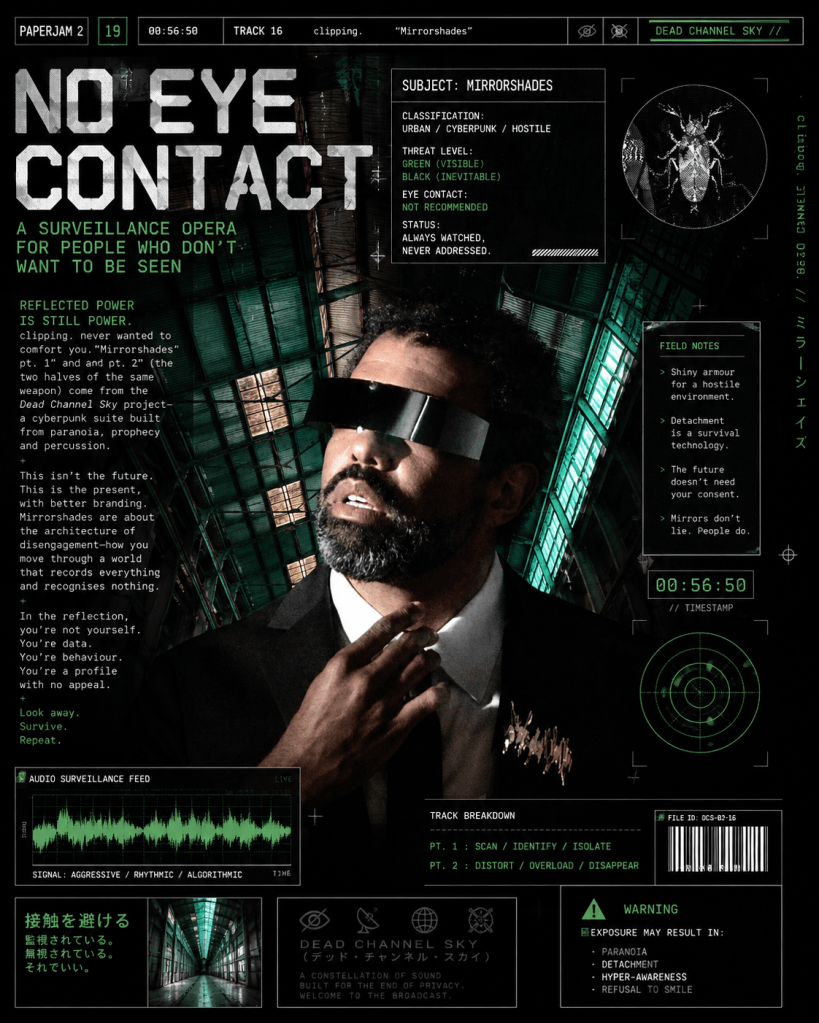
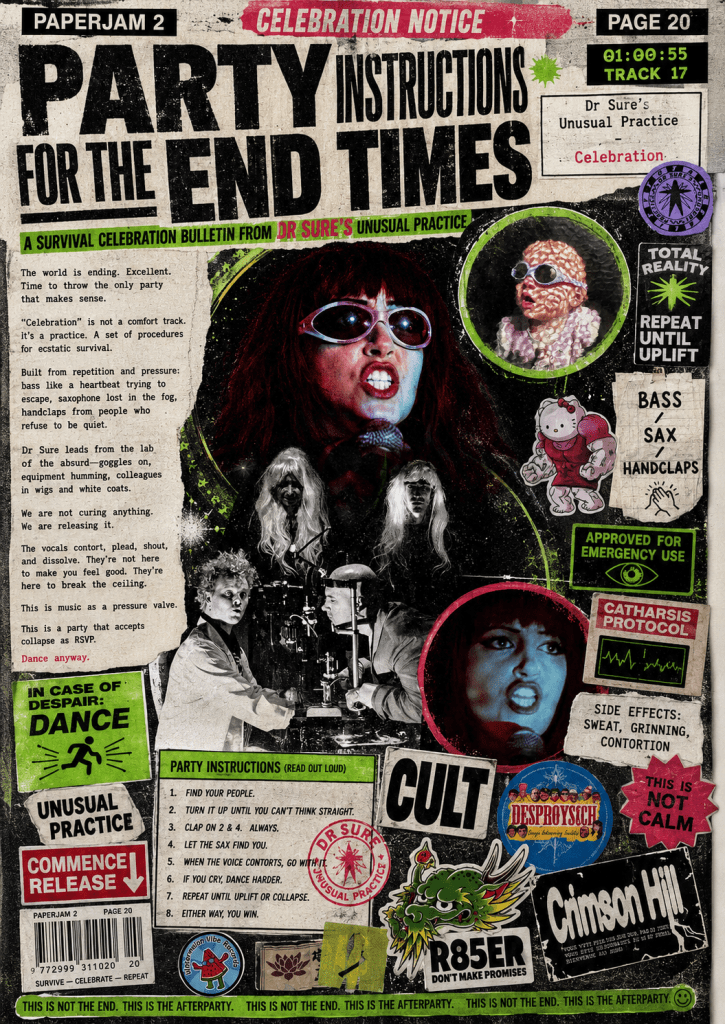
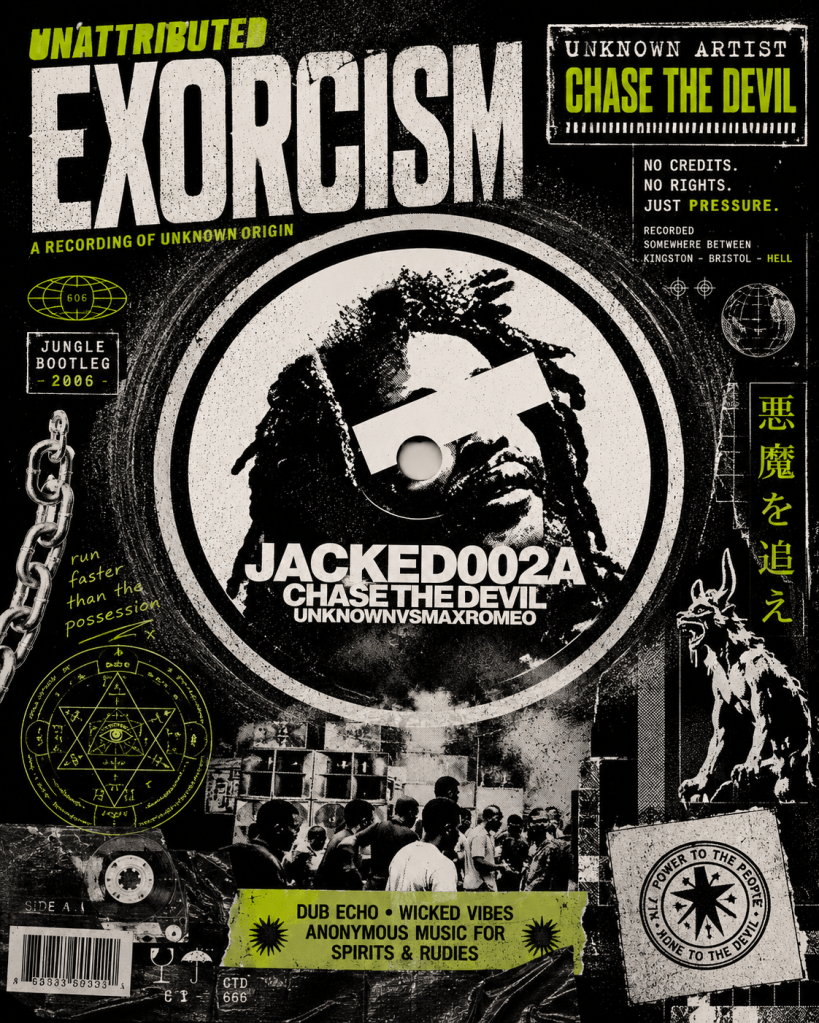
The final run hardens. clipping.’s “Mirrorshades” becomes No Eye Contact, a cyberpunk surveillance page full of mirrored detachment, green-black hostile urban circuitry and Dead Channel Sky paranoia. Dr Sure’s Unusual Practice’s “Celebration” is the cathartic release valve: Party Instructions for the End Times, a deranged celebration notice where repetition, bass, sax, handclaps and contorted vocals become survival protocol. The final track, Unknown Artist’s “Chase the Devil,” closes the musical sequence with Unattributed Exorcism, a 2006 jungle bootleg from Jacked Recordings treated as anonymous occult pressure: no credits, no rights, just pursuit, folklore, dub echo and anti-authority charge.
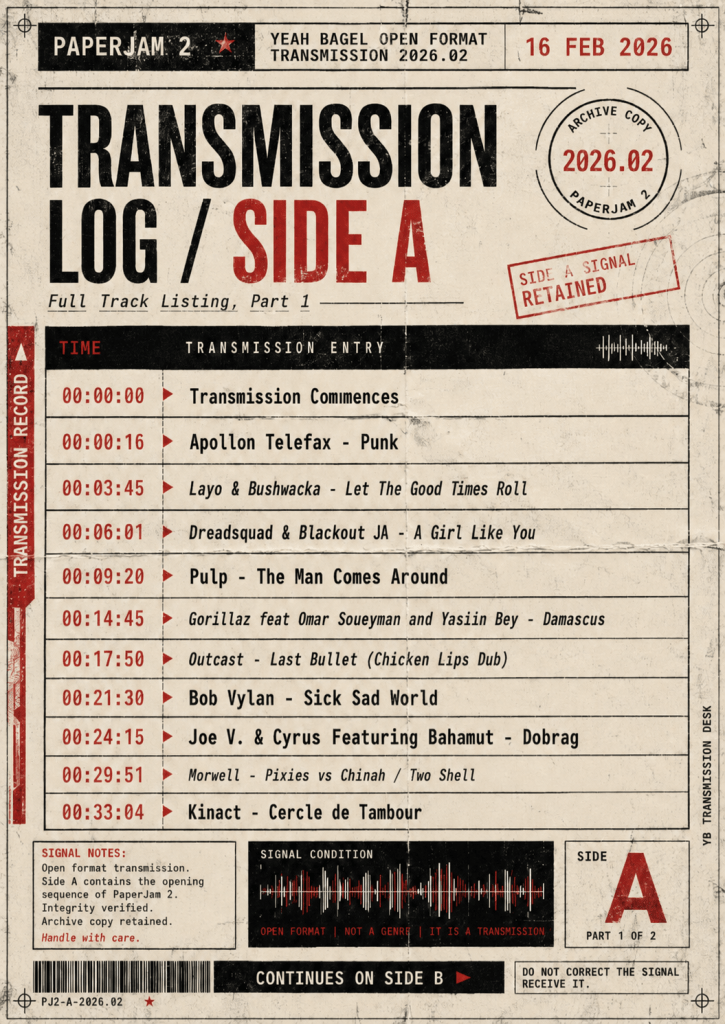
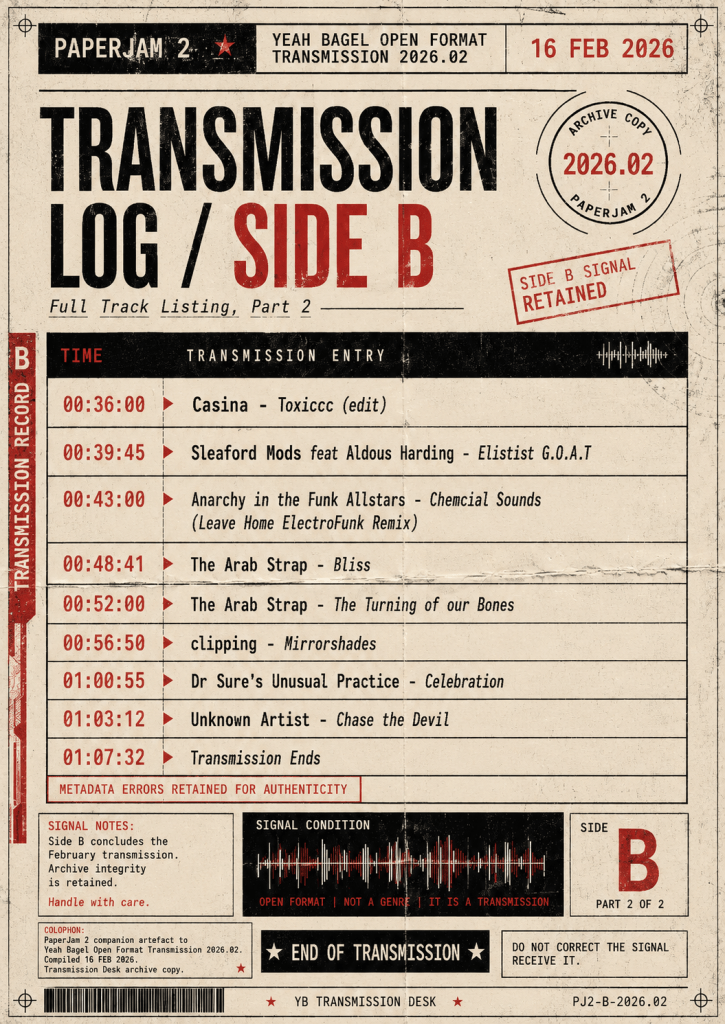
Pages 22 and 23 complete the archive with full Side A and Side B transmission logs, preserving spellings and errors as part of the object’s truth. Page 24 signs off warmly but bruised: Thank You For Staying With The Signal. The back cover includes the Yeah Bagel Open Format Transmission 2026.02 cover and imagines someone sweeping confetti out of a control room after the signal ends.
Across 24 pages, PaperJam 2 turns a 68-minute mix into a tactile emotional machine: part zine, part transmission record, part post-Valentine damage map. Its central thesis is simple and strange: open format is not a genre. It is what happens when the right records collide hard enough to reveal the bruise underneath.
