
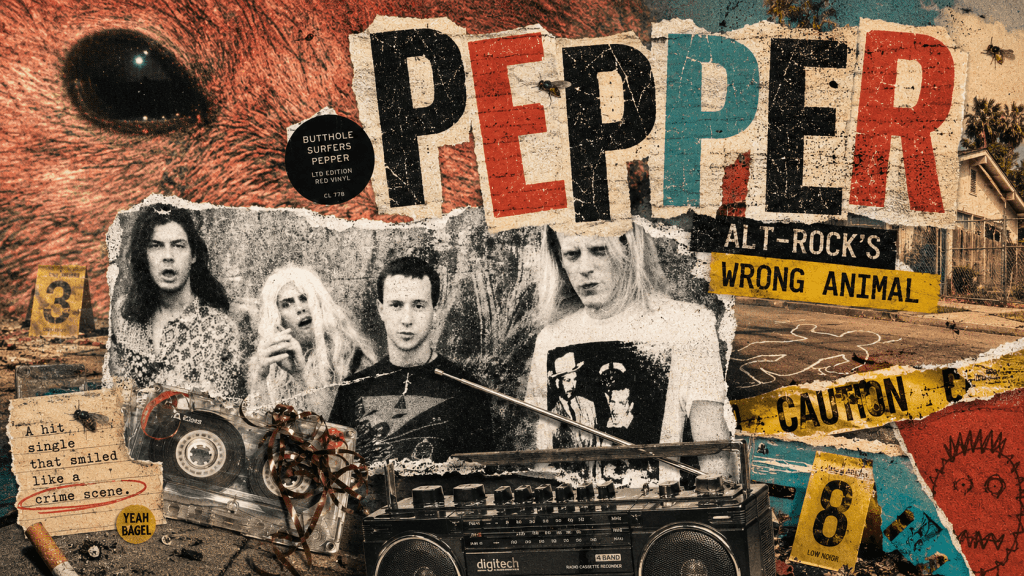
There are songs that become hits because they want to be loved.
Then there is “Pepper” by Butthole Surfers, which became a hit while looking directly at the listener with the dead calm of someone who has just walked away from a small explosion and does not intend to explain the smoke.
Released in 1996, “Pepper” remains one of the strangest moments in the already deeply strange story of alternative rock’s brief corporate occupation of the mainstream. This was the era when major labels were wandering through the underground with cheque books, night-vision goggles, and absolutely no idea what they were signing. After Nirvana cracked open the wall, everyone who had ever owned a distortion pedal, a basement tape, a fanzine, a suspicious van, or a troubling stage show suddenly became a possible investment opportunity. The Butthole Surfers, somehow, were included in this gold rush. This is still funny. It may always be funny.
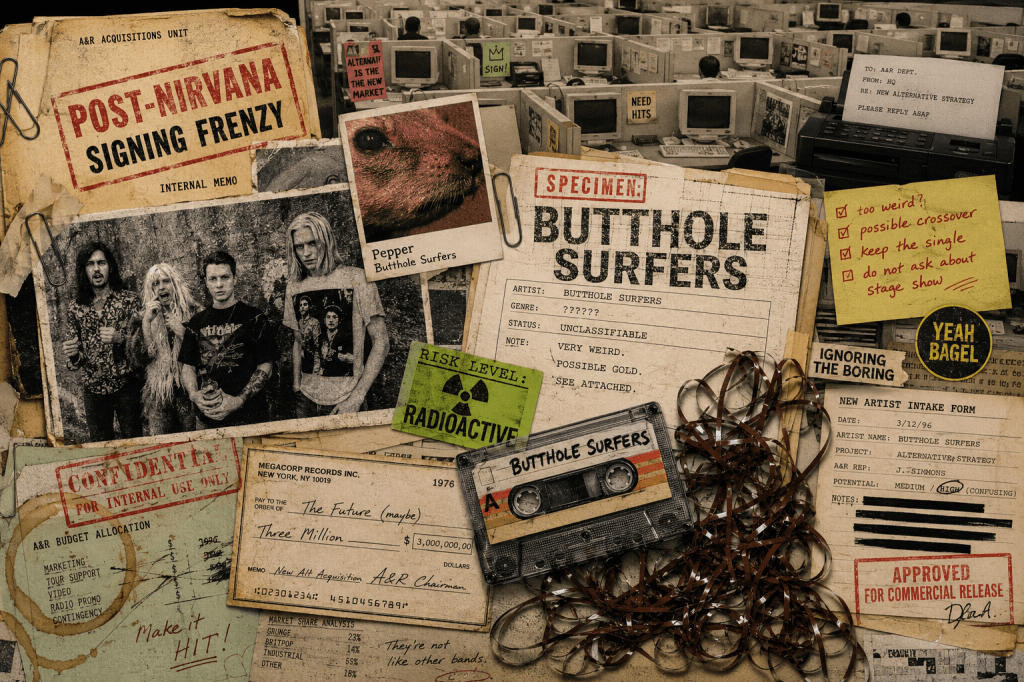
Because the Butthole Surfers were not a tidy proposition. They were not misunderstood sweethearts waiting for a crossover chorus. They were a Texas psychedelic noise organism, a travelling fever, a band whose earlier work seemed less recorded than confiscated from a cult compound after the helicopters left. Gibby Haynes, Paul Leary, King Coffey and their various co-conspirators made music that did not so much reject good taste as chase it into a ditch wearing a clown mask and carrying a broken projector. They belonged to that older, nastier underground where “alternative” did not mean lifestyle branding. It meant something might happen to your furniture.
And then came “Pepper.”
Not with a roar. Not with punk-rock fists. Not even with the usual Butthole Surfers carnival of acid-damaged panic. “Pepper” slinks in on a dry little beat, a lazy guitar figure, and Gibby Haynes talking, not singing, in that flat, narcotic drawl that makes the whole song feel like a police statement delivered from a hammock. It has the posture of a novelty hit and the soul of a minor apocalypse. It is casual, almost breezy, except the breeze is coming through a smashed window.
The genius of “Pepper” is that it does not sound shocked by its own horror. It itemises disaster as if reading names from a yearbook found at the bottom of a lake. Its characters drift through disease, death, scars, violence, boredom, and dumb luck with the soft inevitability of suburban gossip. The verses are full of people half-remembered and fully doomed. Nobody is centred. Nobody gets rescued. The song simply moves from face to face, like a camera panning across a barbecue where everyone is pretending not to notice the ambulance lights.
That is why the chorus still lands with such horrible charm. It turns fatalism into a hook. It understands that the great American pop trick is not to deny death, but to make it singable enough for the car radio. “Pepper” arrived in the mid-90s wearing the clothes of slacker absurdism, but underneath it was older and meaner. It was a murder ballad disguised as alt-rock. A playground chant for people who had outlived their own expectations. A sunshine bummer with flies on it.
The obvious comparison, then and now, is Beck’s “Loser.” Both tracks speak-sing their way through collage logic. Both feel assembled from junk-shop Americana, hip-hop cadence, white-boy weirdness, and the emotional weather of Generation X trying to shrug itself into meaning. But “Loser” has a self-conscious scruffiness, the sound of someone turning failure into costume jewellery. “Pepper” is colder. Less cute. Less interested in persona. Beck made alienation sound wry. Butthole Surfers made it sound epidemiological.
It also helped that “Pepper” was secretly very well built. For all the band’s reputation as chaos merchants, this is not chaos. This is control wearing a stained shirt. The beat is simple enough to survive terrible speakers. The guitar riff is instantly legible. The vocal sits close and dry. The chorus blooms at exactly the right moment. The backwards-sounding bridge gives the whole thing a brief occult shimmer, like the tape itself has started mumbling in its sleep. The song knows what it is doing. It just does not want to look professional while doing it.
This is where the Butthole Surfers trick becomes important. Their early legend can sometimes obscure the fact that underneath the spectacle, they had ears. Sick ears, yes. Ears with unpaid parking tickets. But ears nonetheless. “Pepper” did not become a hit by accident alone. It became a hit because the band found a way to compress their worldview into something radio could digest before realising it had swallowed glass. They sanded off just enough splinters to get through the gate, but not enough to make the thing safe.
In retrospect, “Pepper” feels like one of the last great moments when mainstream alternative radio accidentally let the wrong animal into the petting zoo. By 1996, the genre was already hardening into format. The weirdness that had once seemed genuinely destabilising was being packaged into marketable gestures: distortion but not danger, irony but not infection, angst with a barcode. “Pepper” slipped through because it could pass, at a glance, as quirky. But listen again and it is not quirky at all. It is bleak, funny, blank-eyed, and oddly compassionate in the way only a deeply unsentimental song can be.
Because there is compassion here, though it is not soft. “Pepper” does not mock its doomed little cast. It does not elevate them either. It simply notices them. The damaged, the reckless, the unlucky, the stupid, the already half-gone. They are not metaphors for America, but America shows up anyway, loitering in the background with a gas station coffee and a suspicious grin. The song catches the cheap immortality of people who become stories after something bad happens to them. Not legends. Not heroes. Just names repeated because the ending was memorable.
That may be why “Pepper” has aged better than plenty of more respectable alt-rock hits from the same period. It has not dated into flannel nostalgia because it was never really selling the 90s dream. It was selling the underside: boredom, chemical drift, moral static, local tragedy, cheap thrills, television death, that particular pre-internet feeling of hearing something awful about someone and having no way to process it except by telling somebody else. It sounds like rumour as rhythm. It sounds like a town with one good record store and three ways to ruin your life.
And yes, it is still absurd that this was the Butthole Surfers’ big crossover. Absurd in the beautiful sense. Absurd in the sense that culture occasionally trips over its own shoelaces and reveals a trapdoor. A band who once seemed designed to repel polite society ended up with a radio staple, an MTV presence, and a place in the memory palace of people who may never have investigated the deeper, more diseased tunnels of the catalogue. For some listeners, “Pepper” is the whole Butthole Surfers story. For others, it is the suspiciously clean doorway into a much filthier building.
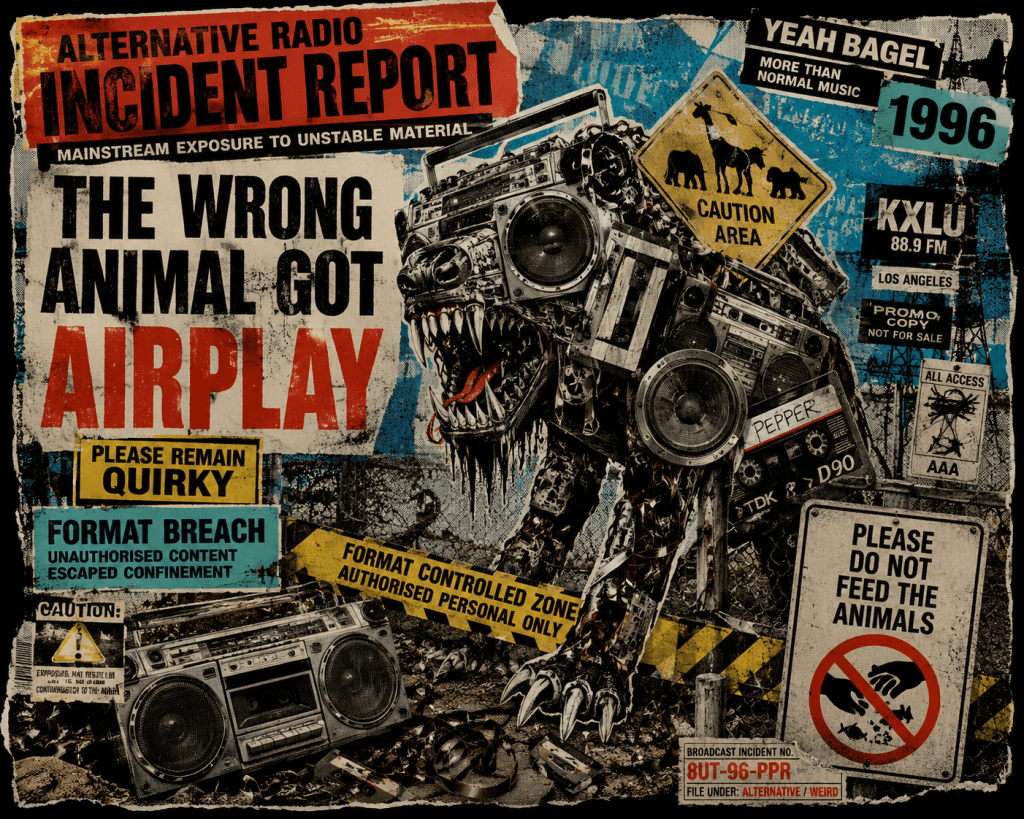
But that doorway matters. Gateway songs are often treated as compromises, as if accessibility automatically means betrayal. “Pepper” complicates that. It is accessible, absolutely. It is also unmistakably theirs. Not the most extreme version of them. Not the most deranged. But a distilled one. The humour, the dread, the sideways groove, the fascination with bodies and damage and American weirdness, all of it is there. The difference is that this time, the nightmare learned to whistle.
Which brings us to the French For Horse Edit, a version that understands something crucial about “Pepper”: the song was always closer to the dancefloor than rock orthodoxy wanted to admit. The edit tightens the stride, trims the excess, and lets the groove walk into the room first. At four minutes, sitting in that 80/160 BPM hinge-zone where head-nod and breakbeat can share the same cigarette, it treats “Pepper” not as a museum object from 1996 but as usable contraband. The deadpan vocal becomes a hypeman from the wrong side of town. The riff becomes a loop with dirt under its nails. The chorus stops being only a singalong and starts behaving like a pressure valve.
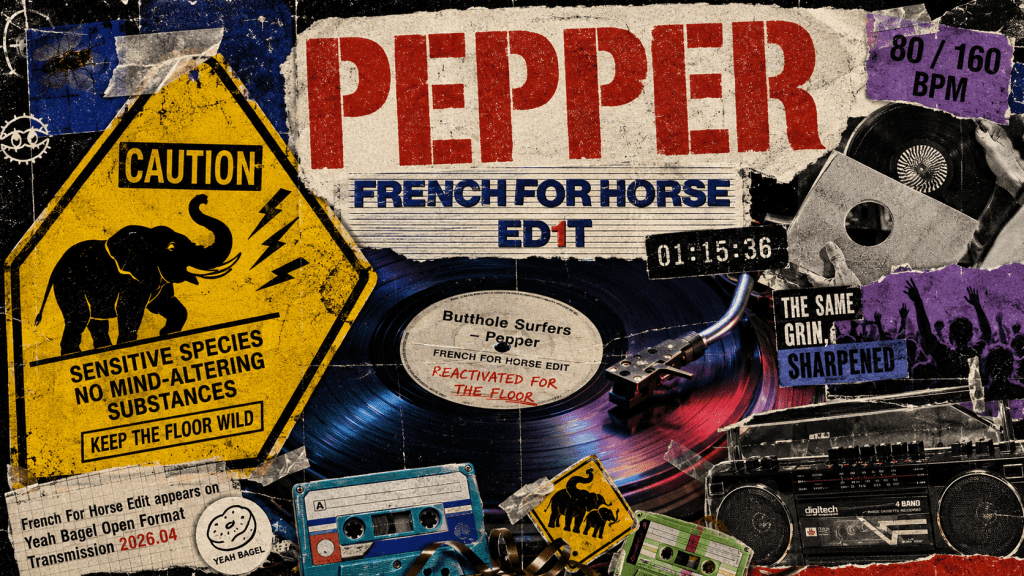
That is the quiet brilliance of the French For Horse approach. It does not polish the weirdness away. It gives it wheels. The original “Pepper” was a radio hit that felt like an accident report. The edit turns it into a party weapon with a haunted registration plate, dragging the Butthole Surfers’ sly little death-disco impulse out from beneath the alt-rock carpet and onto the floor where it can sweat. Not a reinvention, exactly. More a reactivation. The same grin, sharpened. The same dust, kicked up. The same message from the old underground, arriving decades later with fresh boot marks: everybody can die, but first, move.
The French For Horse Edit of Peppe appears on Yeah Bagel Open Format Transmission 2026.04
 Yeah Bagel