

COMPANION ARTEFACT TO OPEN FORMAT TRANSMISSION 2026.06

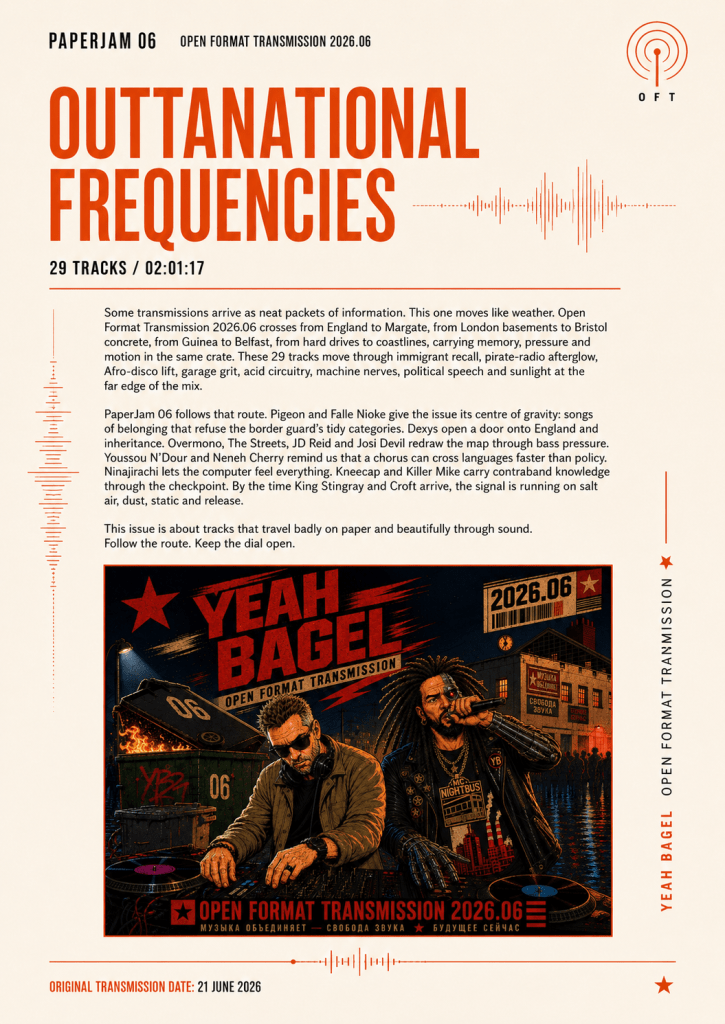








Outternational Frequencies
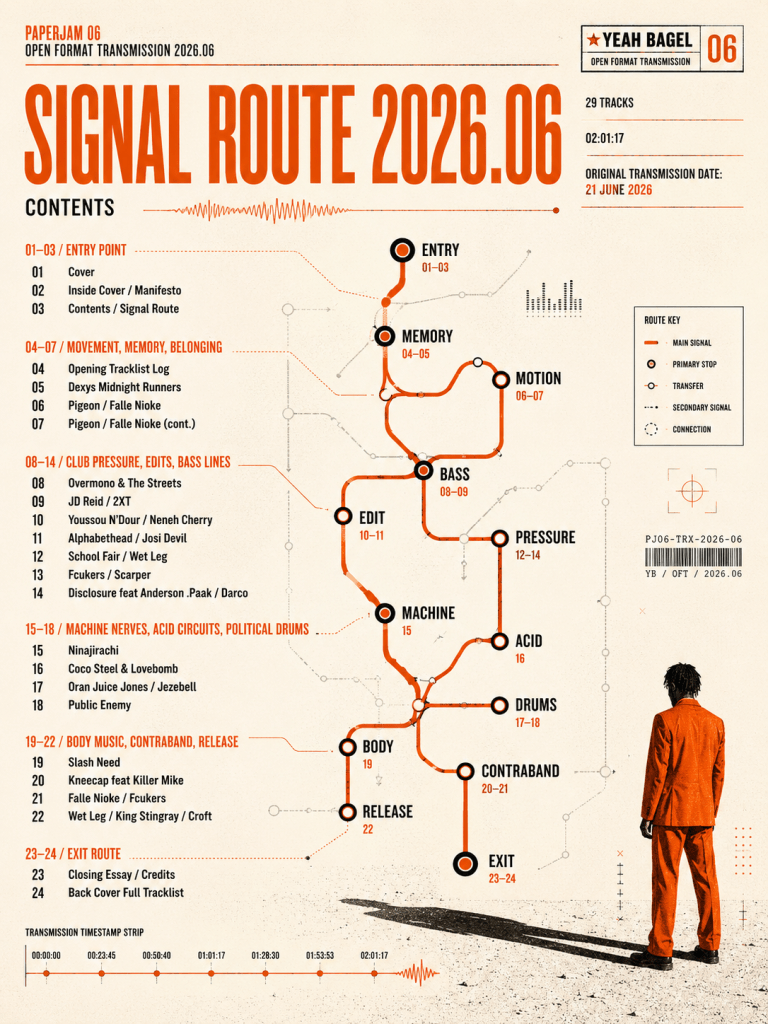
PaperJam 06 is the printed echo of Yeah Bagel’s Open Format Transmission 2026.06, a companion artefact built around a two-hour route through memory, pressure, edits, borders, bodies, weather, machinery, club shadows and release. It is not simply a track-by-track zine. It is a visual map of a selector’s logic: how one record speaks to the next, how old ghosts re-enter new rooms, and how a mixtape becomes a kind of emotional geography.
The issue opens with the striking cover image of Falle Nioke standing in an orange suit beneath the vast PAPERJAM06 masthead. The design is stark, warm and declarative: cream ground, black shadows, orange typography, a cover that feels like a border-crossing document and a fashion editorial smuggled into the same file. The headline phrase OUTTANATIONAL FREQUENCIES frames the whole issue. This is a mix about music moving beyond passport logic: through London, West Africa, Belfast, New York, Australia, rave rooms, bedroom studios, old singles, edits, bootlegs and unlicensed emotional territory.
The early pages establish the issue’s operating system. Pages 2 to 4 act like a manifesto, contents page and route map, visually drawing on archive paperwork, signal diagrams, warning symbols and Eastern-bloc-adjacent graphic order. They explain PaperJam 06 as the visual shadow of the transmission, a zine built to honour Yeah Bagel’s selection and sequencing rather than flatten the playlist into metadata. The message is clear: this route is intentional, but not smooth. It is meant to jump, misbehave, remember, and connect tracks by mood, pressure and instinct.
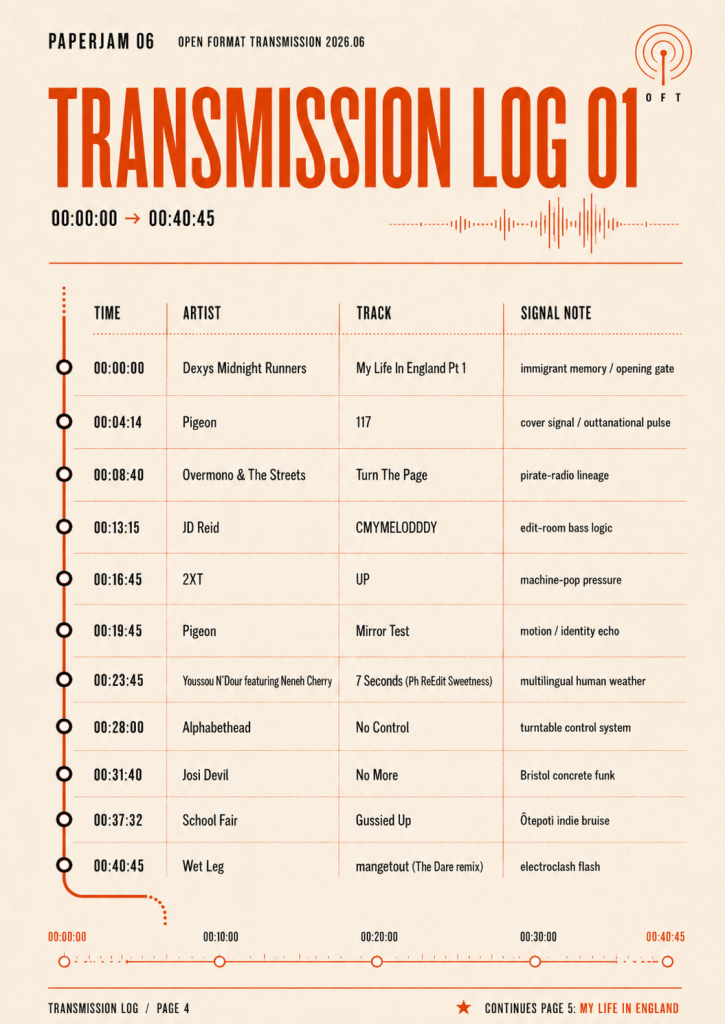
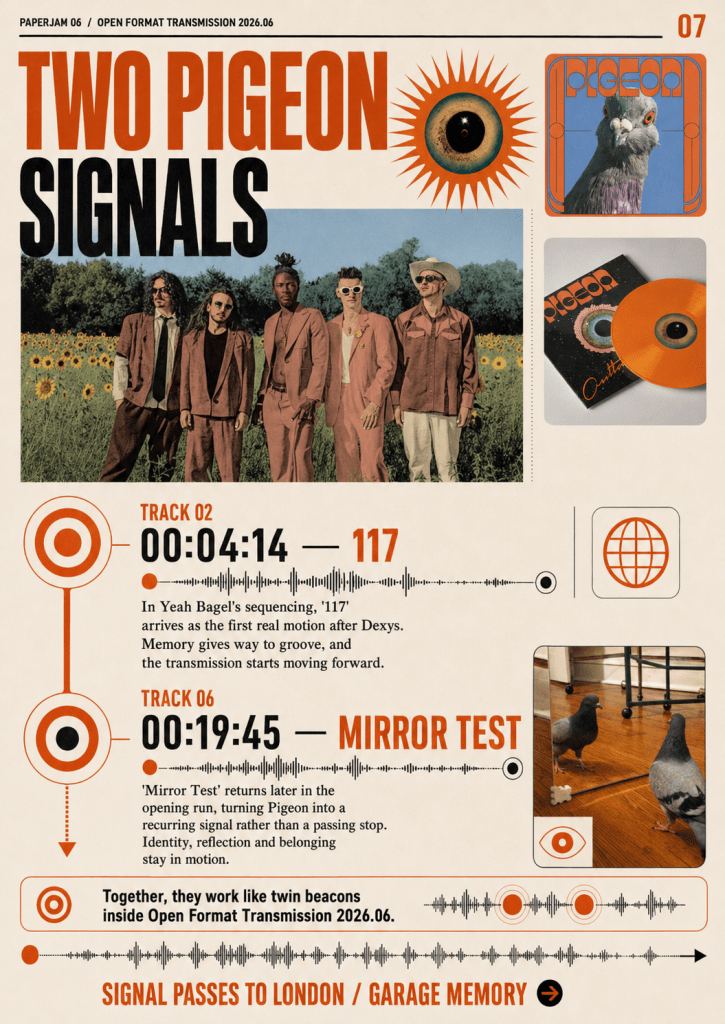
The transmission begins with Dexys Midnight Runners’ “My Life In England Pt 1”, treated as an opening memory flare. Kevin Rowland becomes an emblem of English identity as performance, argument, ache and theatre. The issue positions Dexys not as nostalgia but as a restless entry point: a song about belonging that refuses to sit still. From there the route opens outward into Pigeon and Falle Nioke, with pages 6 and 7 forming a two-part spread around “117” and “Mirror Test.” This is where the issue’s central language of movement emerges: Afro-disco, post-punk, kraut motion, West African vocal tradition, Margate light, Lagos memory and London circuitry. Pigeon’s sound is framed as a hybrid engine, while Falle Nioke’s voice becomes the human voltage running through it.
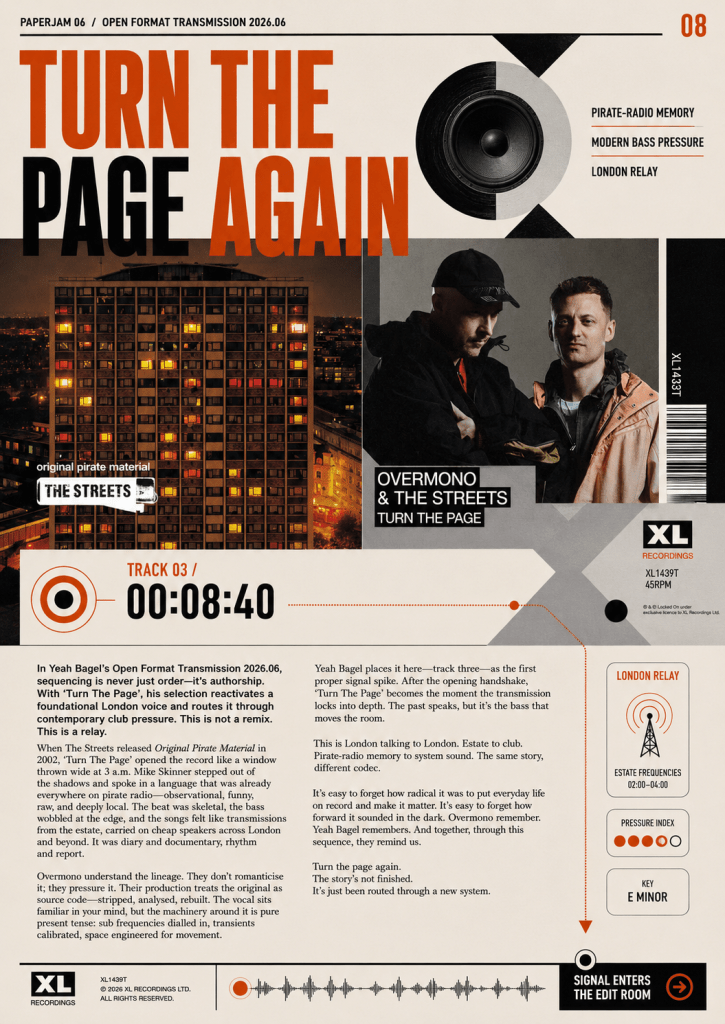
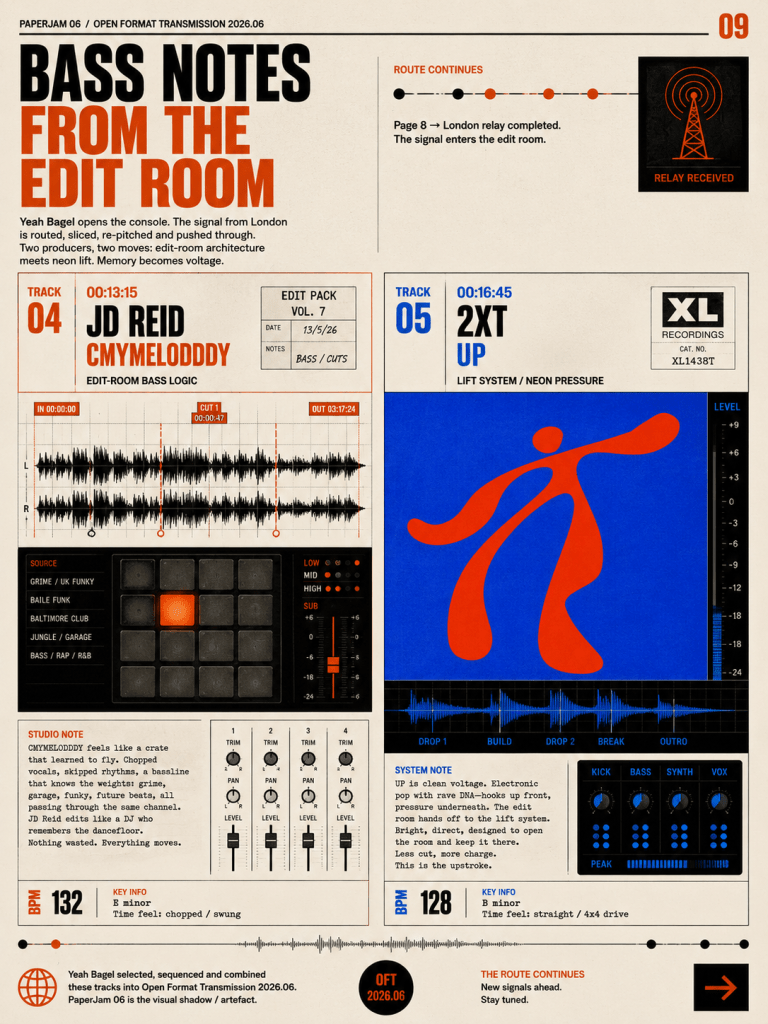
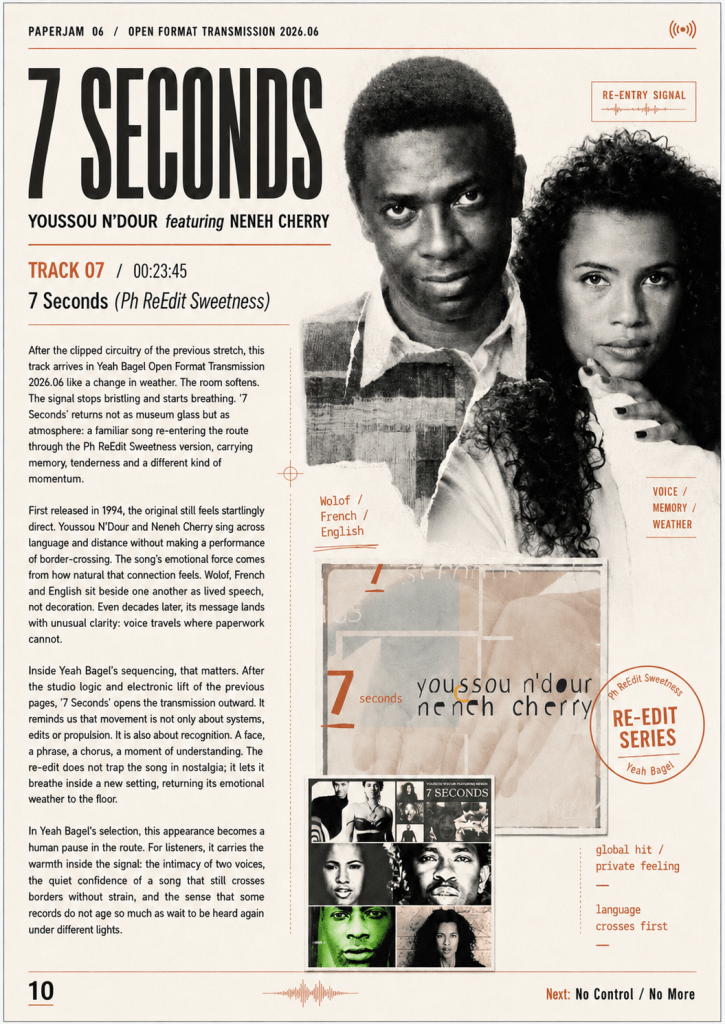
The next section drives into club pressure and edit culture. Overmono & The Streets’ “Turn The Page” becomes a tower-block transmission, bridging UK garage, street narrative and modern electronic heft. JD Reid’s “CMYMELODDDY” and 2XT’s “UP” push the issue into bass mechanics and abstract club lift. Then Youssou N’Dour and Neneh Cherry’s “7 Seconds”, in the Ph ReEdit Sweetness version, gives the sequence a sudden human pause. The page treats the song as a familiar face returning in new light, not preserved behind museum glass but re-entering the dancefloor with tenderness intact.
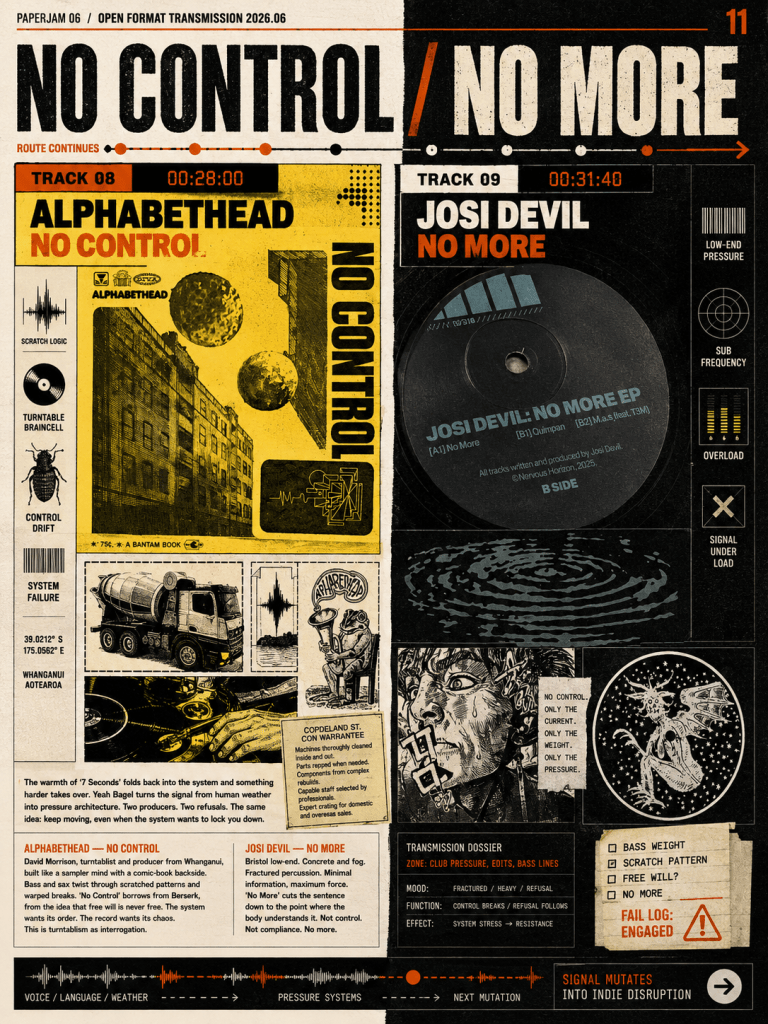
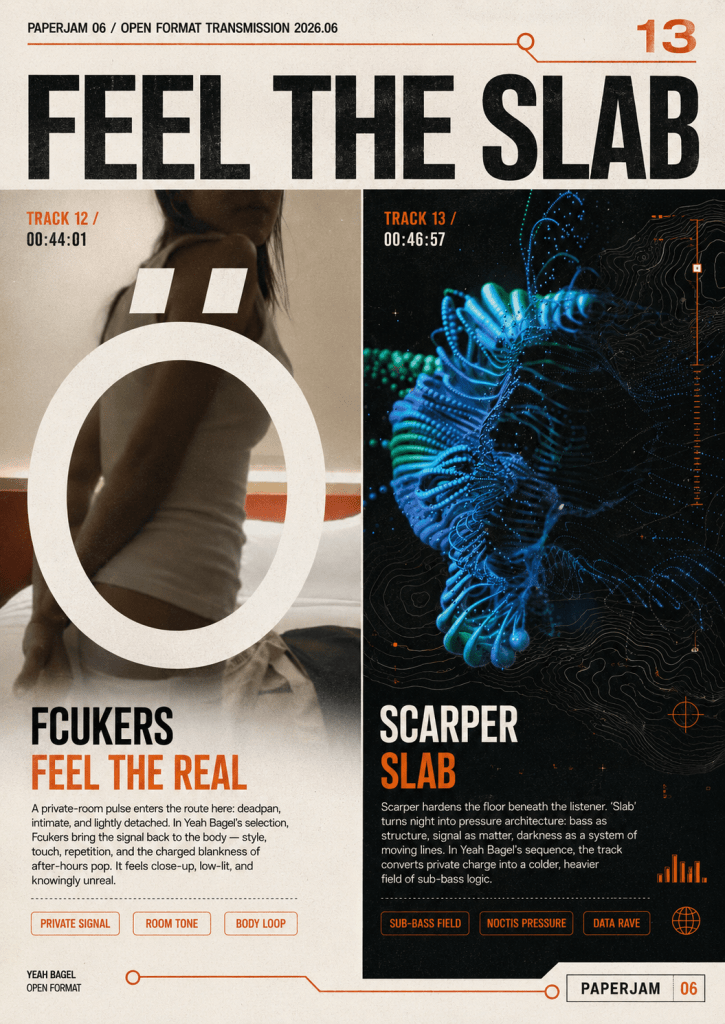
The mid-section becomes increasingly unstable, funny and wired. Alphabethead’s “No Control” and Josi Devil’s “No More” bring yellow hazard graphics, weird electronics and raw underground artefacts. School Fair’s “Gussied Up” and Wet Leg’s “mangetout (The Dare remix)” tilt the issue toward awkward domestic interiors, bedroom static and strange youth-performance unease. Fcukers’ “Feel The Real” and Scarper’s “Slab” sharpen that into club claustrophobia and slick electronic tension. By the time Disclosure feat Anderson .Paak’s “NO CAP” meets Darco’s “We We We,” the issue is moving through bodies, slogans, edited pop architecture and glossy rhythm systems.
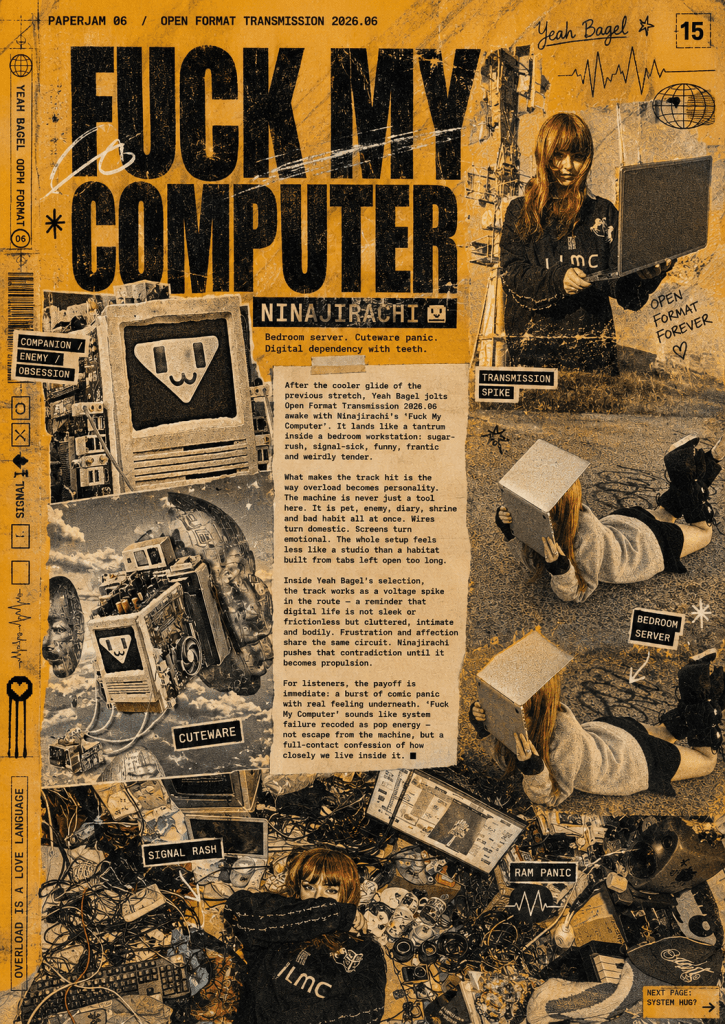
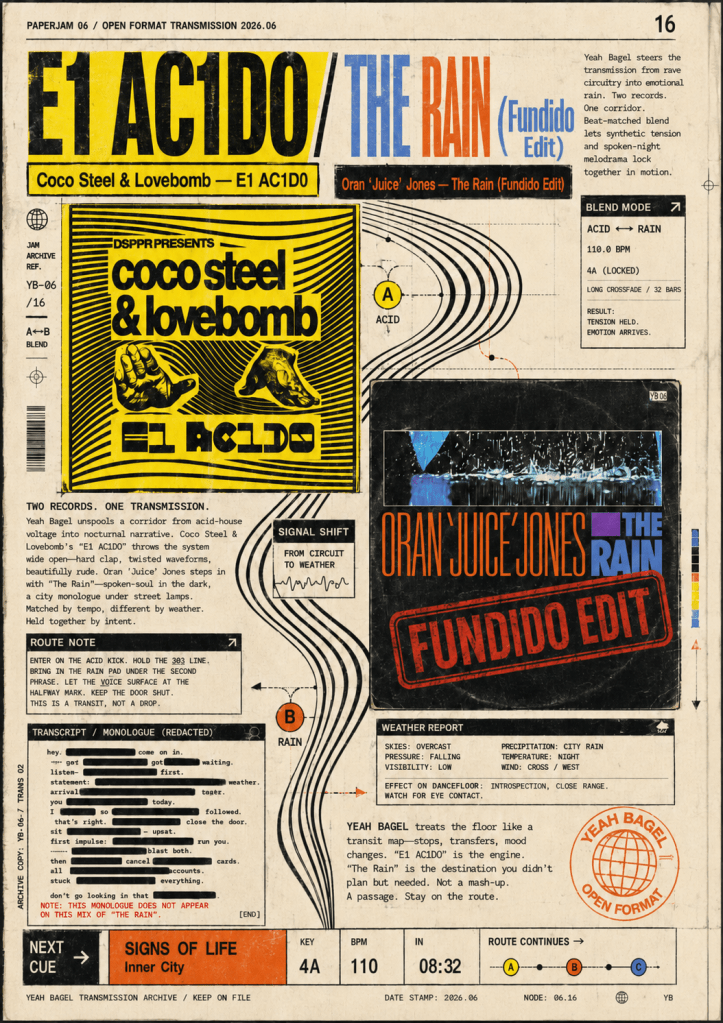
Page 15 marks the arrival of machine nerves with Ninajirachi’s “Fuck My Computer.” The visual field fills with cables, crashed machines, bright blue skies and digital exhaustion. It feels like the moment the system becomes cute, hostile and overloaded all at once. Page 16 follows with Coco Steel & Lovebomb’s “E1 AC1D0” blended into Oran “Juice” Jones’ “The Rain (Fundido Edit).” This is one of the issue’s key conceptual pages: acid circuits meeting melodrama, rave voltage dissolving into emotional rain. The beat-matched blend is treated as a single corridor, not a mash-up. The page knows that Yeah Bagel’s route is doing the thinking.
Page 17 continues this logic, pairing Jezebell’s “Hush Hush (Cotton Bud Re-master)” with Public Enemy’s “Confusion (Here Come The Drums).” Public Enemy takes the dominant visual weight, turning the page into a warning poster of drums, alarm signals and political force. The note that “Hush Hush” contains samples of Kajagoogoo’s “Too Shy” adds a hidden pop-history trapdoor. Here, the mix moves from seduction and sample-memory into public confrontation. The drums arrive like a barricade being wheeled into place.
Page 18, “Hole In The Border,” pairs Slash Need’s “Hole One” with Kneecap feat Killer Mike’s “Smugglers & Scholars.” It is one of the issue’s most explosive pages visually: torn-paper division, red-and-black contraband language, masked bodies, Belfast resistance, Killer Mike’s grave political presence, and Slash Need’s basement abrasion. The spread argues that underground culture is contraband knowledge, something carried through bodies, language, style and survival.
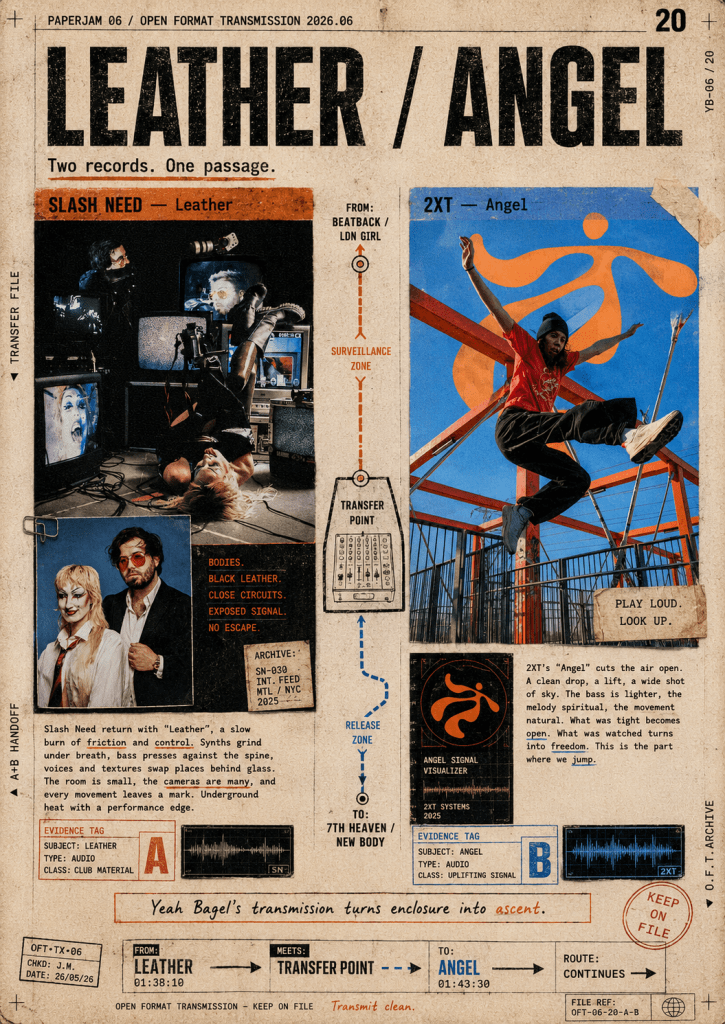
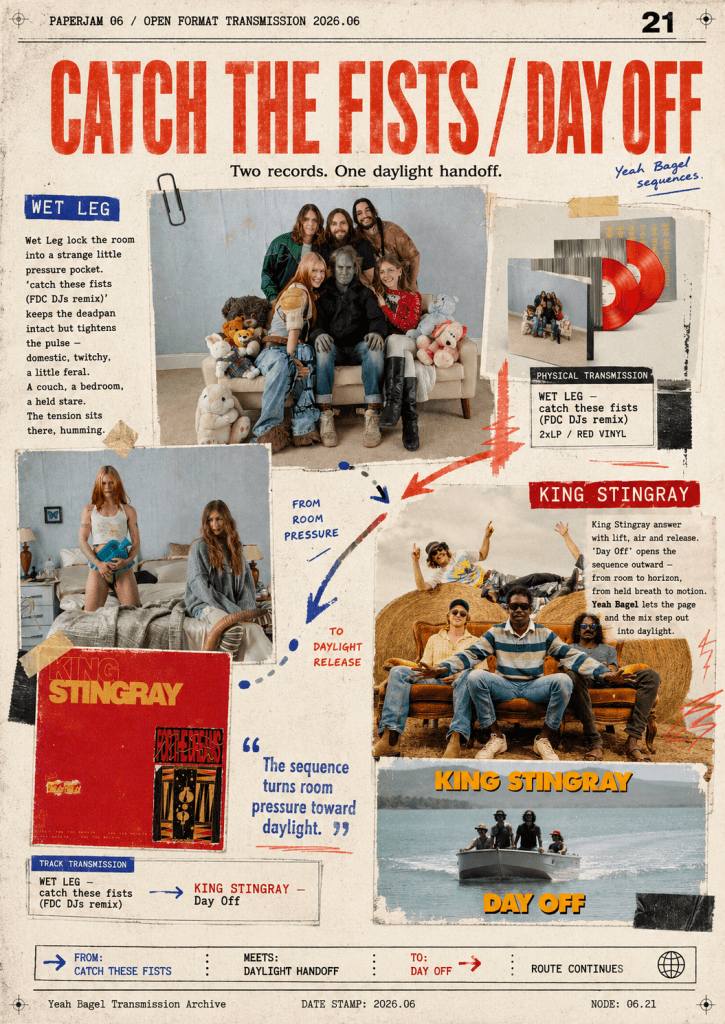
The late stretch begins to open again. Page 19 moves from Fcukers’ “Beatback” into Falle Nioke’s “LDN Girl,” shifting from club shadow to daylight. The page treats the transition as a transfer file: New York cool and locked-room attitude giving way to warmth, street melody and human lift. Page 20 pairs Slash Need’s “Leather” with 2XT’s “Angel,” moving from surveillance-room body pressure into orange-blue open-air release. Page 21 pushes further outward with Wet Leg’s “Catch The Fists (FDC DJs Remix)” and King Stingray’s “Day Off,” where domestic weirdness collides with coastal ease, red vinyl, hay bales, boats and late-arriving daylight.
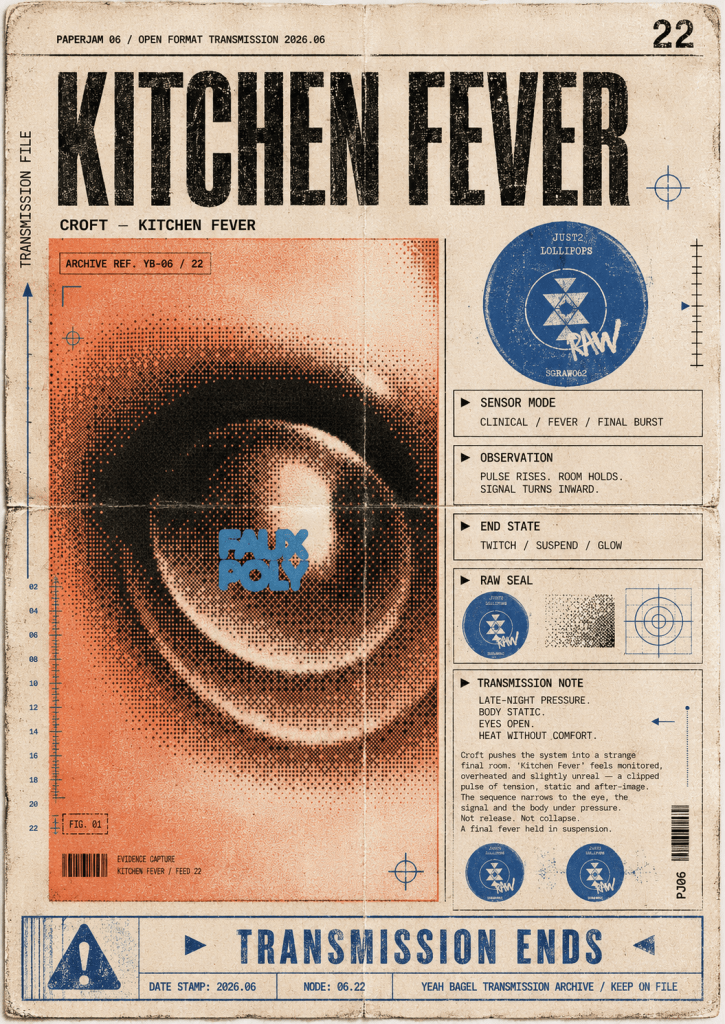
The final track page, Page 22, lands on Croft’s “Kitchen Fever.” Instead of a grand finale, the transmission ends in a strange domestic signal: halftone eyes, blue labels, abstract fever and the sense of a kitchen light left on after everyone has gone. The end is twitchy, suspended and archival.
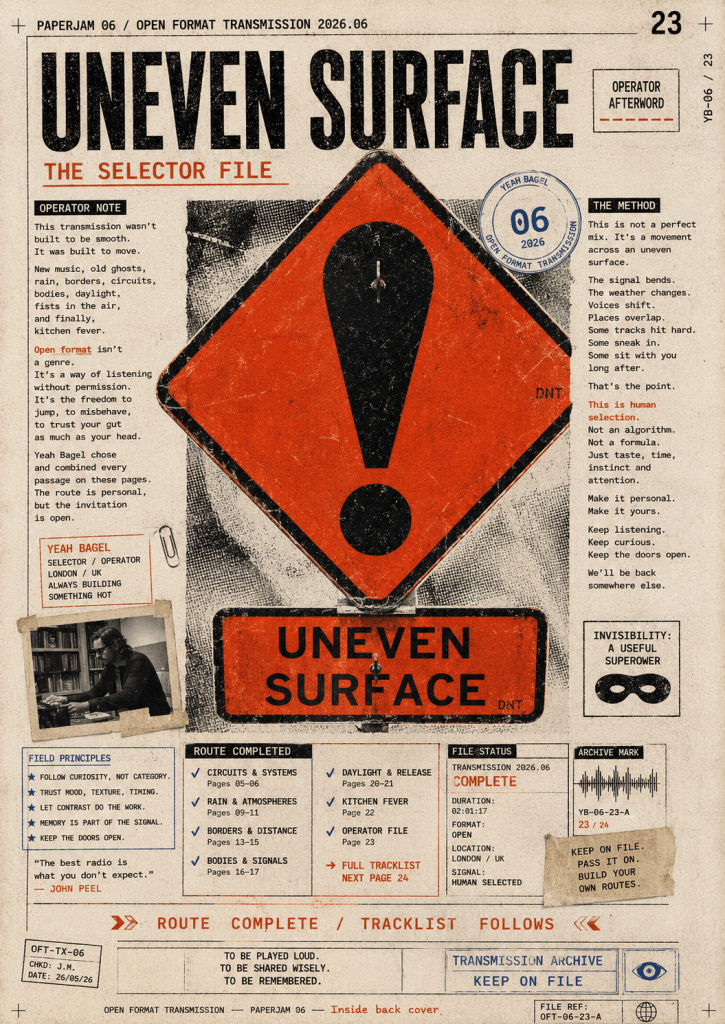
Page 23, “Uneven Surface,” becomes the issue’s afterword and philosophical key. Built around a road-warning sign, it declares that open format is not a genre but a way of listening. The best radio is what you do not expect. Yeah Bagel’s selection is framed as human judgement, not algorithmic prediction: taste, timing, curiosity and instinct. Page 24 closes with the full tracklist, a clean archive back cover that turns the entire journey into evidence.
In the end, PaperJam 06 is about the beauty of the uneven route. It celebrates the mix as a living passage: not seamless, not obedient, but charged with purpose. It is a zine about records talking across borders, rooms, decades and weather systems. It is a reminder that music still becomes powerful when someone chooses it, places it beside something unexpected, and trusts the listener to cross the rough ground.

ABOUT THE EDITORS
PaperJam is assembled, argued over, glued down and occasionally rescued from printer failure by husband-and-wife editorial unit Eli “Static” Mercer and Nia “Nix” Adeyemi-Mercer.
Eli is originally from Seattle: a rain-soaked zine obsessive, tape-archive scavenger and layout gremlin raised on basement shows, college radio, busted photocopiers and the noble art of making pages look like they were intercepted mid-transmission.
Nia is from East London: editor, headline assassin, pirate-radio disciple and cultural scalpel. Her background runs through market-stall bootlegs, grime clashes, protest flyers, night buses and sentences sharp enough to cut through laminated nostalgia.
Together, they make PaperJam as the printed shadow of Yeah Bagel’s Open Format Transmission: part fanzine, part archive leak, part evidence folder, part love letter to music that refuses to behave.
Their working method is simple: Eli finds the static. Nia makes it speak. Then they staple the whole thing together before the signal disappears.
