
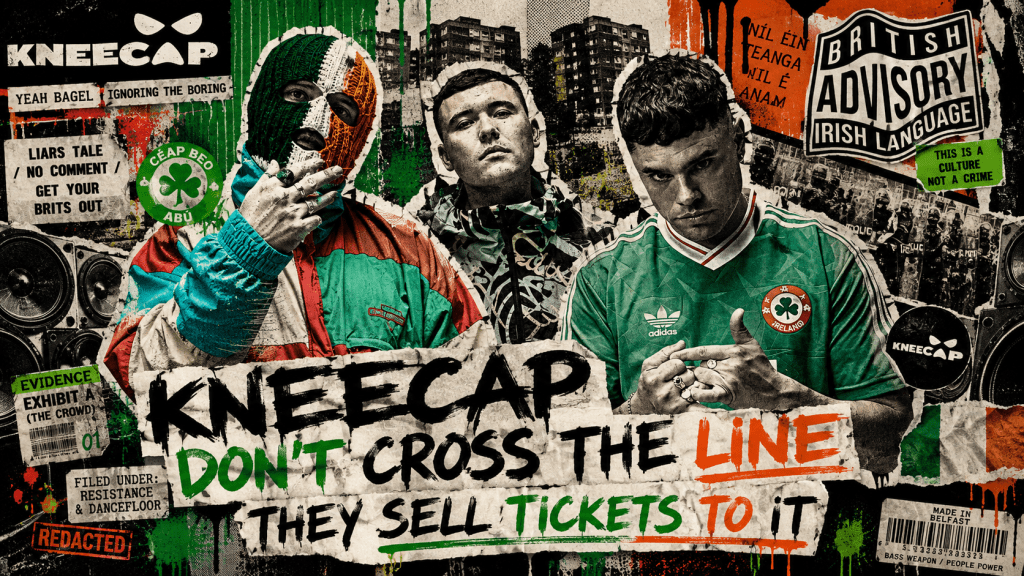
There are bands who make political music, and then there are bands who turn politics into a room with sweat on the ceiling.
Kneecap belong to the second category. They do not approach the culture war with a pamphlet folded politely in the back pocket. They arrive with a bassline, a balaclava, a mouthful of Gaeilge, a pint-glass grin, and the spiritual confidence of people who know that outrage is only dangerous when it has no rhythm. In their hands, provocation is not garnish. It is architecture. It holds the whole building up.
Across this Yeah Bagel transmission, Kneecap do not appear once. They recur. “Liars Tale” lands first, early enough to tilt the room. Then comes “No Comment,” with Sub Focus driving it into drum-and-bass pressure. Later, “Get Your Brits Out” returns like an old slogan sprayed fresh on a new wall. Three tracks, three temperatures: accusation, escalation, release. Together they form a rough map of what Kneecap do best. They turn a fight into a chorus. They turn a chorus into a crowd. They turn the crowd into evidence.
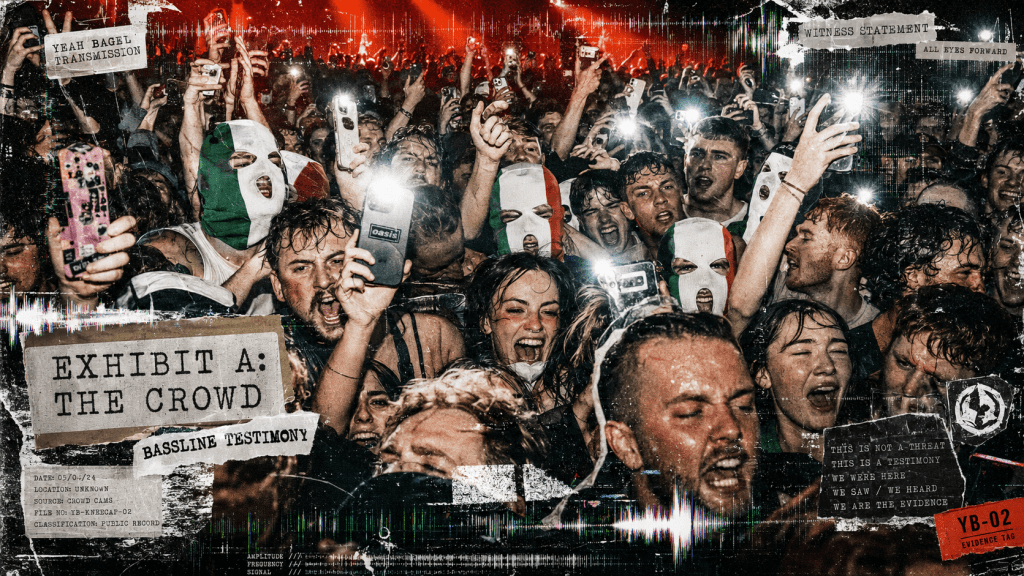
Kneecap are Mo Chara, Móglaí Bap and DJ Próvaí: Belfast rap group, Irish-language wrecking crew, tabloid irritant, club-night accelerant, walking complaint form for the British establishment. But reducing them to “controversial” is lazy. Controversy is what happens around them. The work itself is sharper, funnier and more musically cunning than the panic it generates.
That panic is part of the weather now. Kneecap have become one of those rare groups where every release arrives pre-surrounded: think-pieces warming up, politicians clearing throats, algorithms twitching, fans already shouting the hook before the drop has fully opened its eyes. Their second album FENIAN did not simply arrive as a record. It arrived as a flare. A reclaimed word, a thrown gauntlet, a refusal to file the sharp parts off Irish identity so it can be safely exported as heritage content.
That is where “Liars Tale” matters. It does not open the door politely. It boots it inward.
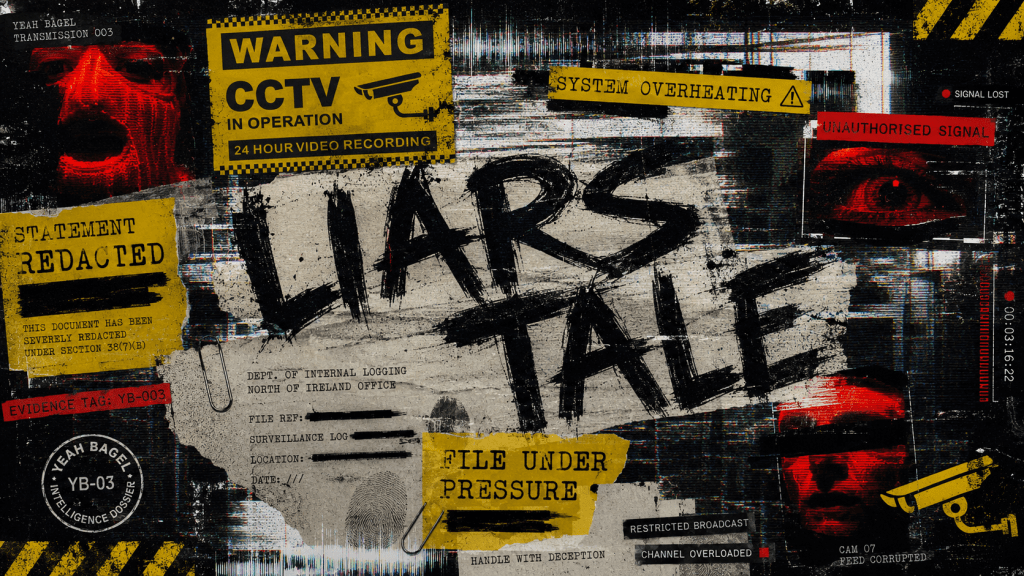
The track sounds like a system overheating under its own lies. Not “punk-rap” in the branding-deck sense, but punk-rave as civic malfunction: sirens, churn, pressure, voices moving like they are being chased through fluorescent corridors. There is something deliberately ugly in the sound, a refusal to smooth the accusation into digestible protest-pop. It feels less like a song aimed at power than a song designed to make power check the locks.
And yet Kneecap’s trick is that the heaviness never becomes stiff. “Liars Tale” still moves. It has shoulders. It has spit. It has that Belfast comic voltage where fury and piss-taking keep slapping each other awake. They understand something a lot of earnest political music forgets: anger needs rhythm or it curdles. Satire needs bass or it becomes homework. Kneecap make the lecture hall collapse into the rave and then ask why everyone looks so surprised.
By the time “No Comment” arrives, the argument has changed gear.
A collaboration with Sub Focus could have gone two ways. It could have been a festival upgrade, a neat cross-market collision, Kneecap strapped to a drum-and-bass engine for maximum tent detonation. It is that, partly. But “No Comment” is more pointed than a simple big-room weapon. It turns legal pressure, media pressure and state pressure into kinetic pressure. The title is courtroom language, press-conference language, police-station language. It is the sound of refusing the trap question.
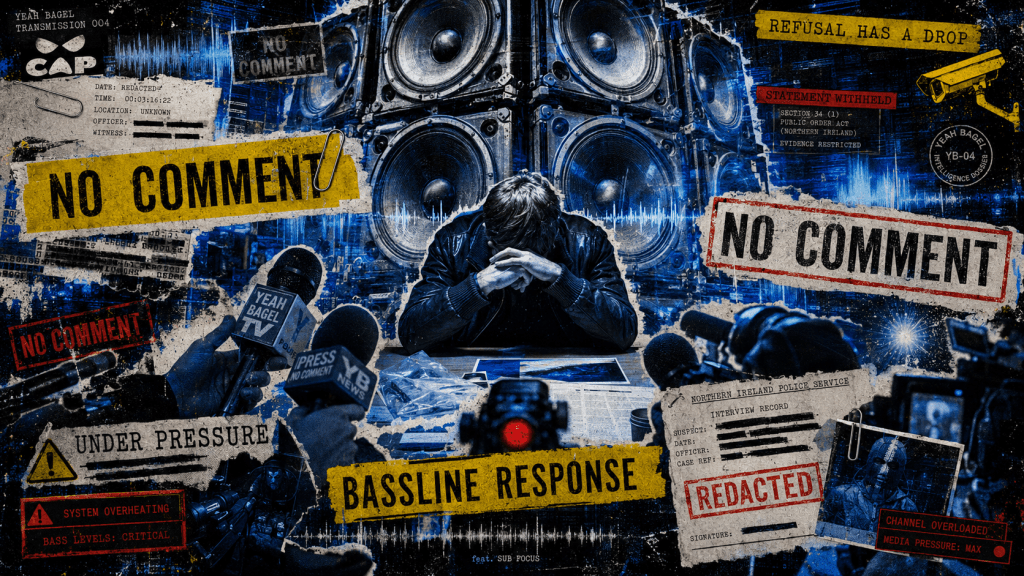
Sub Focus gives the track velocity. Kneecap bring the grievance, the smirk and the refusal to behave like grateful defendants. The result is not a retreat from politics into dance music. It is politics using dance music as getaway vehicle.
That matters. Too often, “serious” music is expected to announce itself through grimness. Kneecap reject that bargain. Their seriousness is in the stakes, not the posture. The music can still bang hard enough to rattle someone’s fillings loose. The bodies can still move. The crowd can still shout. The rave is not an escape from the subject. It is the subject becoming communal.
In “No Comment,” the beat does not decorate the message. It translates it. The drop becomes pressure release, the bass becomes crowd speech, the momentum becomes a form of collective refusal. You can hear the difference between being silenced and choosing not to answer.
Then comes “Get Your Brits Out.”
Older, cruder, funnier, more obviously built as a slogan-machine, it still sounds like a lit match in a bin full of press releases. In the context of this transmission, it plays like origin-story residue. Not because it is immature, exactly, but because it contains the raw Kneecap formula in near-cartoon concentration: republican baiting, class-clown blasphemy, Gaeilge as living weapon, Belfast nightlife as political theatre, the punchline and the barricade sharing a taxi home.
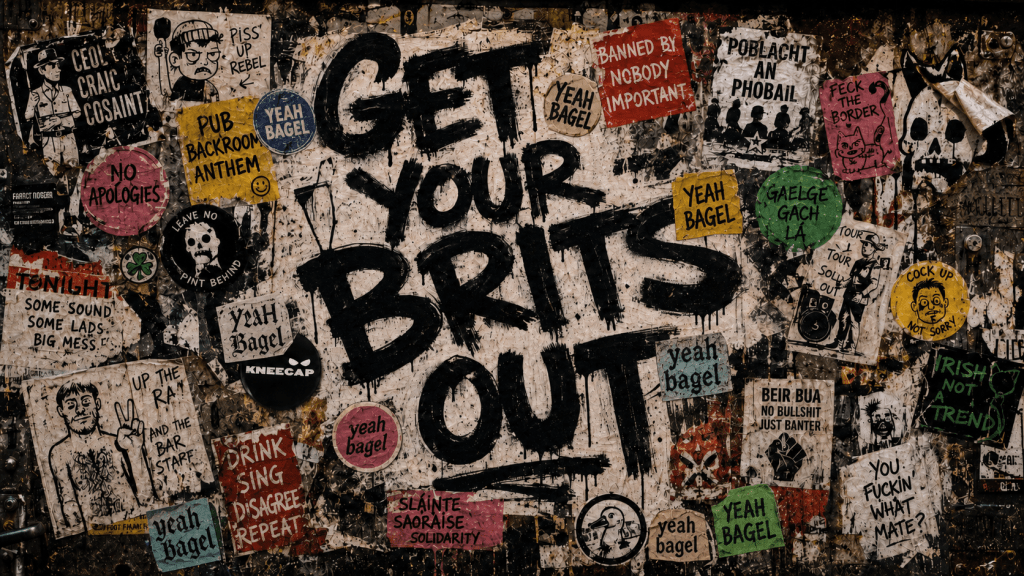
It is easy to misunderstand a track like “Get Your Brits Out” if you insist on treating it as a manifesto in standard font. Kneecap do not work in standard font. They work in marker pen, pub toilet etching, sound-system shout, court transcript, schoolyard chant, historical wound, meme logic and folk memory. Their language is deliberately unstable. It slips between Irish and English, insult and joke, slogan and song, because that is where their power sits.
The Irish language is not used here as decoration. It is not a Celtic flourish draped over otherwise ordinary rap music. It is central to the confrontation. Kneecap make Gaeilge feel rude, young, mobile and dangerous again. Not dangerous because the language itself is threatening, but because a living language refuses the museum. It refuses to be kept behind glass with a little plaque saying “nearly lost.” It turns up in the club, sweaty and late, asking who booked the cops.
This is the deeper story beneath the noise. Kneecap are not just being provocative for the clip cycle, though they are very good at feeding the clip cycle a raw steak. They are fighting over who gets to define respectability, who gets to speak in public, what languages are allowed to sound modern, and how much historical memory polite society expects people to swallow before breakfast.
That is why the establishment reaction often seems so overcooked. Kneecap are treated as a scandal because they refuse the approved script for post-conflict cultural expression. They do not offer reconciliation as a soft-focus tourism advert. They do not package Irish identity as a tasteful export with acoustic guitar and rolling hills. They bring the rave, the republican ghosts, the swear words, the jokes about drugs, the rage about occupation, the solidarity politics, the self-mythology, the chaos. They bring the whole messy household and dare everyone to pretend the furniture was ever arranged neatly.
The three tracks in Yeah Bagel’s Open Format Transmission 2026.01 show that range more clearly than a single feature single could. “Liars Tale” is Kneecap as accusation: darker, more focused, sharpened by the political moment. “No Comment” is Kneecap as pressure system: legal trouble and state suspicion converted into bassline defiance. “Get Your Brits Out” is Kneecap as chant, cartoon, grenade, pub backroom anthem, and historical itch.
Put together, they tell a story of escalation. The early provocation becomes the public case. The public case becomes the new material. The new material feeds the myth. The myth feeds the crowd. The crowd feeds the next record. A loop, not a ladder.
And somewhere inside that loop is the real achievement. Kneecap have made Irish-language rap feel not like a worthy cultural project but like the most obvious thing in the world. Of course this language belongs on distorted bass. Of course it belongs over rave drums. Of course it belongs in satire, filth, grief, fury and joy. Of course a language survives not by being respected to death, but by being used badly, brilliantly, loudly, casually, sexually, politically, stupidly, beautifully.
That is the part their enemies never quite know what to do with. You can condemn a slogan. You can tut at a lyric. You can perform concern at the aesthetics. But it is much harder to stop a crowd from learning the words, especially when half the pleasure is knowing that someone, somewhere, is furious that the words exist.

Kneecap are not polite ambassadors. Good. Polite ambassadors rarely change the air in a room. They are not a museum exhibit, a diversity initiative, or a grant-funded language revival workshop with biodegradable lanyards. They are a three-man argument with a smoke machine. They are Belfast refusing to behave as a case study. They are proof that political music does not need to choose between thought and impact, between laughter and seriousness, between the archive and the dancefloor.
On this transmission, they do exactly what they are supposed to do. They disrupt the flow by becoming part of it. They make the mix feel less like a sequence of tracks and more like a city being fly-posted in real time. By the end of their third appearance, the message is clear: Kneecap are not asking to be understood on anyone else’s terms.
They are building the terms themselves.
Then turning them up.
