
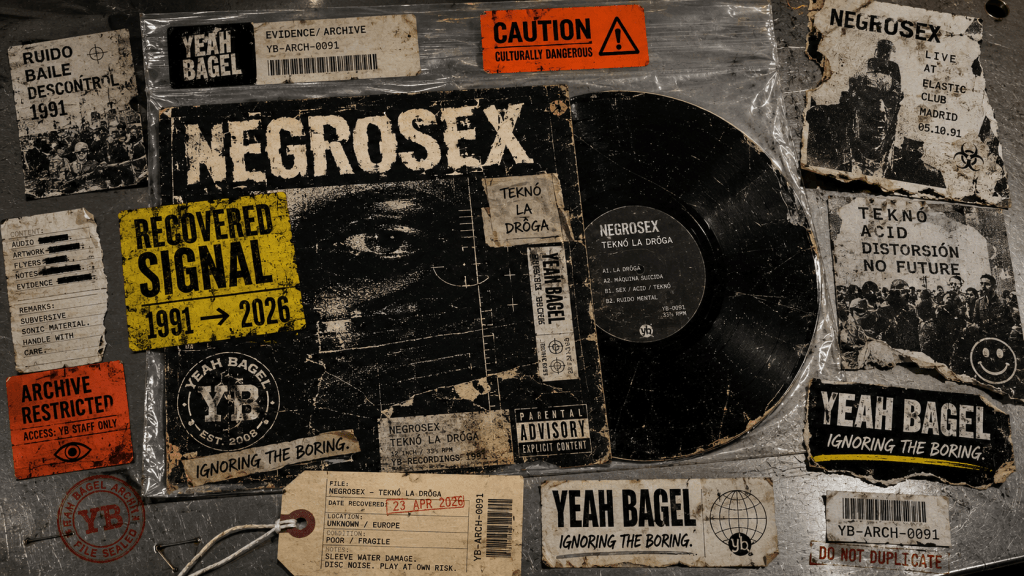
Some records do not come back as nostalgia.
They come back as evidence.
Not clean evidence. Not nicely filed, alphabetised, restored and placed under tasteful museum lighting with a little card saying European electronic music, early 1990s, mixed media, please do not touch. No. They come back sticky. They come back with the corner bent. They come back smelling faintly of dry ice, photocopy toner, floor cleaner, cigarette ash, sweat, bad decisions and imported vinyl that cost too much but somehow still felt essential.
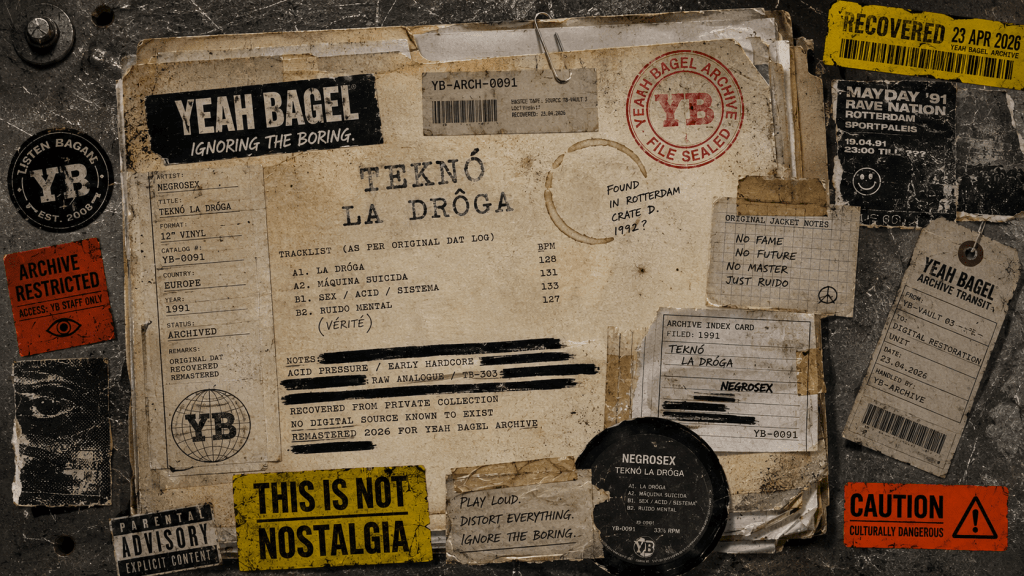
Negrosex come back like that.
A name that does not sit quietly in 2026. A name that arrives carrying all the wrong charges, all the wrong heat, all the old provocations that cannot be politely sanded down without also removing part of the object itself. You do not have to pretend it lands neutrally now. It does not. But underground music history is not a wellness retreat. It is full of ugly names, wrong symbols, reckless jokes, bad typography, anti-clerical bait, erotic sabotage, cheap shock tactics, and flashes of genuine future hiding inside the cultural bin fire.
That is the thing about the archive. Sometimes the signal is real, even when the packaging has teeth.
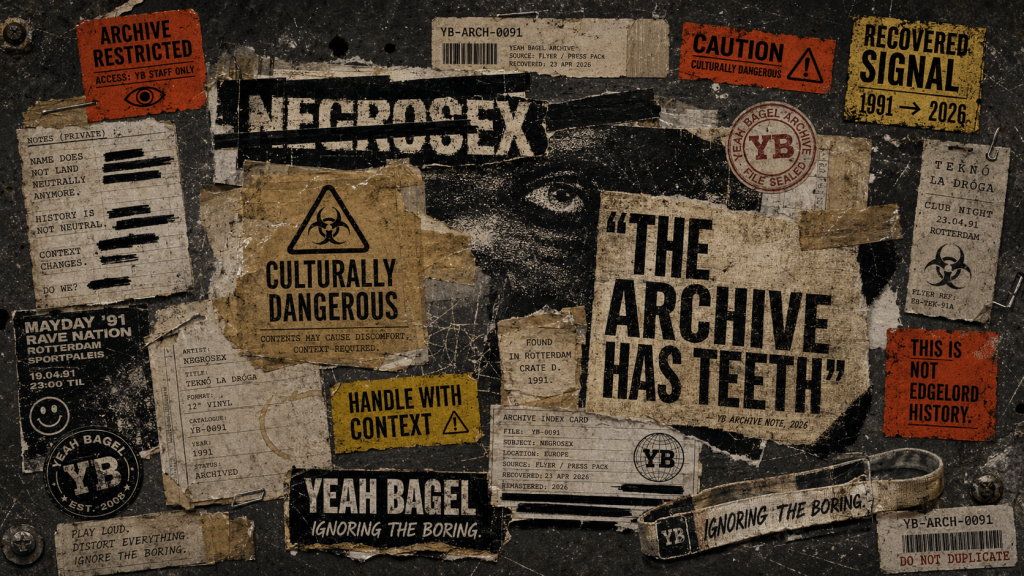
Negrosex was the project of Luden Barnemünde and Johanna Cosmo Fetsch, and the record that still matters is “Teknó La Drôga,” released in 1991, then dragged back into the light decades later by Mecanica. In one sense, it is a small story: a hard electronic 12-inch, a few versions, a cult trail, a reissue for the people who know that history does not only happen in canon-friendly capitals. But in another sense, it opens a trapdoor beneath the polished myth of techno.
Because this is not techno as lifestyle architecture.
This is not the tasteful black-shirt continuum. Not the airport-lounge minimalism. Not the boutique festival stage where the kick drum has been pressure-washed for international consumption. This is techno before it learned how to behave in brand decks. Techno with metal fillings. Techno with photocopied pupils. Techno with a Germanic jawline, a New Beat leer, and an EBM bootprint drying in the corridor.

“Teknó La Drôga” does not float. It stamps.
The title alone feels like a warning label peeled from a machine that has already injured several employees. The accent marks wobble like contraband signage. The spelling looks slightly corrupted, half slogan, half police report. This is part of the pleasure. The record understands that early techno was not only futurism. It was also bad electricity moving through Europe at speed. It was warehouse humour. It was post-industrial body music finding new muscles. It was the dancefloor as a temporary black market in sensation.
There is nothing polite about the groove. It works by insistence. The beat does not invite you in; it processes you. The synth lines do not shimmer; they jab and coil. The vocal fragments feel less like singing than instruction, a command language for bodies already halfway gone. You can hear the late-80s hard beat DNA in it, the Belgian pressure, the EBM severity, the sense that club music did not yet know which future it belonged to and was therefore trying several at once.
That uncertainty is what gives the track its charge.
Today, genres arrive pre-sorted. The streaming cupboard has a drawer for everything. Industrial techno. Acid. Dark disco. Body music. Minimal wave. Peak-time. Leftfield. Algorithmic little kennels for unruly dogs. “Teknó La Drôga” belongs to the moment before those fences got higher. It is not confused. It is promiscuous in the old underground sense: grabbing what it needs, damaging the furniture, refusing to explain itself to the landlord.
That refusal matters.
Because dance music history is often told through triumphal lines. Detroit to Berlin. Chicago to the world. Ibiza, London, Frankfurt, Tresor, Love Parade, superclubs, comedown, revival. All useful, all incomplete. The real map is messier. It includes local labels, private studios, home-built identities, records that moved through bags and booths before they moved through histories. It includes tracks that were not necessarily “important” in the institutional sense, but were absolutely important in the dark at 3.17am when the room tilted and everyone understood the same stupid, sacred thing at once.
Negrosex belong to that second map.
The one drawn in marker pen on the back of a flyer.
Before “Teknó La Drôga,” there was “God and Evil,” released in 1989 on the pair’s own Bit Bites Brain label. Even the label name sounds like a motherboard chewing itself. The single gained attention partly because of its provocative cover, which did what underground covers often did then: poked at church, sex, scandal, authority and taste with a stick sharpened in art school and dipped in nightclub sweat. Whether that shock still works, whether it should, whether it ever did anything beyond announce itself loudly, those are fair questions. But the move also tells you something about the project’s operating temperature. Negrosex were not trying to be respectable. Respectability was the wrong room.
Then New Zone enters the story, and “Teknó La Drôga” becomes the record that survives the weather.
The remarkable thing, listening now, is how little it sounds like a relic once the needle drops in your head. The surface says period piece. The typography says 1991. The machinery says old world future, the kind imagined in basements before laptops made everything visually clean and spiritually suspicious. But the physical logic of it still works. It is built for bodies, not discourse. It does not need a heritage plaque to justify itself. The kick still knows where the floor is. The bass still moves like a guilty engine. The track still has that strange narcotic quality suggested by the title: not euphoria exactly, more compulsion. A little ugly. A little funny. A little dangerous in the theatrical sense, like a club night where the smoke machine has become self-aware and started judging the clientele.

This is where the reissue becomes more than collector bait.
A good reissue does not simply say, this existed. It says, listen again, the past is not finished with you. Mecanica’s 2025 return of “Teknó La Drôga” puts the versions back into circulation and lets the track re-enter a world that has become both more connected and more forgetful. Everything is available, apparently, and yet so much disappears. Availability is not memory. Streaming is not care. The archive still needs people who will dig, restore, argue, press, annotate, and send old wrong machines back into the room humming.
Negrosex benefit from that kind of attention because they sit in a zone that is easy to miss if your history has been too neatly laminated. They are not cosy pioneers. They are not saints of the machine. They do not offer a clean origin story. They offer something more interesting: a record that sounds like a door between scenes being kicked open by accident.
You can hear techno becoming more brutal and more bodily. You can hear New Beat refusing to die politely. You can hear industrial music learning that the club might be a better factory than the factory. You can hear Europe after the 1980s, wired, aroused, anxious, metallic, half-joking, half-serious, looking for a new ritual and finding one in the kick drum.
That is the long way round to the point.
“Teknó La Drôga” still hits because it is not refined. It has not been made safe by age. It has not become tasteful enough to lose its smell. It remains a little embarrassing in the best possible way, a reminder that scenes are built not only by geniuses and manifestos, but by excess, bad taste, obsession, accident, and people in small rooms pushing machines until the machines start giving up secrets.
Negrosex were not asking to be loved forever.
They were sending a signal.
And sometimes the signal waits thirty years, trapped in the wires, until the present becomes strange enough to receive it.

Teknó La Drôga v1.4 appears on Yeah Bagel’s Open Format Transmission 2026.01 at 00:43:29 – 00:49:30.
