

There are bands, and then there are warnings with legs.
KINACT are not a band in the ordinary sense. They do not arrive politely through the front door of music, carrying guitars in soft cases and a tidy press release about influences. They come clanking up the street in the shape of a civic hallucination. Bottles. Wire. Tyres. Tin cans. Dolls. Plastic. Rubble. The city’s rejected material dragged back into public view and made to dance before anyone can pretend not to recognise it.

Their name is not decoration. KinAct: Kinshasa in action. The capital city not as backdrop, not as exotic postcard, not as texture for European ears, but as pressure system. A place moving, shedding, arguing, sweating, inventing. A place where sound is not something you add afterwards. It is already there in the traffic, the shouting, the generators, the selling, the construction, the scraping, the spiritual static in the air.
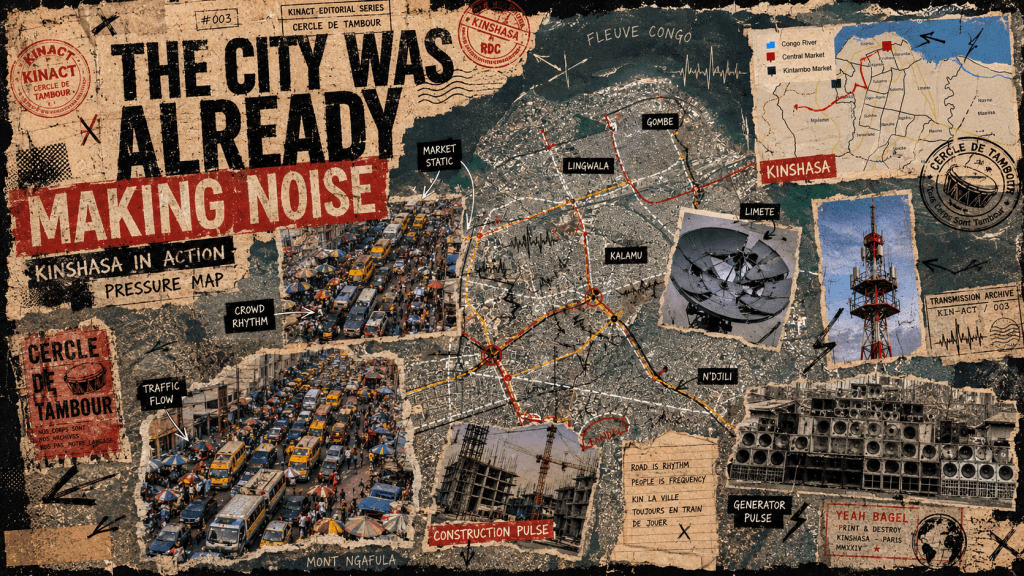
This is why “Cercle de Tambour” does not feel like a song so much as a zone you step into.
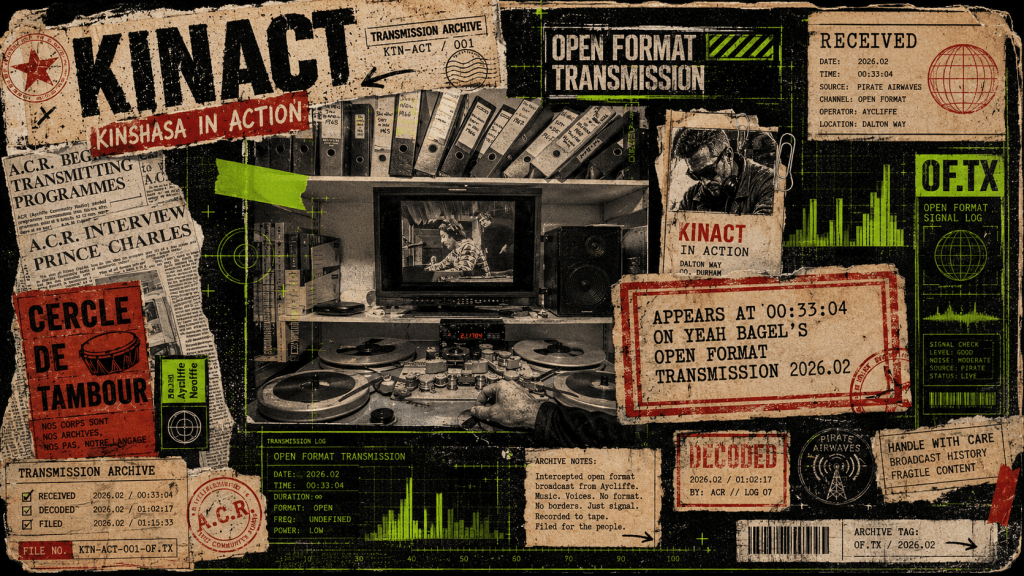
It appears at 00:33:04 on Yeah Bagel’s Open Format Transmission 2026.02, sitting there like a strange metal heart inside the mix. Around it, the playlist has plenty of beautiful disruption: Apollon Telefax flicking punk into the socket, Gorillaz dragging Damascus into the pop machine, Bob Vylan opening another wound in British public life. But KINACT hit differently. They sound less like they are performing a track than documenting a ritual already in progress.
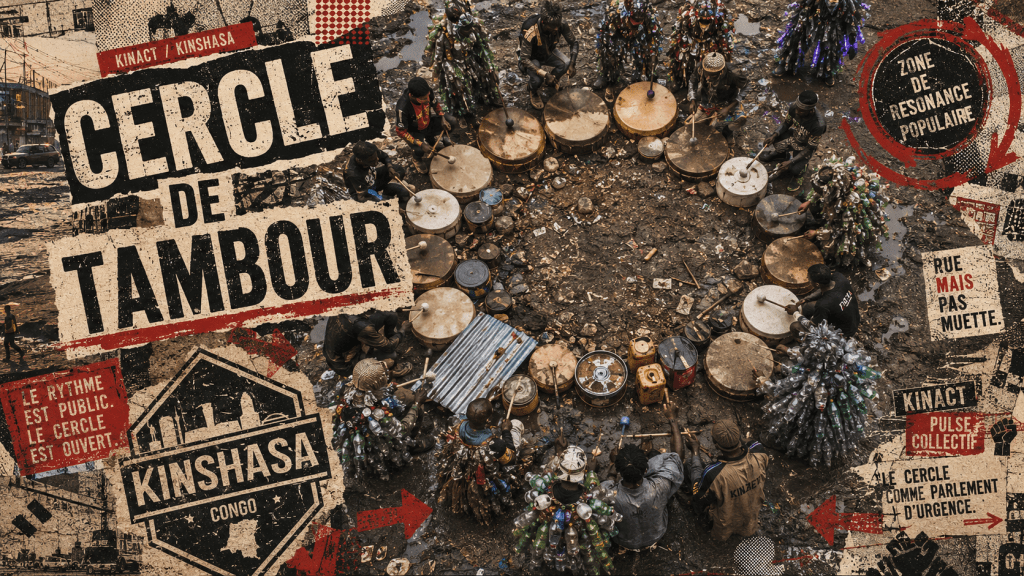
The drum circle is not a circle of comfort. This is not wellness percussion for the corporate away day. This is the circle as emergency parliament. The circle as workshop. The circle as street court. The circle as spell. Everything inside it has been used, broken, discarded, reassigned. The beat does not simply keep time. It scavenges time.
KINACT began as a street performance collective, and that origin matters. Their work belongs to bodies in public space before it belongs to streaming platforms. Their costumes are sculptures, but they are also arguments. They turn waste into regalia, pollution into procession, junk into character, damaged infrastructure into a moving mythology. In a city where the street is often the theatre because the theatre is unavailable, KINACT make the road itself become stage, gallery, protest, shrine and nightclub.
That is the key to hearing “Cercle de Tambour.” You cannot hear it properly as a clean studio object. You have to imagine it with dust at ankle height. You have to imagine the performers moving through a crowd, not above it. You have to imagine sound being produced by things that were never supposed to be instruments, because that is part of the moral force of the thing. A drill is not neutral once it becomes rhythm. A saw is not neutral once it starts singing. A hammer is not neutral when it stops building for capital and starts knocking out a communal pulse.
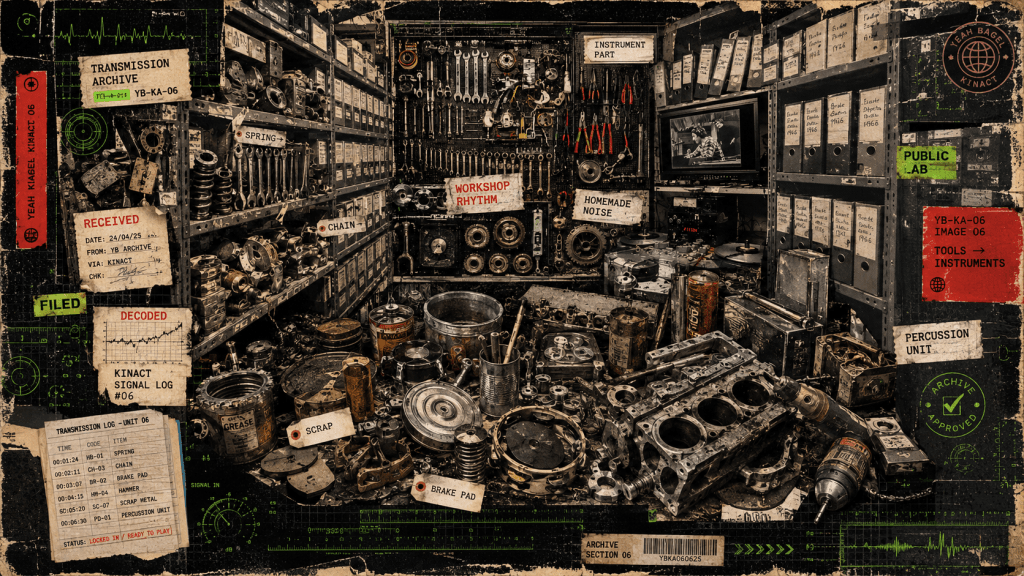
On Kinshasa in Action, KINACT convert the tools of labour and survival into percussive weapons. The album’s great trick is that it never treats this conversion as novelty. There is no cheeky “look what we made from rubbish” gimmick here. The sound is too urgent for that. “Cercle de Tambour” has the thick air of necessity. It does not ask whether the scrap can become music. It behaves as though scrap has always been music, and only the comfortable world was too clean-eared to notice.
The track’s energy is rough, circular, insistent. It does not build like a conventional club record, with a neat lift and a satisfying drop. It churns. It gathers bodies. It knocks metal against skin, breath against object, chant against impact. The rhythms feel handmade in the oldest and newest senses at once. Ancient because the circle is one of humanity’s first technologies. Contemporary because the materials are modern ruins: plastic, machinery, industrial leftovers, the afterlife of consumption.
This is where KINACT become difficult in the best way. They make beauty, but they do not let beauty behave itself. They know the global music marketplace loves turning marginal invention into flavour. It likes the phrase “raw energy.” It likes “found sound.” It likes “ritual.” It likes the thrilling little shiver of proximity to danger, provided the danger can be packaged, tagged and safely admired.
KINACT resist that flattening because their work keeps pointing back to the conditions that made it. The waste is not aesthetic seasoning. The waste is evidence. The costume is not costume in the theatre-school sense. It is witness protection for the truth. A figure made of tyres is not just visually striking; it drags a history of extraction, labour, transport and suffocation behind it. A body covered in cans does not merely glitter. It rattles with the sound of what the city has swallowed and spat back.
“Cercle de Tambour” therefore carries two pulses at once. One is physical: the immediate thrill of rhythm, the bodily yes of percussion hitting the nervous system before language can get its shoes on. The other is political: the knowledge that these sounds come from a world where survival requires constant transformation. What is available becomes what is needed. What is dumped becomes what speaks. What is ignored becomes impossible to ignore.

There is a useful comparison to be made with the wider lineage of Congolese amplified invention: Konono No.1’s electrified likembé distortion, Kasai Allstars’ trance logic, the homemade circuitry of KOKOKO!, the streetwise future-noise that has kept Kinshasa in the global experimental imagination. But KINACT are not simply the next name in that export chain. They feel more theatrical, more sculptural, more confrontational. Their music arrives wearing its own evidence locker.
The most powerful thing about “Cercle de Tambour” is that it refuses the false split between art and function. It is dance music, yes, but dance as pressure release, dance as testimony, dance as public assembly. It is sound art, yes, but sound art with dirt under the nails. It is protest, yes, but not the kind that waits for a slogan to explain itself. It is ritual, but not as nostalgia. It is ritual built from the things capitalism leaves behind when it thinks nobody is looking.
That is why it belongs on Yeah Bagel. Because Yeah Bagel is at its best when the playlist becomes a map of beautiful trouble, when a track opens a trapdoor into a whole system of bodies, histories and electrical weather. “Cercle de Tambour” is one of those tracks. It does not just sit between other records. It changes the temperature of the room.
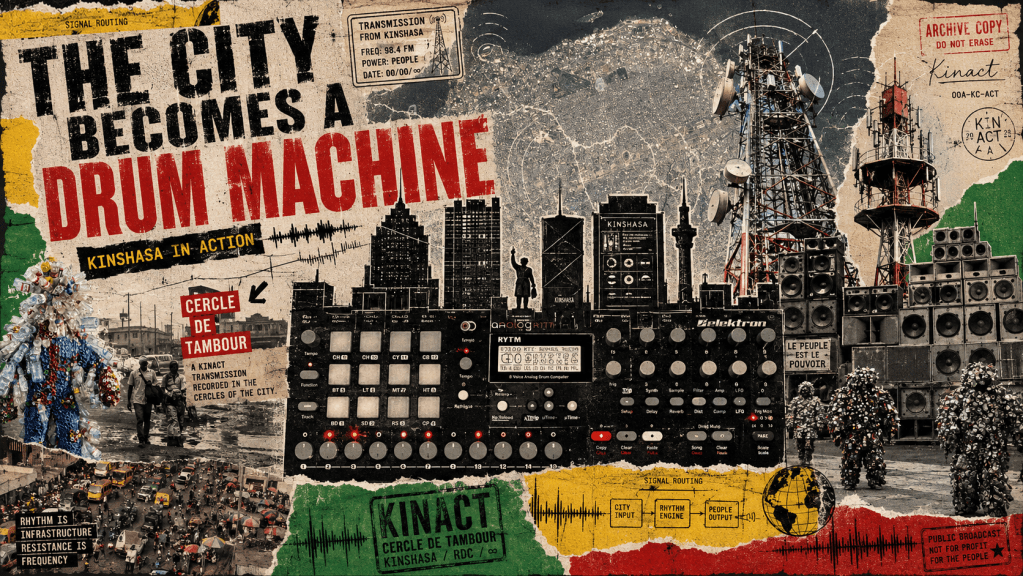
By the time it passes, the ear has been rearranged. Ordinary noise starts looking suspiciously musical. The bin outside becomes percussion. The building site becomes ensemble. The city becomes a drum machine with bad wiring and ancestral memory. The future, briefly, sounds less like a pristine upgrade and more like a crowd in the street, making rhythm from the wreckage.
KINACT do not offer escape from Kinshasa. They offer Kinshasa in action: moving, clattering, arguing, remembering, refusing, making itself heard with whatever is at hand.
And on “Cercle de Tambour,” whatever is at hand becomes thunder.
Cercle de Tambour appears on Open Format Transmission 2026.02 at 00:33:04-00:36:00.
