
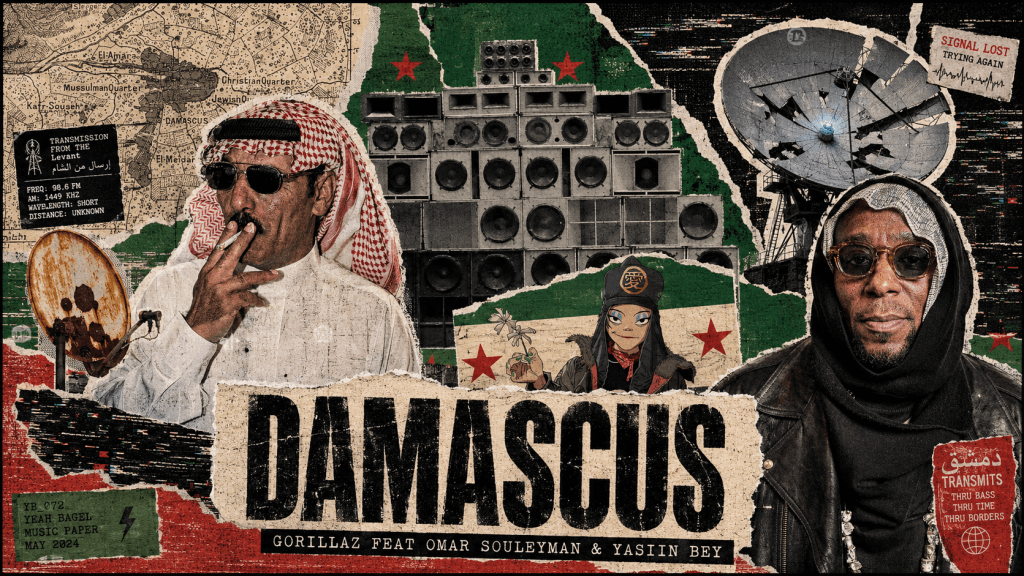
There are Gorillaz songs that behave like singles. Then there are Gorillaz songs that behave like illegal radio transmissions picked up through concrete, grief, heat shimmer and old satellite equipment.
“Damascus” is the second kind.
On paper, it looks like one of those impossible Damon Albarn guest-list collisions that should collapse under the weight of its own passport stamps: Gorillaz featuring Omar Souleyman and Yasiin Bey. Cartoon band. Syrian dabke lightning rod. Brooklyn rap mystic. A title that does not arrive neutrally. A city that carries history like dust in the throat. A beat that wants bodies moving even as the context around it feels scorched.
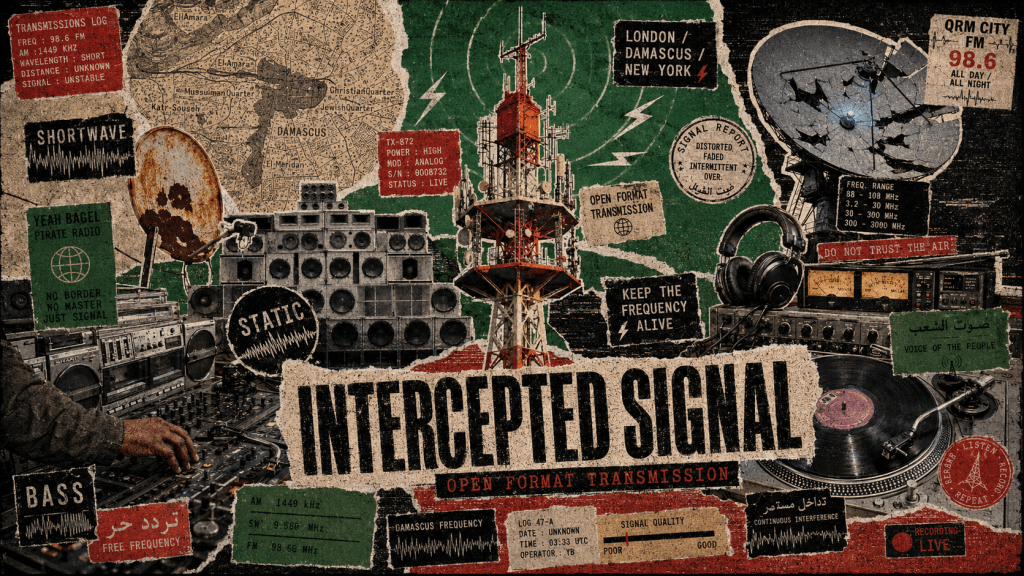
That tension is the point.
“Damascus” appears on The Mountain, Gorillaz’s 2026 album of ghosts, border crossings, mourning rituals and absurdly ambitious global pop engineering. It is not a tidy “world music” garnish stuck on the edge of a British alternative-pop plate. It feels more like a checkpoint rave at the edge of the living world. The song does what Gorillaz have always done when they are at their best: it builds a fictional space where very real voices can collide without being sanded into politeness.
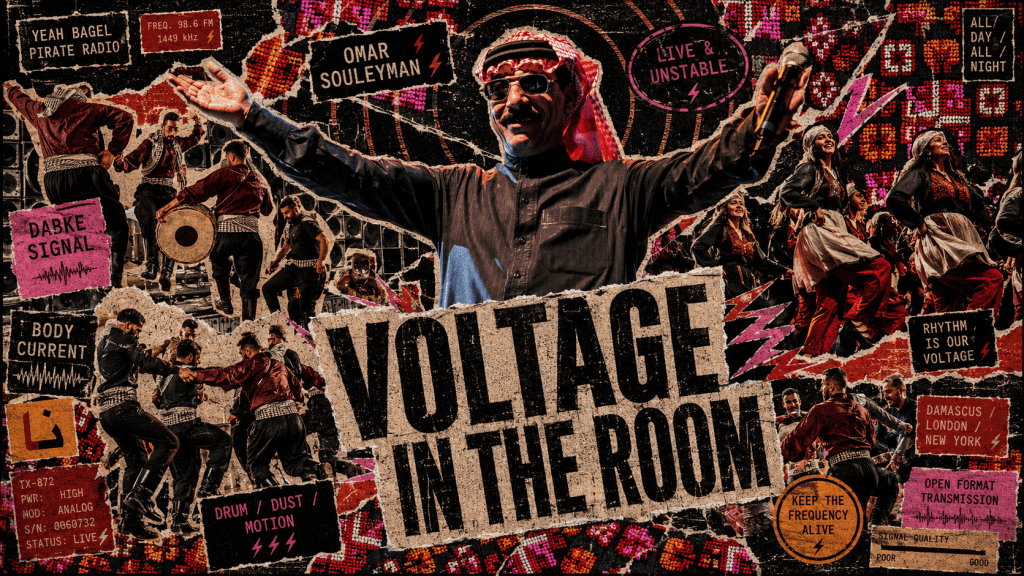
Omar Souleyman does not enter the track as decoration. He arrives like voltage. His voice carries the wedding-party velocity of dabke, that communal propulsion where rhythm is not background but social architecture. Souleyman’s art has always had that strange double charge in Western ears: music built for celebration, heard through the shadow of displacement, war, exile and projection. There is a danger in making him a symbol before letting him be a singer. “Damascus” avoids that mostly because it lets him burn at full brightness. He is not here to explain Syria to anyone. He is here to ignite the room.
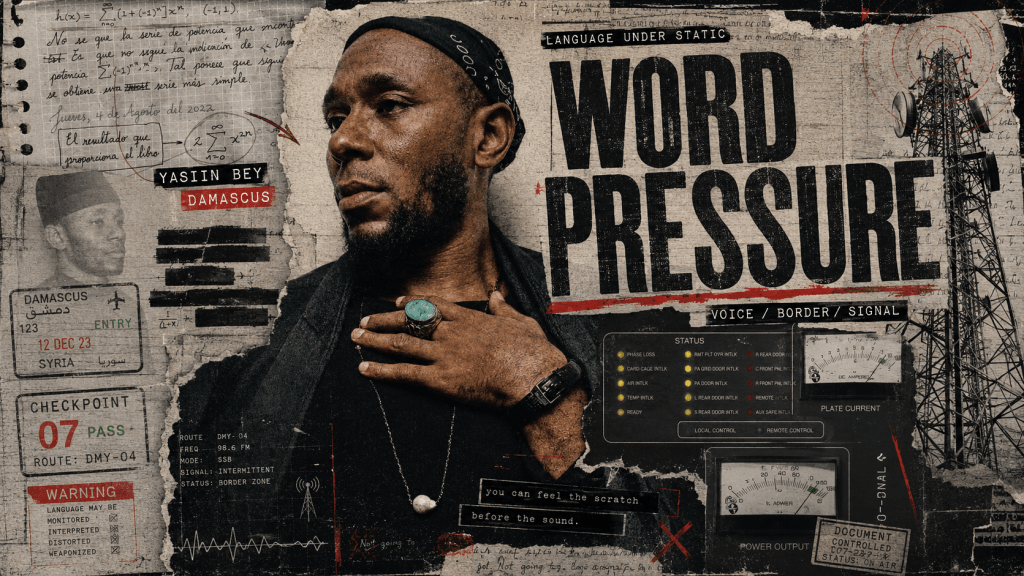
Then Yasiin Bey comes in, not as a tourist in the rhythm but as a man who understands what it means for words to carry border pressure. His delivery has aged into something more incantatory than ornamental. He does not rap like he is trying to win the track. He raps like he is trying to decode it while it is already moving. There is urgency, but also an old-school alertness, the sense that language still matters even when the world has become professionally deaf.
Between them sits Gorillaz, the cartoon empire that somehow became one of modern pop’s most durable smuggling operations.
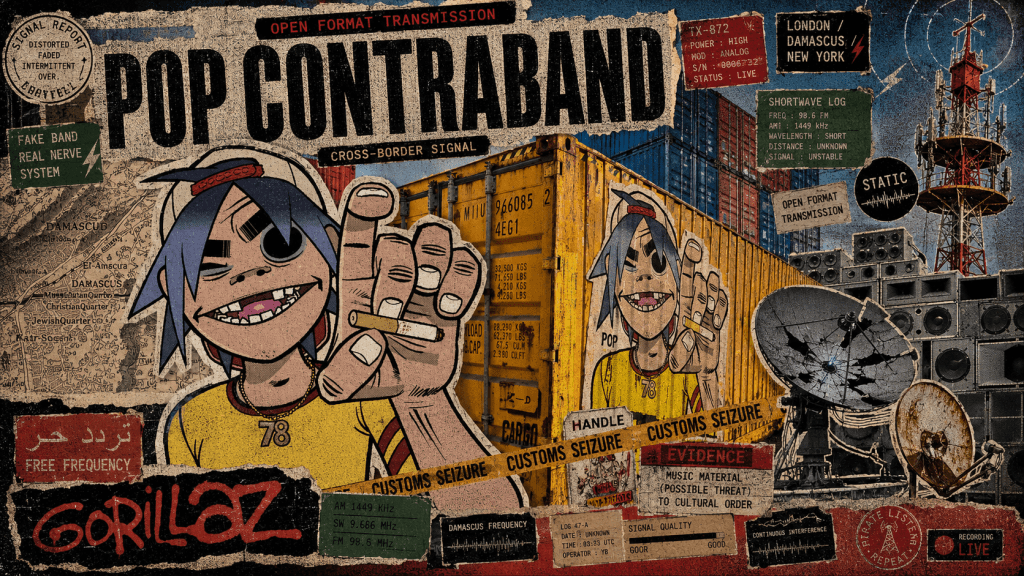
That word, cartoon, still matters. Gorillaz began as a joke with teeth: a fake band created by Damon Albarn and Jamie Hewlett to expose the manufactured absurdity of pop culture, then slowly became more alive than many real bands. The joke mutated. The mask became a method. Because Gorillaz were never bound to a fixed body, genre or nationality, they could become a kind of pop séance room: Del the Funky Homosapien in one corner, Bobby Womack in another, De La Soul laughing through the walls, Lou Reed’s ghostly afterimage hovering somewhere in the wiring, Little Simz, Grace Jones, Popcaan, Ibrahim Ferrer, Shaun Ryder, MF DOOM, Kali Uchis, Bad Bunny, Bootie Brown, Roots Manuva, Vince Staples, Tony Allen. A guest list so strange it starts to resemble a world map drawn by a pirate radio operator on no sleep.
But “Damascus” feels sharper than mere eclecticism.
The title does not let the listener float away into cartoon fantasy. Damascus is one of the oldest continuously inhabited cities in the world, but in the contemporary imagination it is also a word marked by civil war, exile, news footage, absence, rubble, geopolitics and the flattening force of Western attention. To call a song “Damascus” in 2026 is to summon more than a place. It summons what happens when a place becomes a headline, then a wound, then a symbol, then a sound again.
That is where the track finds its force. It does not give us a lecture. It gives us motion. It gives us rhythm as refusal. It gives us the body before the think-piece can get its lanyard on.
There is something deeply Gorillaz about that. Albarn’s best work has often understood that pop music can hold contradictions better than politics can. A song can be celebratory and haunted. It can be synthetic and earthy. It can be catchy while carrying dread in its pockets. Gorillaz have spent decades making apocalypse danceable, not because apocalypse is fun, but because dance is one of the last available forms of public defiance when everything else has been privatised, militarised or turned into content.
“Damascus” lands inside that tradition, but with a different flavour of heat. It is not the stoned end-of-days drift of “Clint Eastwood.” It is not the glittering melancholy of “On Melancholy Hill.” It is not the mutant club-pop sprawl of “Stylo,” although Yasiin Bey’s presence naturally makes the family resemblance glow. “Damascus” feels closer to a flare fired above a gathering. It is communal, wired, insistent. It does not brood in a bedroom. It moves through the street.
The production understands the importance of not over-domesticating the ingredients. Too often, big Western collaborations with non-Western artists turn into a kind of velvet cage: exotic vocal, polite beat, tasteful press release. Here, the song has elbows. Souleyman’s dabke pulse is allowed to make the track lurch and surge. Bey does not smooth it out. Gorillaz do not force it into a flat-pack pop chorus. The result is a track that sounds assembled across distance, which it was, but not diluted by that distance. It carries the thrilling awkwardness of real collaboration, the sense of artists meeting at speed rather than posing together for the brochure.
That matters because Gorillaz have always walked a narrow bridge. Their greatest strength, the ability to bring wildly different artists into one animated universe, is also their greatest risk. At worst, the project can feel like a collector’s cabinet, full of beautiful imported objects arranged by Albarn’s magpie hand. At best, it becomes something rarer: a place where musicians from different histories do not dissolve into “fusion,” but keep their edges and spark against each other.
“Damascus” belongs to the better version.
It also feels important that this is not a young band discovering “global sounds” as a late-career brand refresh. Gorillaz have been border-hopping since the beginning. The difference now is that the stakes around borders have changed. The 2000s dream of frictionless global culture, all file-sharing, guest verses and airport lounges, has curdled into something harder. Walls are back. Nationalism is back. War is not background noise, if it ever was. Migration is treated as a crisis when the poor move and as lifestyle when the rich do it. Algorithms flatten difference while pretending to celebrate it. Everyone is connected. Nobody is safe.
In that climate, “Damascus” feels less like genre play and more like a test of whether pop can still imagine connection without lying about the damage.
The answer, for four minutes, is yes.
Not a clean yes. Not a utopian yes. A cracked yes. A bass-bin yes. A yes written on a wall, half-covered by dust, still visible when the lights hit it. The track does not solve the politics it invokes. Songs do not rebuild cities. They do not open borders. They do not reverse exile. But they can keep a name alive inside the bloodstream. They can refuse the deadening effect of headlines. They can turn a place back into sound, breath, rhythm, voice.
That is why “Damascus” works as a Yeah Bagel track. It is not simply interesting because Gorillaz got Omar Souleyman and Yasiin Bey on the same record. It is interesting because the combination says something about what music can still do when the official channels have turned to static. It can make an impossible room. It can let the cartoon become more truthful than the news. It can make celebration sound like survival without turning survival into spectacle.
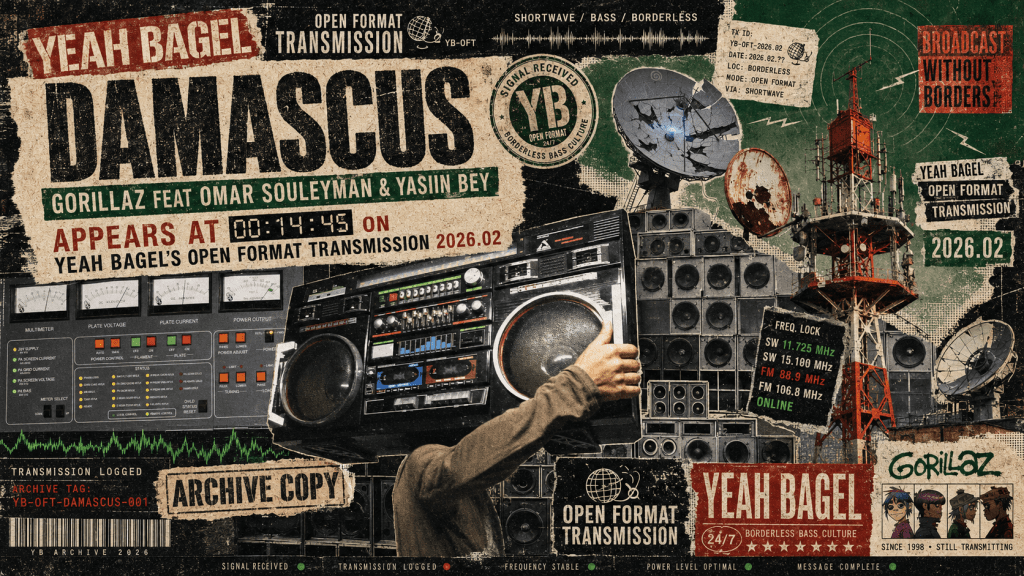
On Yeah Bagel’s Open Format Transmission 2026.02, “Damascus” appears early, at 00:14:45, and it feels like a door being kicked open in the mix. Before it, there is swagger, humour, groove, the familiar thrill of the crate being raided. After it, the transmission has changed temperature. The room is bigger. The stakes are higher. The dancefloor has acquired a border crossing.
Gorillaz have spent twenty-five years pretending to be a fake band. “Damascus” is another reminder that the fake band keeps finding real nerves.
And when Souleyman’s voice cuts through the machine, when Yasiin Bey answers from another frequency, when Albarn’s ghost-world pop laboratory locks into motion, the song becomes more than a collaboration.
It becomes a flare.
Not over the city as symbol.
Over the city as memory.
Over the city as rhythm.
Over the city as something still alive.
