
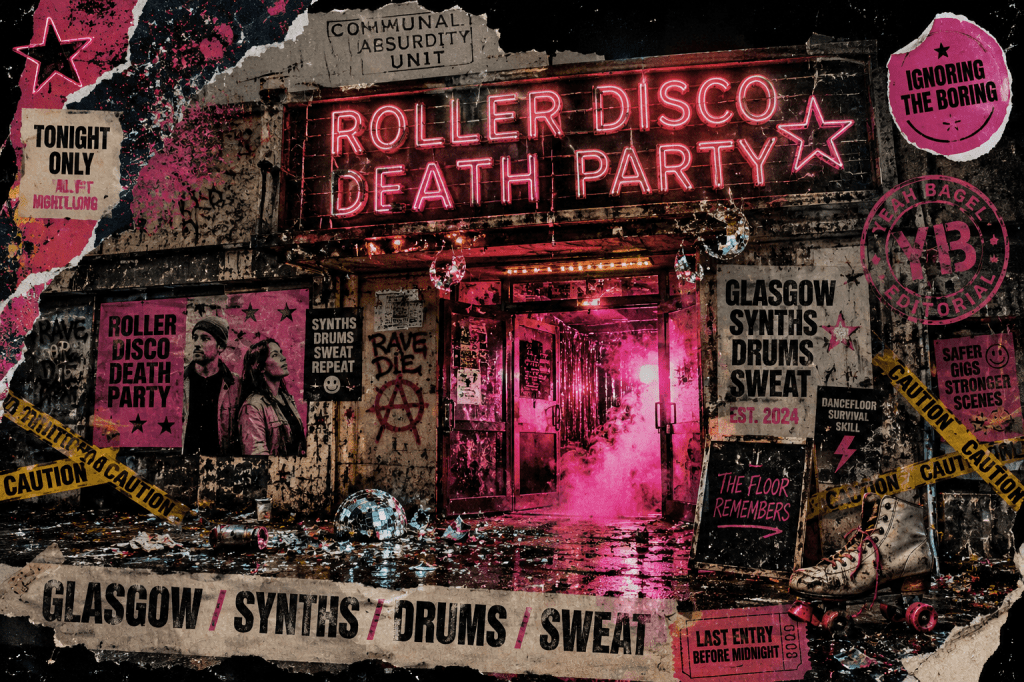
Roller Disco Death Party sounds like a band name rescued from a condemned leisure centre.
You can almost see it glowing above the entrance: cracked neon, pink smoke, municipal carpet, one busted mirrorball refusing to clock off. It promises fun, but not polite fun. Not playlist-background fun. Not the kind of fun that arrives pre-approved by a brand partnership and leaves before the room gets weird.
This is fun with its hair stuck to its forehead.
Fun with a siren in the bassline.
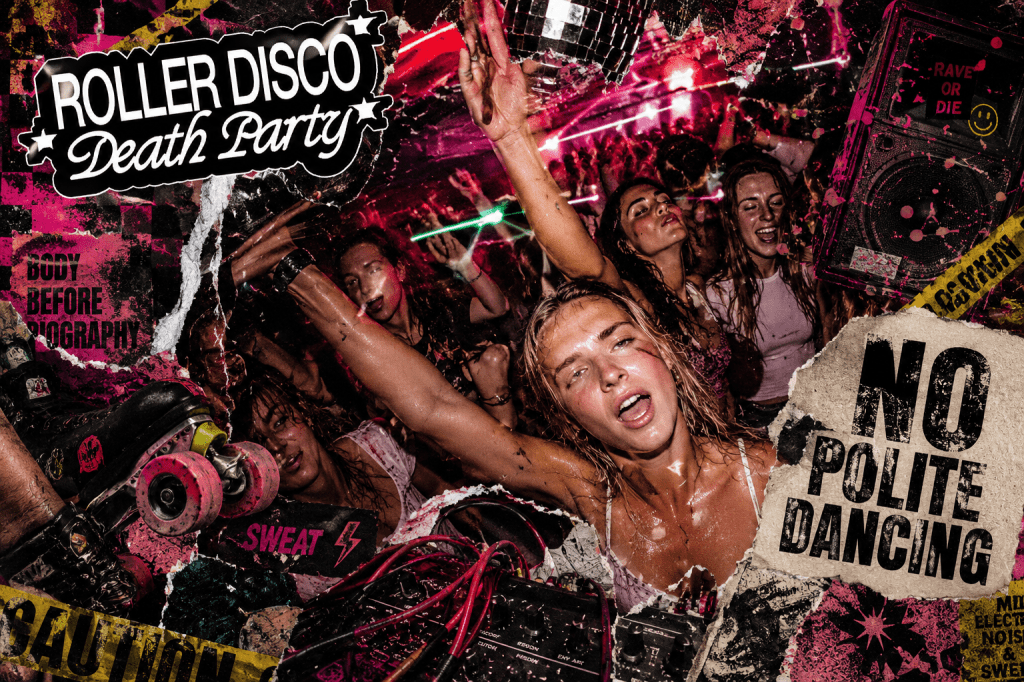
Fun that knows the dancefloor has always been one of the places people go when ordinary life starts making unreasonable demands.
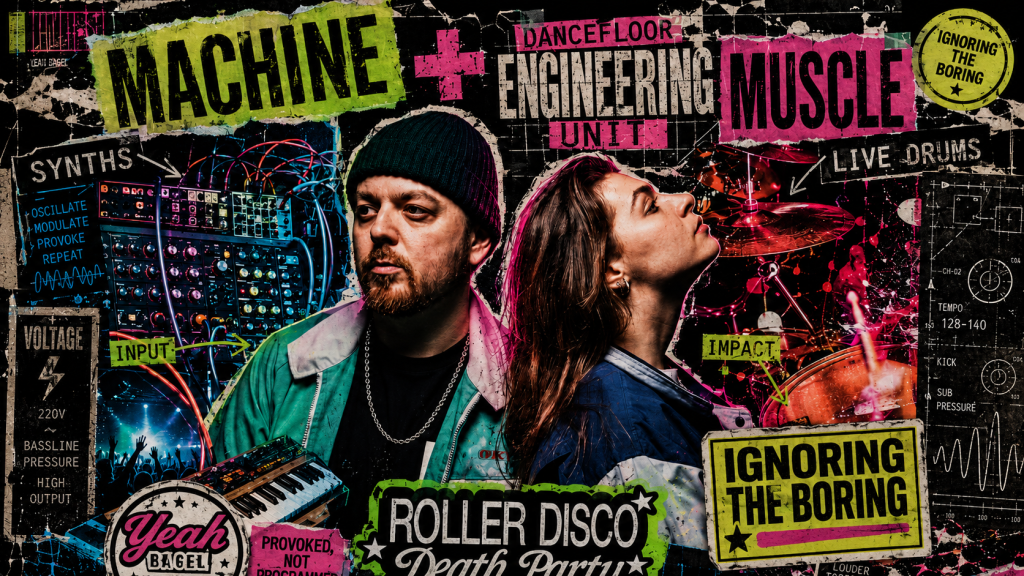
The Glasgow duo are built on a beautifully simple piece of machinery: Neal McHarg on synths, Amelia on drums, and between them a sound that seems to understand exactly what happens when club music is pulled out of the laptop and made to sweat in public. The beat does not simply arrive. It has limbs. It has elbows. It has a pulse that feels less programmed than provoked.
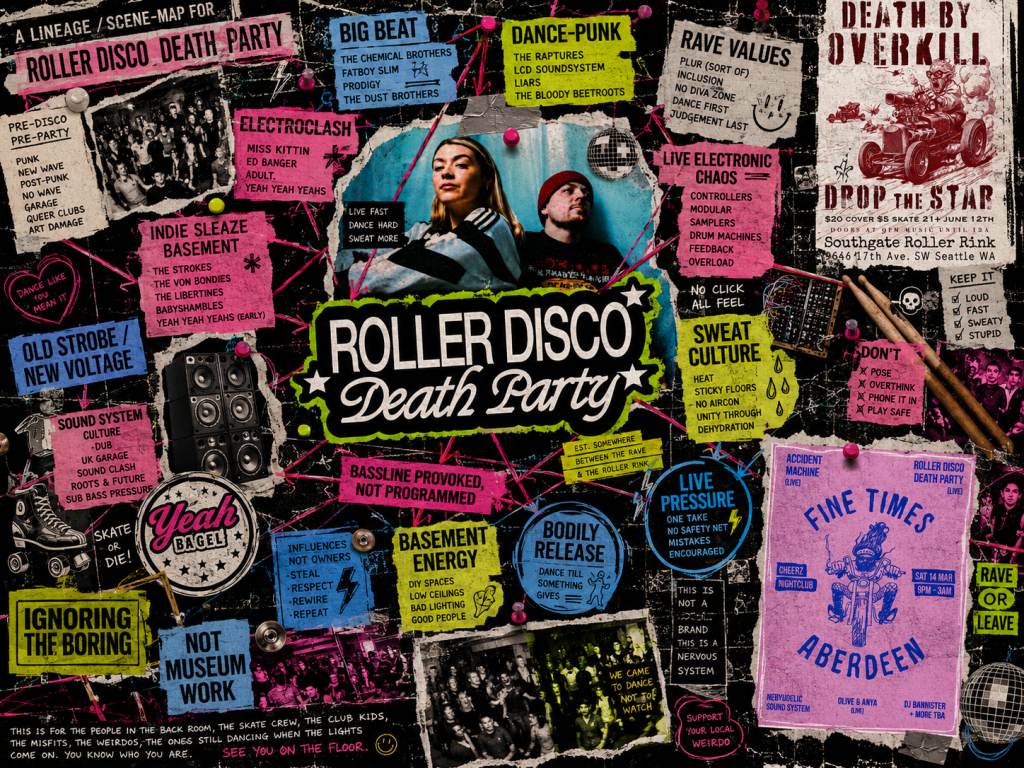
You can hear the family tree straight away: Soulwax, The Chemical Brothers, Justice, big beat, electroclash, dance-punk, the lost religion of the early-2000s indie sleaze basement when everyone wanted the DJ to be a band and the band to be a small electrical fire. But Roller Disco Death Party are not doing museum work. This is not someone polishing an old strobe and calling it a scene. They take that lineage and shove it back into the room, where it belongs, among bodies, sweat, poor decisions, good shoes, bad eyeliner, and the holy nonsense of strangers moving together.
That matters.
Because dance music, at its best, has never just been about dancing. Dancing is the visible part. The flailing evidence. The public confession. Underneath it sits something harder to monetise: permission. Permission to loosen the armour. Permission to become ridiculous. Permission to exist outside the dreary spreadsheet of usefulness for five minutes, or six, or until the last kick drum finally collapses into feedback.
Roller Disco Death Party understand that permission is not frivolous. It is political in the old, bodily sense. Their origin story runs through community work, youth empowerment, safer gigs, mutual care, and the stubborn belief that music scenes are not just content farms with wristbands. That background gives the project its spine. The songs want you to move, yes, but they also seem to believe that movement can be collective rather than competitive. Nobody needs to be cool alone in the corner. The whole point is to join the voltage.
The Pink EP feels like their first proper calling card: four tracks of live-wire dancefloor engineering, all bright impact and basement pressure. “Day By Day” stretches itself into six minutes of rising electronic momentum, while “Last Days Of Isolation” carries the title of the post-pandemic hangover like a flyer found in the pocket of a coat you wore to your first gig back. “Keep The Balance” says the quiet part out loud. The whole enterprise is about balance: machine and muscle, euphoria and damage, party and death, disco and the thing waiting outside when the lights come up.
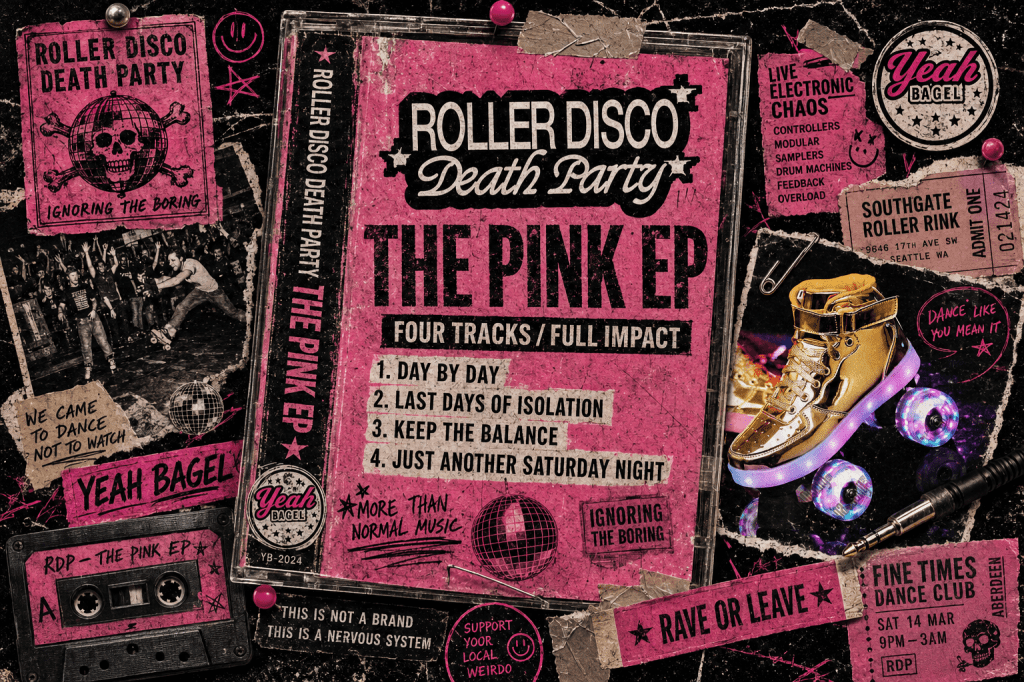
Then there is “Just Another Saturday Night”, which is exactly the sort of title that knows there is no such thing. A Saturday night is never just a Saturday night to the people who need it. It is release valve, reunion, exorcism, flirtation, field test, group therapy with a kick drum. Some nights save you in tiny ways. Some nights ruin you in ways you later call character development. Roller Disco Death Party make music for that unstable border.
By the time “Move Dance Groove” arrives, featuring Paque and carrying the fingerprints of Jagz Kooner, the signal has sharpened. The title is almost caveman direct, three commands nailed to the wall. Move. Dance. Groove. No overthinking. No chin-stroking at the back. No tasteful little nodding performance from men in expensive jackets. The track knows what it wants from you. It wants the body before the biography.
And maybe that is why Roller Disco Death Party feel so useful right now.
So much contemporary music culture has become weirdly bloodless. Songs are treated as assets. Artists are turned into scheduling problems. Discovery becomes admin. Even rebellion is asked to optimise its rollout strategy. Against that, a band like Roller Disco Death Party feels gloriously inconvenient. They are not selling a moodboard. They are building a room. A room where drums hit like furniture being dragged across a club floor. A room where synths flash and buckle. A room where old rave values get pulled from the drawer, dusted off, and made dangerous again.
The name helps, obviously. Roller Disco Death Party is not a name you half-remember. It lands like a poster wheat-pasted over a council warning. But the name also contains the whole argument. Roller disco: pleasure, movement, communal absurdity, wheels underfoot, the possibility of falling over and laughing anyway. Death party: the knowledge that pleasure is never innocent, that every dancefloor has ghosts, that the best nights often glow because the world outside is trying to flatten everyone into obedience.
That tension is the band.
Not escapism exactly. Escape suggests you leave the world behind. Roller Disco Death Party sound more like a break-in: into joy, into noise, into the temporary republic of the dancefloor. They are not pretending the fire exits are clearly marked. They are simply insisting the bass still works.
And sometimes, that is enough.
Sometimes the most sensible response to a collapsing age is to gather in a dark room and make the floor shake.
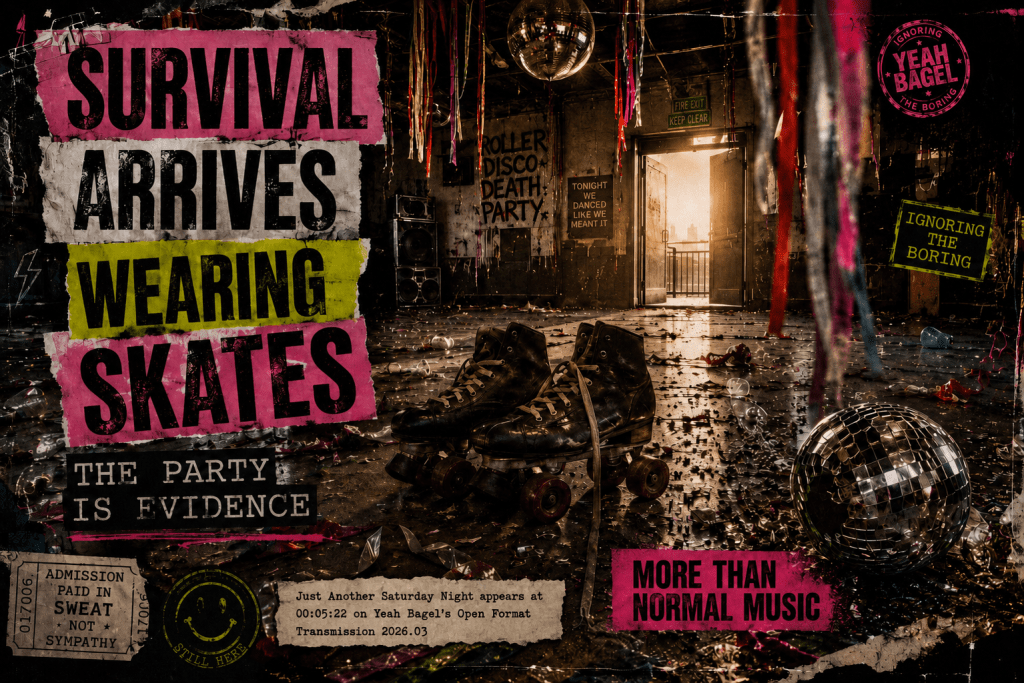
Sometimes survival arrives wearing skates.
Sometimes the party is not denial.
Sometimes the party is evidence that you are still here.
The party is evidence. Just Another Saturday Night appears at 00:05:22 on Yeah Bagel’s Open Format Transmission 2026.03
