
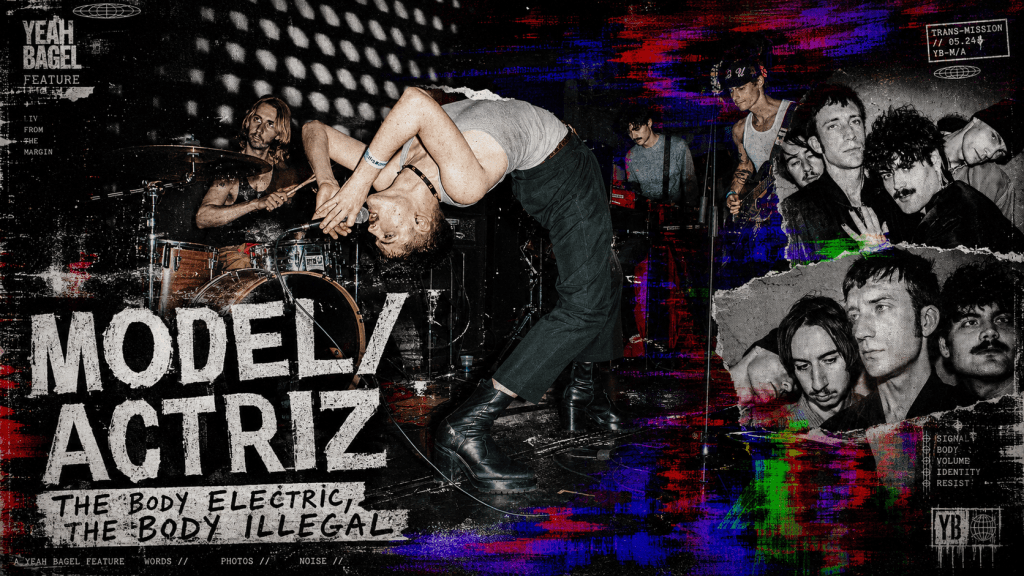
There are bands who arrive with songs. Model/Actriz arrived with impact.
Not the polite kind. Not a nice morning mist over the Brooklyn rooftops. More the kind that makes the walls sweat, knocks the glass from the bathroom shelf, turns a nightclub into a small theatre of moral panic. Their music has always felt less like a performance than a physical encounter: a hand on the shoulder in the dark, a bassline coming up through the soles, a voice somewhere between confession booth, catwalk, basement show and emergency broadcast.
Model/Actriz are often filed under post-punk, noise rock, industrial, dance-punk, art rock, all the useful little boxes we use when something refuses to sit still. But the point of this band is not the box. The point is the body inside it. The body wanting, flinching, performing, remembering, sweating, staging itself for strangers and then recoiling when those strangers look back.
The Brooklyn-based quartet is Cole Haden on vocals, Jack Wetmore on guitar, Ruben Radlauer on drums and Aaron Shapiro on bass. Haden, Wetmore and Radlauer first crossed paths around Berklee College of Music in 2016, with Shapiro joining when the band regrouped in 2019. Their debut album Dogsbody arrived in 2023, and their second album Pirouette followed on May 2, 2025.
That timeline sounds tidy enough. It is not. Model/Actriz do not make tidy music. They make rupture with choreography.
The Basement Opera
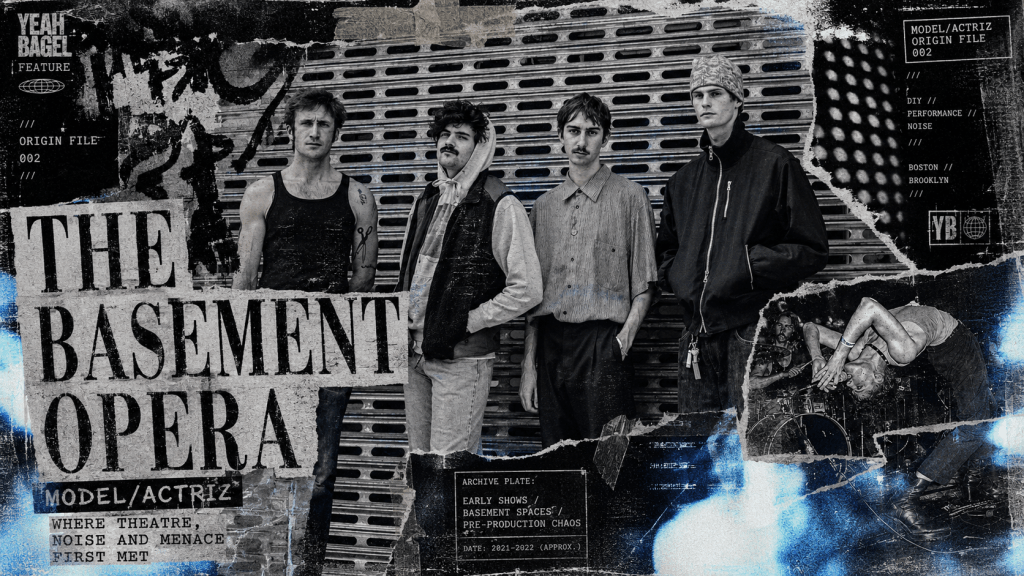
Before the acclaim, before the fashion-world curiosity, before the “best new band” murmurs hardened into something closer to consensus, there was a weird Boston-to-New York origin story with the right ingredients: music school frustration, basement performance, fake blood energy, a singer drawn to theatre and danger, instrumentalists who understood that a guitar did not need to behave like a guitar.
Pitchfork’s early profile of the band describes Wetmore and Radlauer seeing Haden perform what he once called a “Laurie Anderson-type electronic opera” in a Boston basement. The group’s initial version later disbanded, then reformed in New York with Aaron Shapiro on bass.
That matters because Model/Actriz have always carried the smell of theatre without becoming theatre kids. Haden does not simply sing over the band; he prowls through it. His voice is not decoration. It is the lit match, the torn lace, the bouncer, the diva, the bruise. Around him, the band build structures that feel engineered and feral at once: drums like machinery with a pulse, basslines that pull the floor out by degrees, guitar reduced to scrape, shriek, signal, metal-on-tile.
On Dogsbody, released through True Panther in 2023, the band found a language for lust as affliction, queer desire as devotional fever, pleasure as something barbed and magnificent. The record’s reputation formed around intensity, but the better word is precision. The noise was never sludge. It was cut glass. Pitchfork’s review noted the album’s links to early-2000s dance-punk and its “hyper-percussive” force, while also pointing to Haden’s theatrical, bodily treatment of desire.
A lot of heavy music performs aggression as an old uniform. Model/Actriz made it porous. They let camp into the machine. They let softness creep in wearing steel-capped boots.
Queer Desire in a Room Built for Bravado
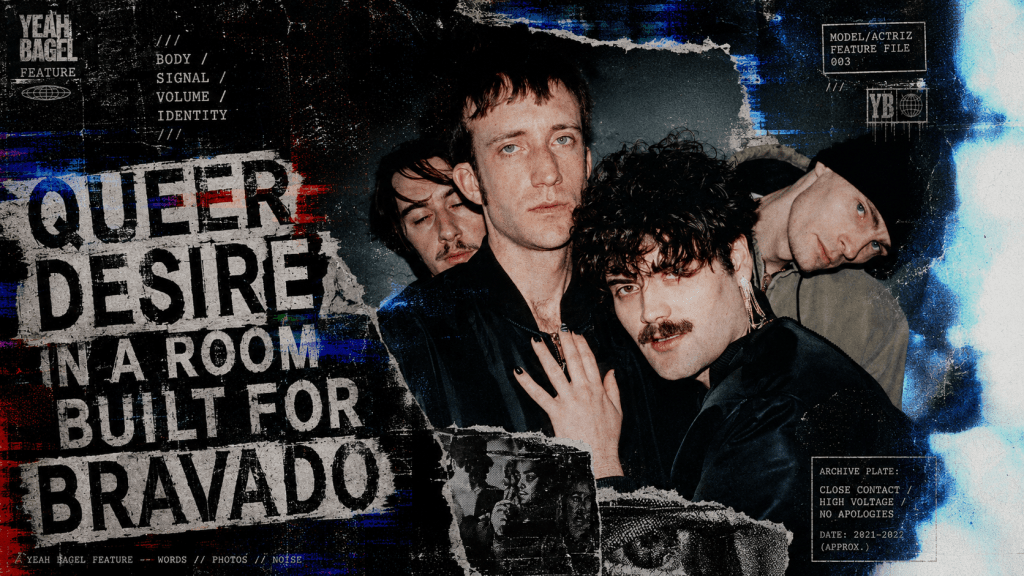
The great Model/Actriz trick is that they do not “add queerness” to post-punk as garnish. They expose the architecture of the room. They ask why certain kinds of desire have historically been allowed to scream through amplifiers while others were expected to arrive coded, coy or tragic.
Haden has spoken about wanting queer themes to be heard in heavier music, and about the lack of representation for “boys on boys” within certain corners of punk, post-punk and industrial culture. In a 2025 SLUG interview, Ruben Radlauer described heavy music as often tied to traditionally masculine energies, and said Pirouette was partly about bringing brightness and softness into that space, not to dilute it, but to let those forces fight and collaborate.
That is crucial. Model/Actriz are not asking to be let into the old house. They are pulling the wallpaper down and finding older wallpaper underneath: shame, glamour, childhood secrecy, diva worship, body fear, spiritual hunger, the strange holiness of wanting to be seen and the equal terror of being witnessed too clearly.
This is why the band’s music feels so alive. It understands that identity is not a slogan. It is a pressure system. It is performance and survival. It is the self in drag as itself.
Dogsbody: The Flesh Learns to Bite
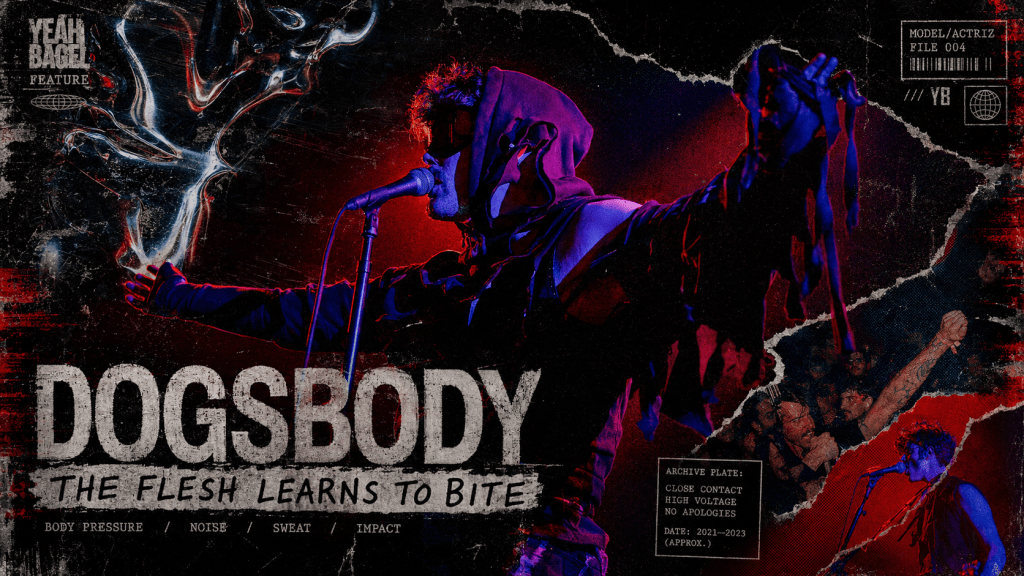
Dogsbody was the first major flare. It sounded like a club night held inside a meat locker. It had the velocity of dance music, the severity of industrial, the splintered angles of noise rock and the theatrical appetite of someone who knows the stage is not an escape from life, but life with better lighting.
The record did not flatter the listener. It stalked them. Yet beneath all the abrasion was something oddly communal. Model/Actriz understood that a crowd can be both audience and organism. Their live reputation grew around that exchange: Haden close to the front row, the band locked tight behind him, the whole thing threatening to become confrontation before revealing itself as intimacy with sharp teeth.
That distinction is important. “Confrontational” can be lazy shorthand for any performer who refuses polite distance. Haden has described his closeness to audience members as a way of creating a private moment within the larger show, rather than simply singling people out.
Dogsbody made the case for Model/Actriz as a band of impact. Pirouette made the case for them as a band of transformation.
Pirouette: The Knife Learns to Dance
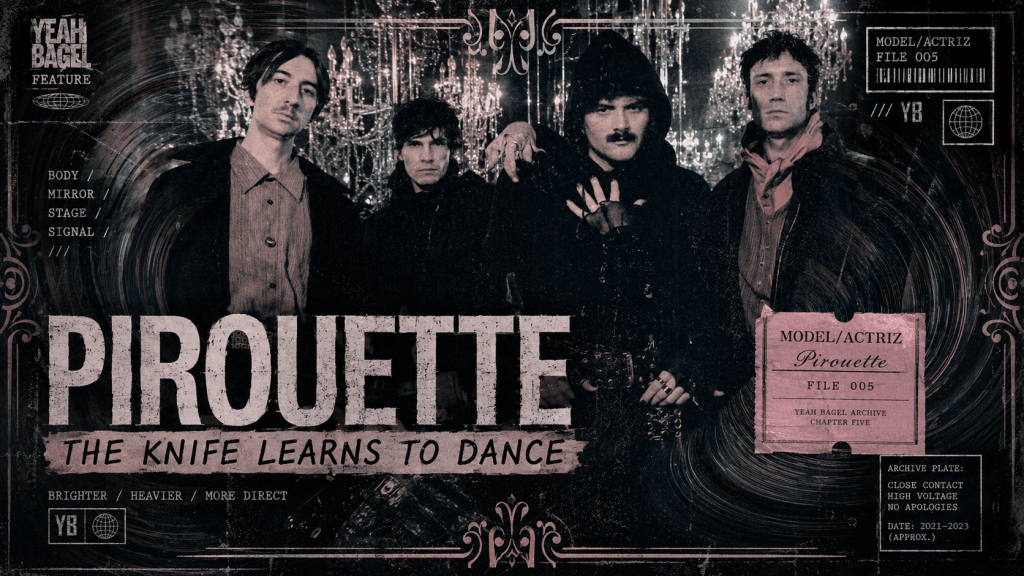
Released on May 2, 2025, Pirouette is not a retreat from intensity. It is a re-aiming. True Panther described it as both a natural progression and a calculated reset, “brighter, heavier, and more direct,” with a pop thread running through club music, cabaret and dancefloor catharsis.
That label copy is useful because it catches the album’s paradox: brighter and heavier. Not brighter instead of heavier. Not poppier as in softened for market. Poppier as in more exposed. More hooks, more melody, more gleam on the blade.
The band’s own Bandcamp credits list Pirouette as written by Model/Actriz, produced by Seth Manchester and Model/Actriz, recorded at Machines With Magnets in Pawtucket, Rhode Island, with additional recording at The Cutting Room and Studio G. The record opens with “Vespers,” followed by “Cinderella,” “Poppy,” “Diva,” “Headlights,” “Acid Rain,” “Departures,” “Audience,” and further cuts across its 11-track run.
Where Dogsbody often felt like the body in extremis, Pirouette feels like the body under lights. The album turns around questions of image, memory, queerness and self-perception. Pitchfork’s review framed it as a record deeply concerned with being seen, with Cole Haden confronting the multiplying versions of himself held in other people’s minds.
That is the curse of performance, and also the fuel. You step into the light to become more yourself. The light makes copies.
On Pirouette, Haden sounds less like he is exorcising a demon and more like he is negotiating with the mirror. The band, meanwhile, have sharpened their physicality into something almost aerodynamic. There are still teeth everywhere, but now they flash under strobes. The songs move with more pop logic, yet the machinery remains beautifully unstable. The hook is bait. The trapdoor is still there.
“Vespers”: Prayer at Club Speed
“Vespers” is the right door into Pirouette because it understands the album’s central contradiction immediately. The title suggests evening prayer, liturgy, hush, candles. The track itself does not kneel. It pulses, advances, glitters, threatens to turn the chapel into a warehouse.
As an opener, it sets out the new Model/Actriz terrain: less basement autopsy, more neon ceremony. The drums are built for movement. The guitar does not decorate the track so much as electrify the perimeter. Haden’s vocal rides the groove with a strange devotional poise, neither swallowed by the band nor floating above it. He sounds installed inside the machine, singing through its wiring.
The Guardian singled out “Vespers” as an example of Pirouette’s poppier approach, noting Haden’s voice functioning almost like a dance-track topline over a relentless groove. Vogue also placed “Vespers” at the front of the album’s controlled chaos, highlighting its pummelling kick drum and forward-driving guitar.
That phrase, controlled chaos, is useful but incomplete. “Vespers” is not chaos tamed. It is chaos rehearsed until it can walk in heels.
The Verraco Remix: Different Shores, Same Fever
Then comes Verraco.
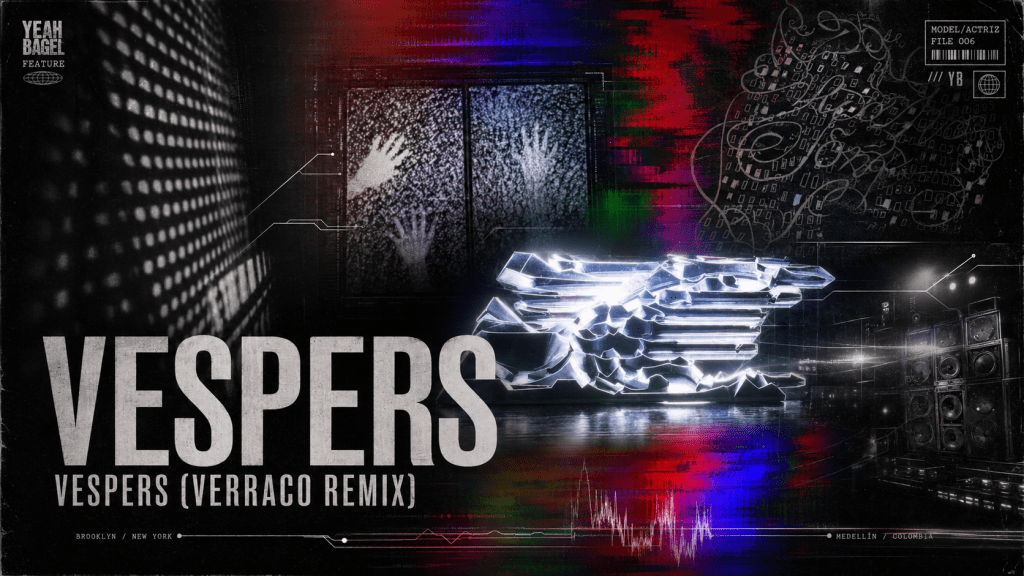
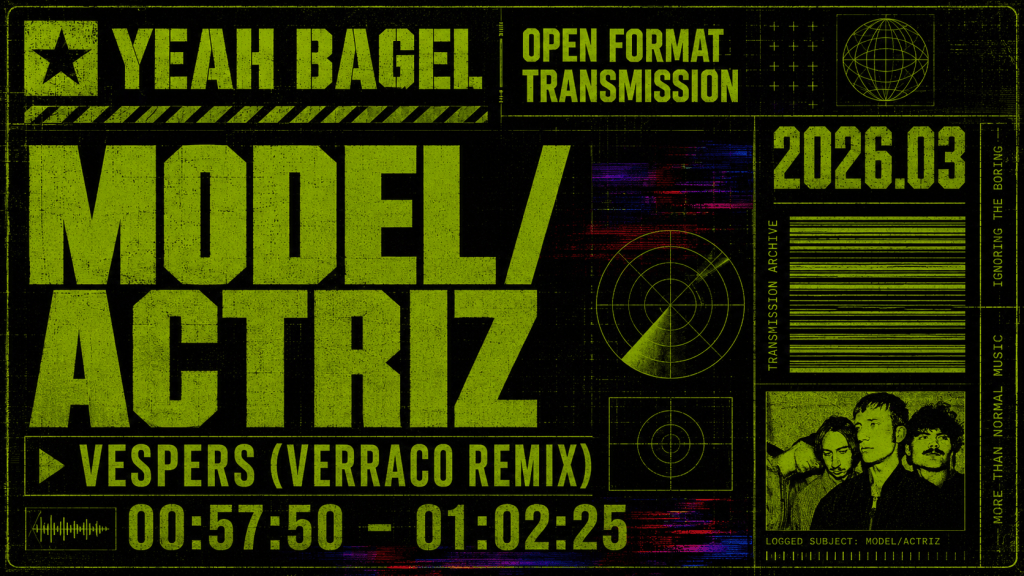
The “Vespers (Verraco Remix)” was released on August 27, 2025. Bandcamp credits the original track as written by Model/Actriz, remixed by Verraco, produced by Seth Manchester and Model/Actriz, and mastered by Matt Colton. Resident Advisor reported the remix as arriving via XL Recordings, with Verraco describing the collaboration as coming from “different shores,” while aiming to keep some of the band’s identity, mix it with his own sound design, and make something functional for the club.
That is the secret engine of the remix: functionality without flattening. The phrase “functional for the club” can sound utilitarian, like a track has been stripped for parts and rebuilt as DJ equipment. But Verraco’s work does not feel like a service entrance bolted onto a rock song. It feels like another hidden room already inside “Vespers” has been opened.
Verraco, born JP López, is a Medellín DJ and producer, co-founder of the TraTraTrax label and an artist associated with the wider global club circuit, including XL Recordings, Voam and Timedance. Resident Advisor lists him as a Medellín producer and TraTraTrax co-runner, while Mixmag has traced his rise through Colombian club culture, Insurgentes, TraTraTrax and a run of increasingly direct dancefloor releases.
That background matters because the remix is not a novelty genre collision. It is a meeting of two different understandings of pressure. Model/Actriz create pressure through bodies in rooms: a band moving as one engine, a vocalist turning vulnerability into voltage. Verraco creates pressure through club architecture: low-end discipline, percussion as hypnosis, texture as propulsion, the sense that sound design can become a living circuit.
The original “Vespers” already had a dancefloor skeleton. Verraco does not need to invent that. Instead, he tightens the joints, changes the lighting, reroutes the bloodstream. The band’s art-rock volatility becomes something more aerodynamic, more nocturnal, more useful to a DJ at the threshold moment of a set: the door opening, or the room dissolving near the end.
This is why his own description of it as a possible intro or outro track lands so well. The remix is transitional music in the richest sense. It does not simply begin or end. It transports. It turns Model/Actriz’s fever into a corridor.
Rock Band, Club Object, Queer Signal
The Verraco remix also points to something broader about Model/Actriz: they were never just a rock band with danceable rhythms. They have always understood the club as a symbolic space, not simply a beat grid. The club is where bodies are edited, exaggerated, endangered, protected, desired. The club is where identity can become temporary architecture. The club is where the self tries on its own future.
Verraco hears that and translates it without sanding down the band’s strangeness. He does not make “Vespers” normal. He makes its abnormality travel differently.
There is a politics in that. Not slogan politics, but spatial politics. Who gets to occupy the room? Who gets to be loud there? Who gets to turn shame into rhythm? Who gets to take the gothic little chapel of the self and wire it into a system big enough for strangers to dance inside?
In that sense, “Vespers (Verraco Remix)” is more than a bonus track or club version. It is a bridge between two scenes that have both spent years smuggling futurism through sweat: queer art-rock and Latin American club music, basement drama and festival-scale pressure, the singer as exposed nerve and the producer as pressure engineer.
It is a remix that understands the original’s bones, then teaches them a new way to move.
The New Shape of Heavy
Model/Actriz’s importance is not just that they are good, though they are brutally, thrillingly good. It is that they suggest a way forward for heavy music at a time when so much guitar culture is either nostalgic, macho, allergic to glamour or terrified of actual sex.
They bring back the dangerous things: camp, tenderness, theatricality, desire, disgust, humour, shame, beauty. They make heaviness feel less like a costume and more like current running through the nervous system. They understand that pop does not have to mean compromise, that club music does not have to mean escape, that noise does not have to mean emotional distance.
Pirouette feels like the moment Model/Actriz stepped out of the basement and realised the bigger room was also theirs. The Verraco remix of “Vespers” extends that room further still, out into the international club circuit, into the intro/outro fog, into the place where bodies are no longer watching a band but moving through the band’s afterimage.
There are groups that want to soundtrack your night.
Model/Actriz want to interrogate the part of you that came out after midnight, powdered its bruises, checked itself in the bathroom mirror and walked back into the room anyway.
The prayer is not quiet.
The prayer has drums. 🜁
