

PaperJam 04 — Open Format Transmission 2026.04
PaperJam 04 is the visual artefact of Yeah Bagel’s Open Format Transmission 2026.04, broadcast on 13 May 2026: a two-hour signal that moves like a hacked transit map through industrial abrasion, dub pressure, political grief, cracked pop glamour, old-school electro, rave archaeology and a final after-hours fadeout. If previous issues felt like dossiers, pamphlets, or bootleg museum labels, Issue 04 feels like something recovered from a control room after the lights went out: scorched paper, mislabelled metadata, warning tape, photocopied flowers, cracked CD-Rs, and a stubborn pulse still moving under the floorboards.
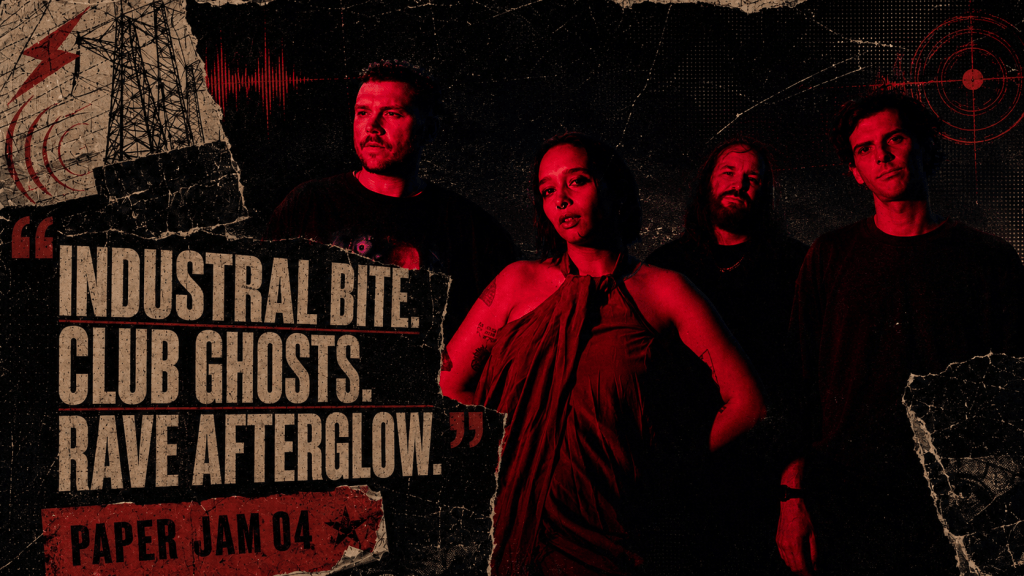
The cover belongs to Mandy, Indiana. Their image becomes the issue’s central visual ghost: red-lit, direct, nocturnal, half band portrait and half threat assessment. They are not merely cover stars, but the issue’s pressure system. They return throughout the edition as a blade, a syntax failure, a body under stage light, a transmission interrupting itself. Around them, PaperJam builds a world of pylon routes, signal diagrams, club flyers, cassette shells, rave scars, handwritten control-room notes and strange bureaucratic fragments. The result is a zine that treats a DJ set not as a playlist, but as an event with weather, architecture and consequences.
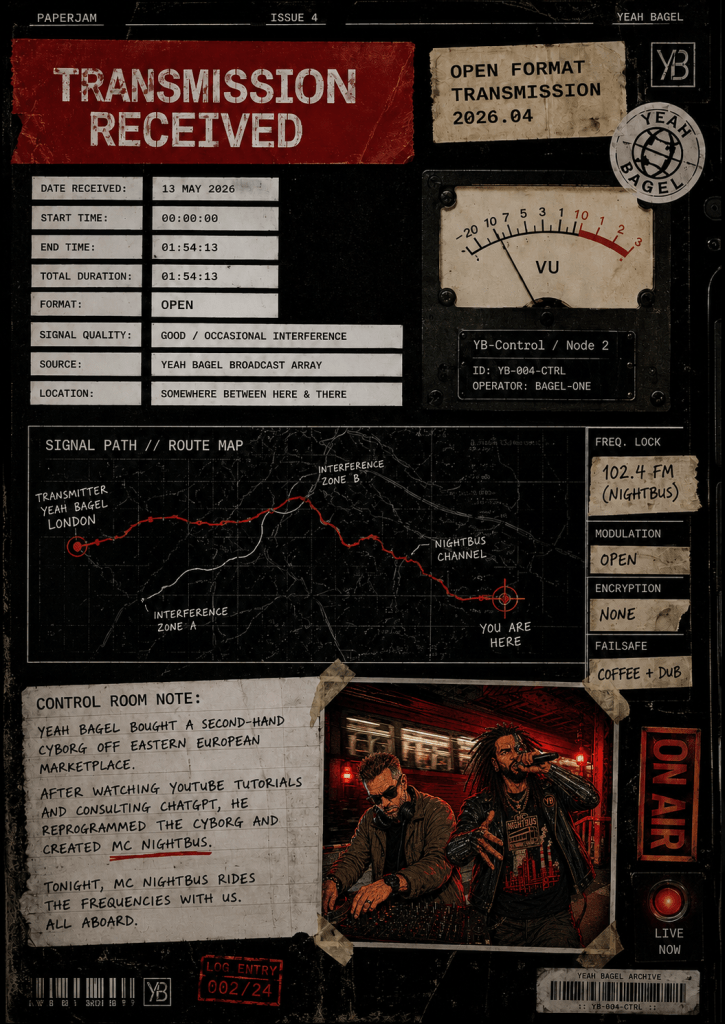
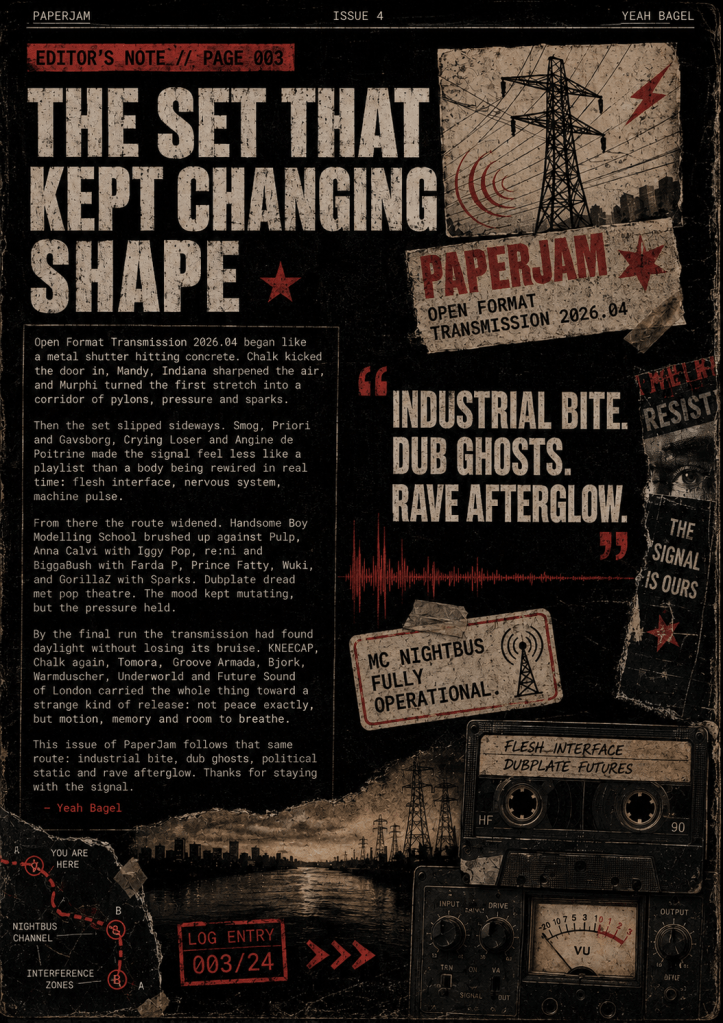
The issue opens with its fictional machinery. Pages 2 and 3 establish the broadcast’s receiving apparatus: Yeah Bagel’s control room, MC Nightbus, the transmission map, and the editorial note. The in-world mythology deepens with the wonderfully absurd detail that Yeah Bagel bought a second-hand cyborg, learned enough from YouTube tutorials and ChatGPT to reprogram it, and created MC Nightbus. It is a joke, but also a statement of method. PaperJam 04 is handmade futurism: grimy, improvised, technologically haunted, but still human at the controls.
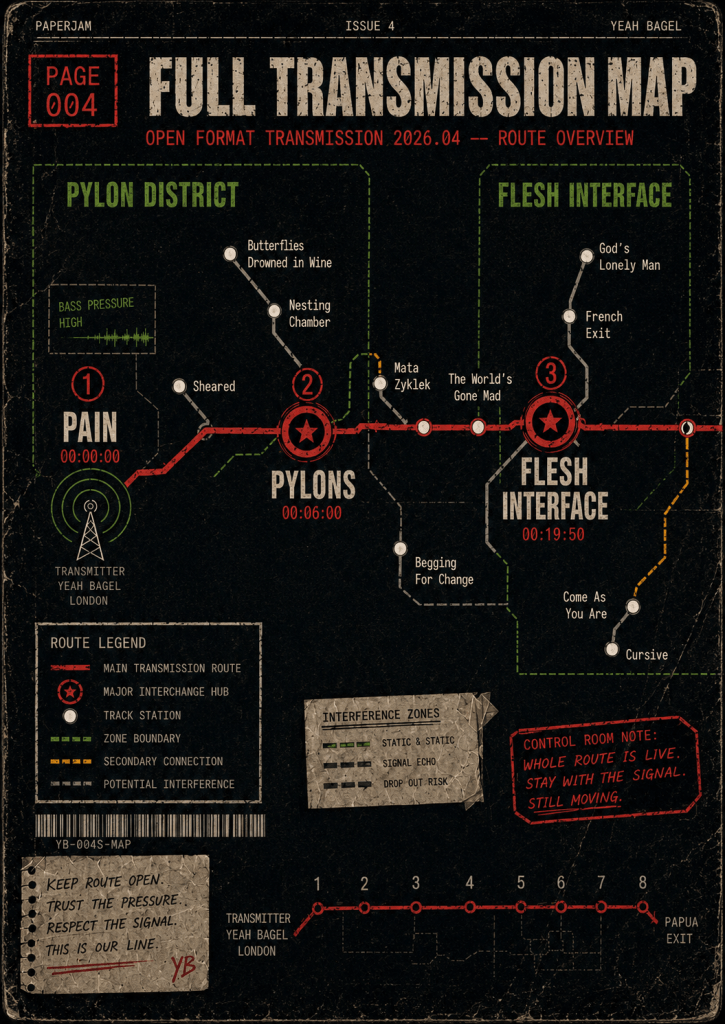
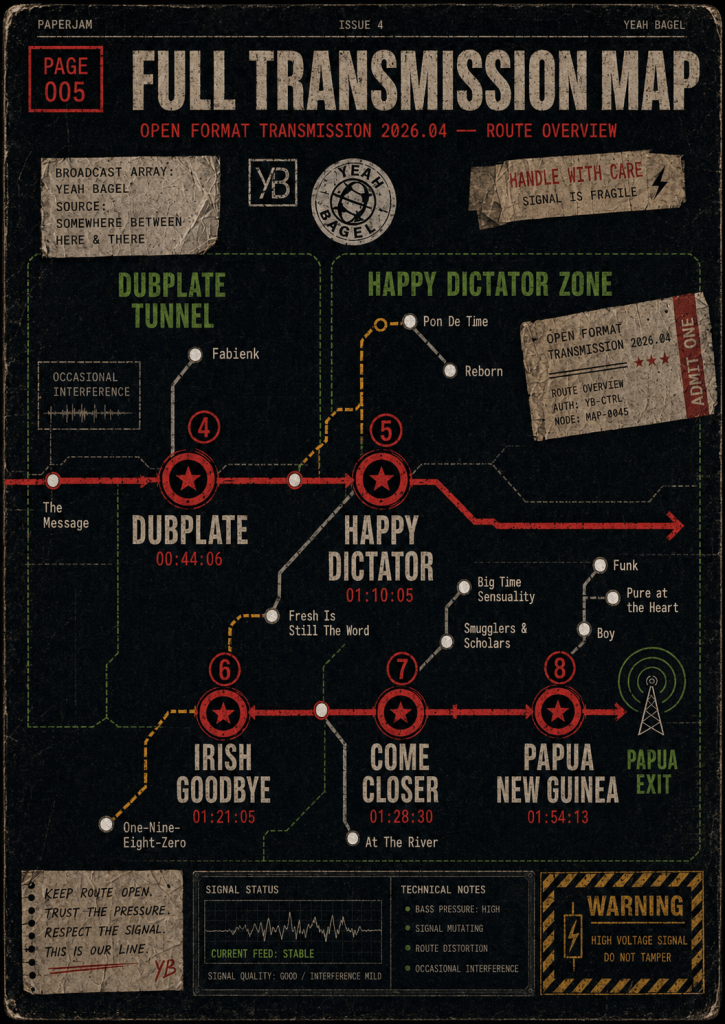
Pages 4 and 5 map the whole set as a transit system. Tracks become stations. “Pain,” “Pylons,” “Flesh Interface,” “Dubplate,” “Happy Dictator,” “Irish Goodbye,” “Come Closer,” and “Papua New Guinea” are treated as hubs along a red route, with interference zones, technical notes and warning panels. This map is the issue’s skeleton. It says the broadcast is not linear so much as infrastructural: a network of pressure points, diversions and exits.
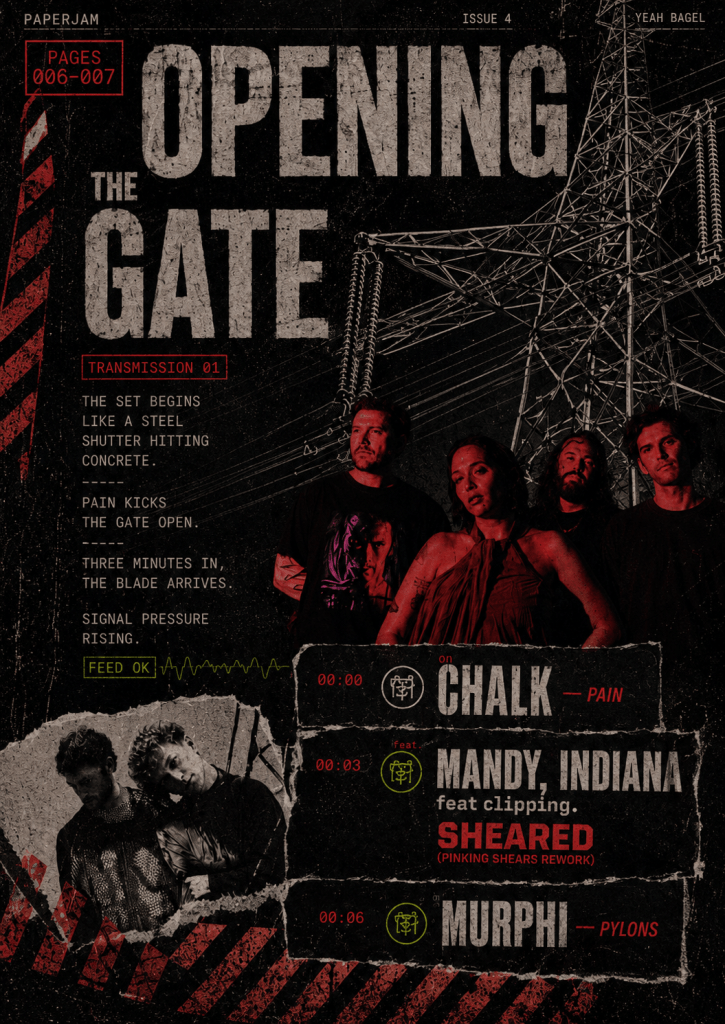
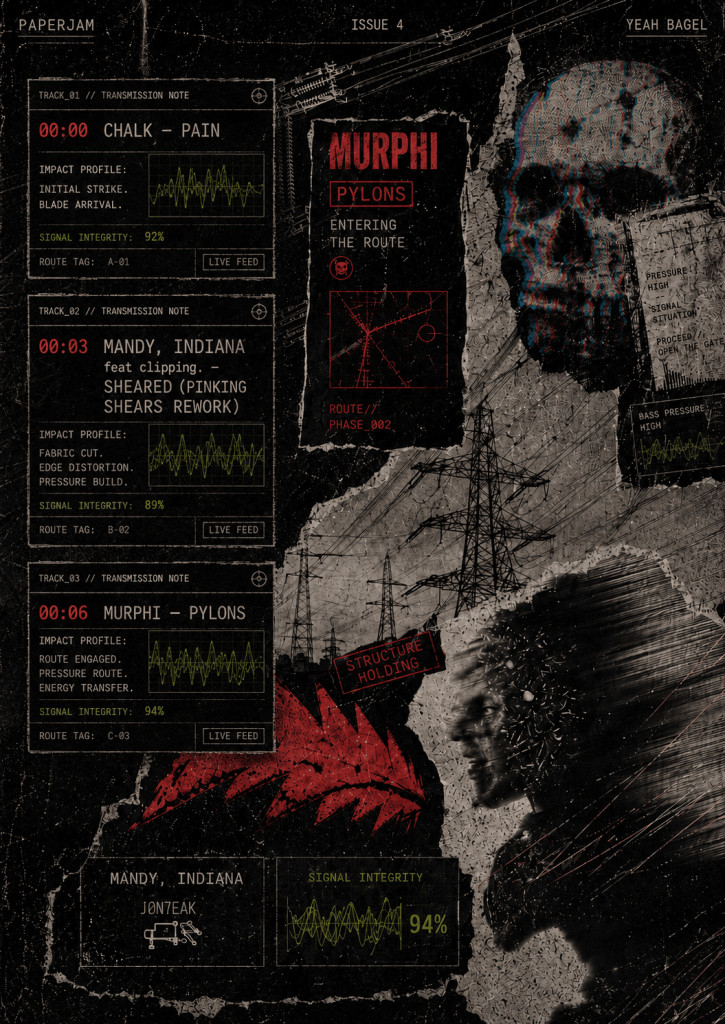
Pages 6 and 7 slam open the metal gate with Chalk, Mandy, Indiana and Murphi. “Pain,” “Sheared,” and “Pylons” are rendered as monochrome industrial collage: pylons, cables, skulls, torn gig posters, warning stripes and damaged typography. The first minutes of the set are brutal and engineered, all steel shutter, high voltage and blade-edge rhythm. Mandy, Indiana and clipping. arrive three minutes in as the cut that changes the air. Murphi’s “Pylons” locks the route into electrical infrastructure.
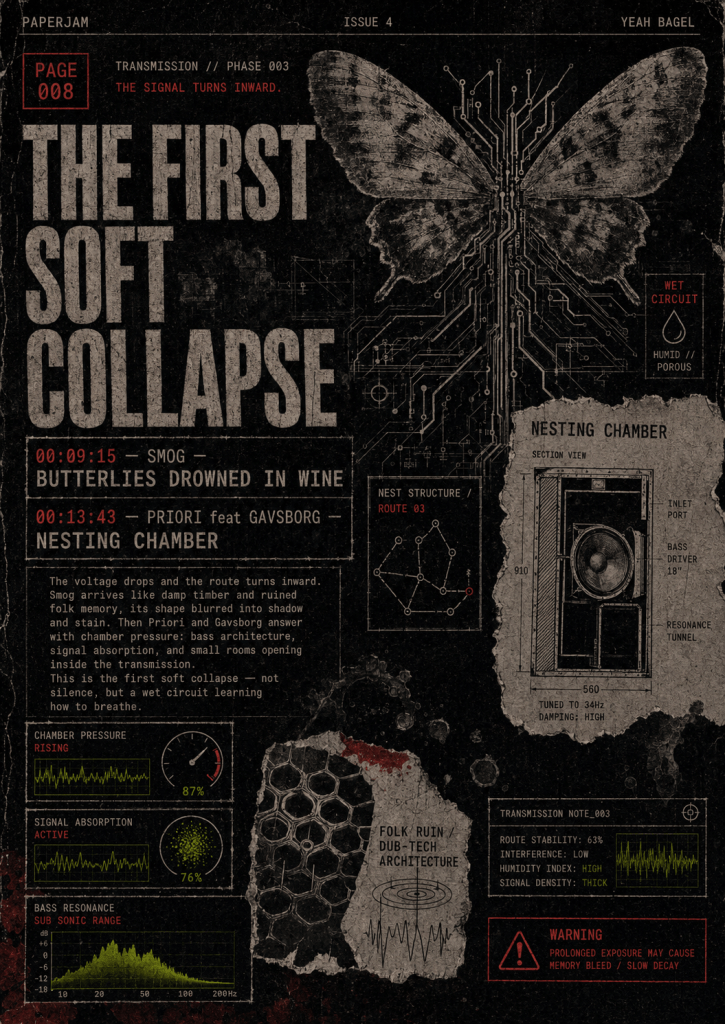
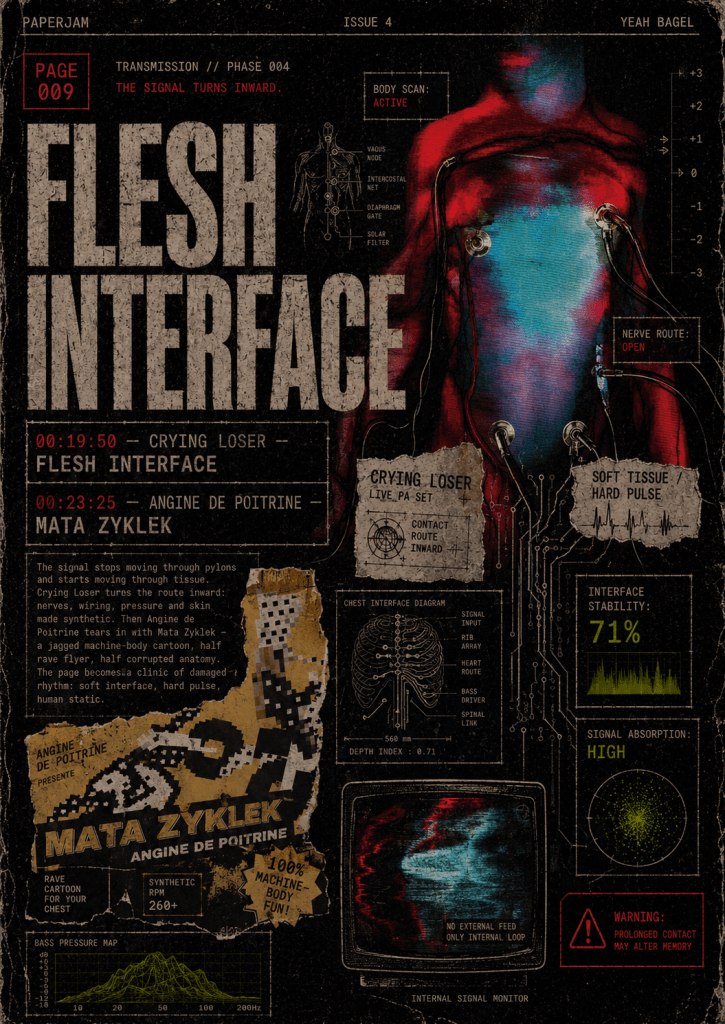
Page 8 provides the first collapse inward. Smog’s “Butterflies Drowned in Wine” and Priori feat Gavsborg’s “Nesting Chamber” turn the issue damp, strange and interior. The page is less assaultive and more porous: a dub-tech chamber where folk ruin and electronic architecture bleed into each other. From there, Page 9 pushes into “Flesh Interface,” a body-machine zone for Crying Loser and Angine de Poitrine. The issue’s nervous system starts to show.
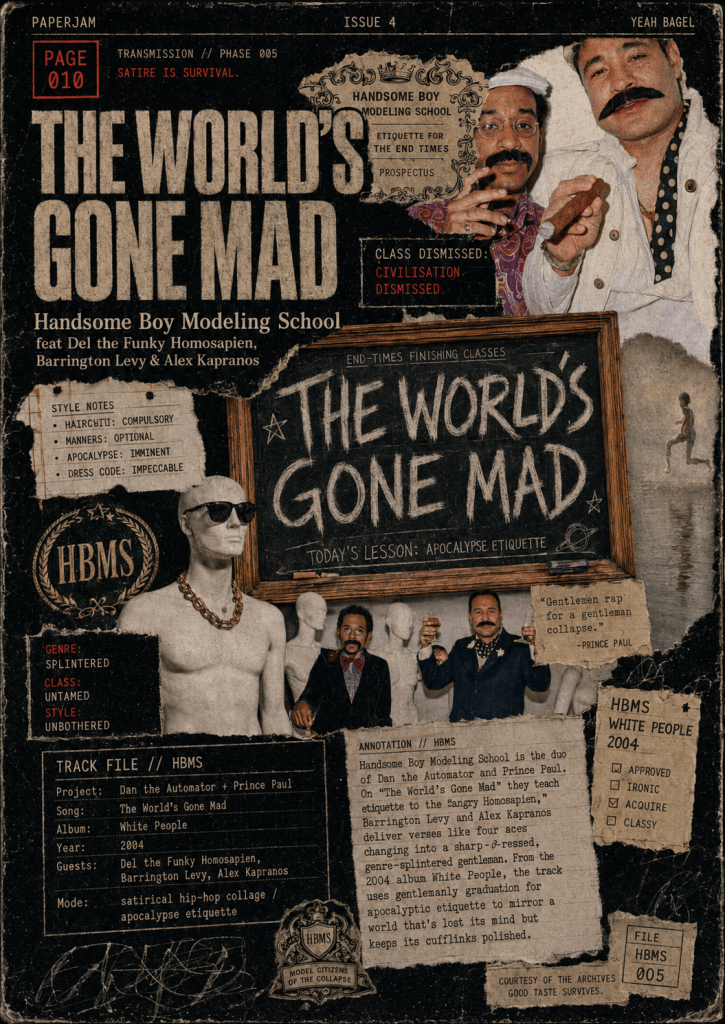
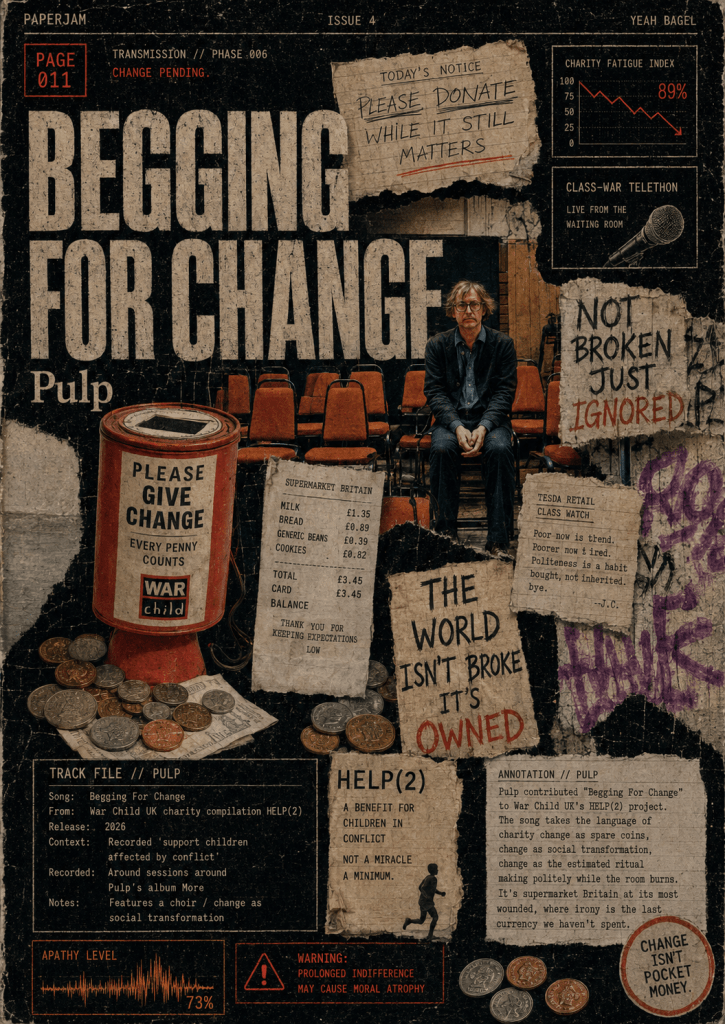
Pages 10 and 11 form the mid-issue satire spread. Handsome Boy Modeling School’s “The World’s Gone Mad” sits beside Pulp’s “Begging For Change,” creating a collision between absurd image-management, charity fatigue, class resentment and genuine moral ache. The spread understands that politics in music can be sharp without becoming a pamphlet with a headache. It stages collapse as a finishing-school prospectus, a benefit appeal, a broken globe and a collection tin wired into a boombox.
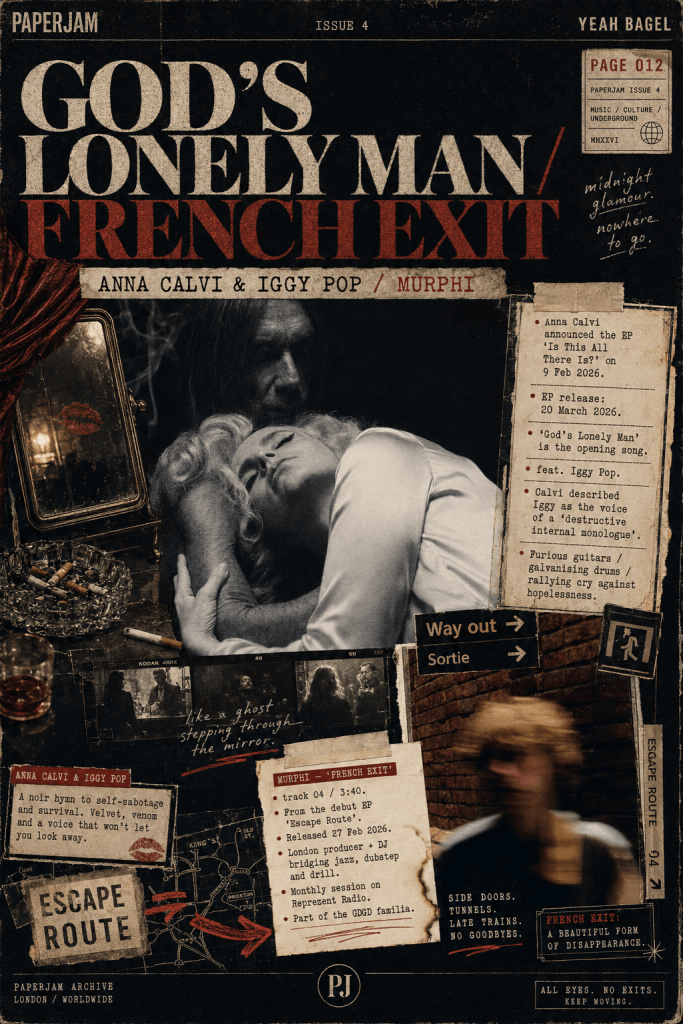
Page 12 shifts into noir glamour with Anna Calvi, Iggy Pop and Murphi. “God’s Lonely Man” is all bar mirrors, cigarette-burn cinema, red velvet and haunted guest energy, while “French Exit” opens a cooler route out through corridors and exit signs. It is one of the issue’s tonal hinges: theatrical, lonely, stylish, and slightly doomed.
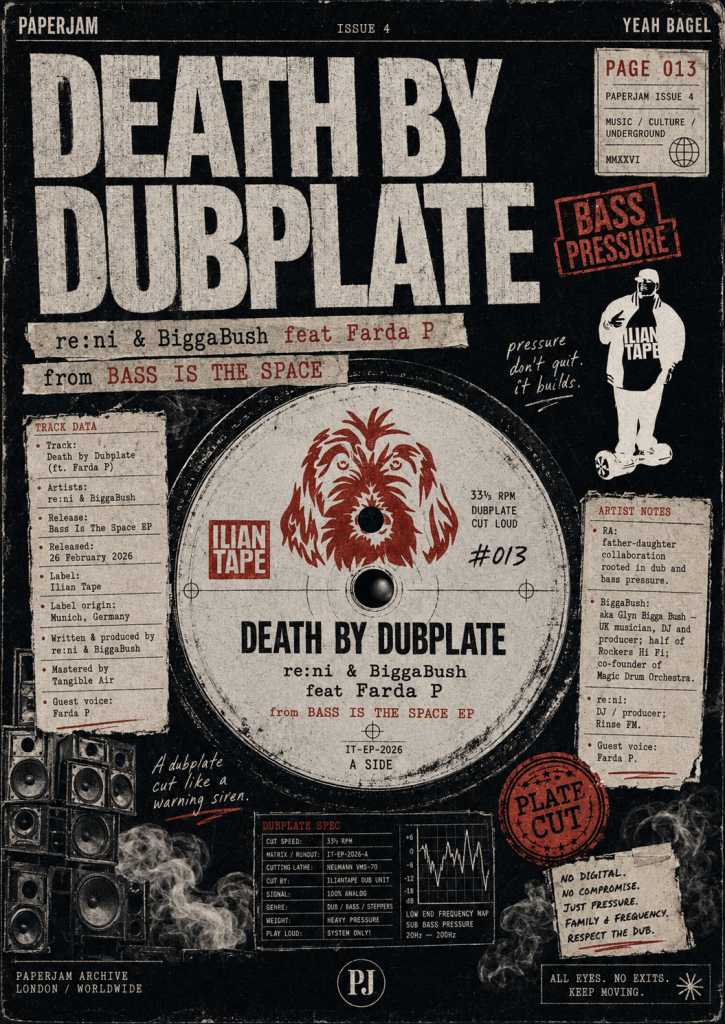
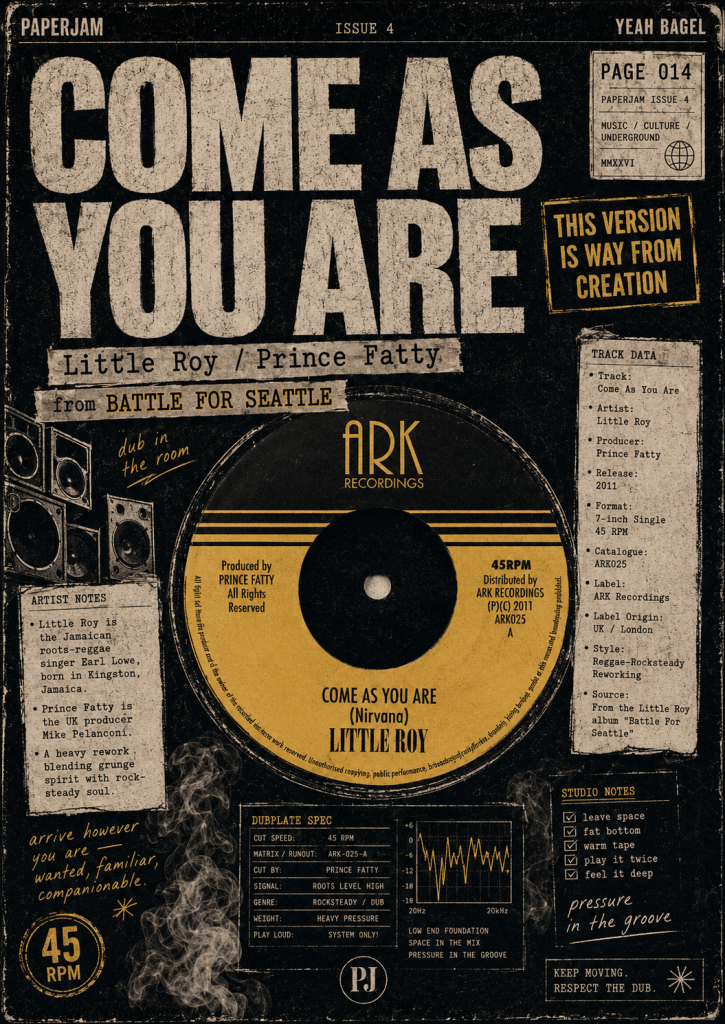
Pages 13 and 14 form the dub chamber. re:ni & BiggaBush feat Farda P’s “Death by Dubplate” gets militant sound-system treatment: Ilian Tape visual references, heavy bass typography, acetate labels and speaker pressure. Prince Fatty and Little Roy’s “Come As You Are” softens the room into dubwise transformation, a version “way from creation,” familiar but re-rooted. Together, the pages turn the middle of the set into smoke, bass, studio handwriting and pressure waves.
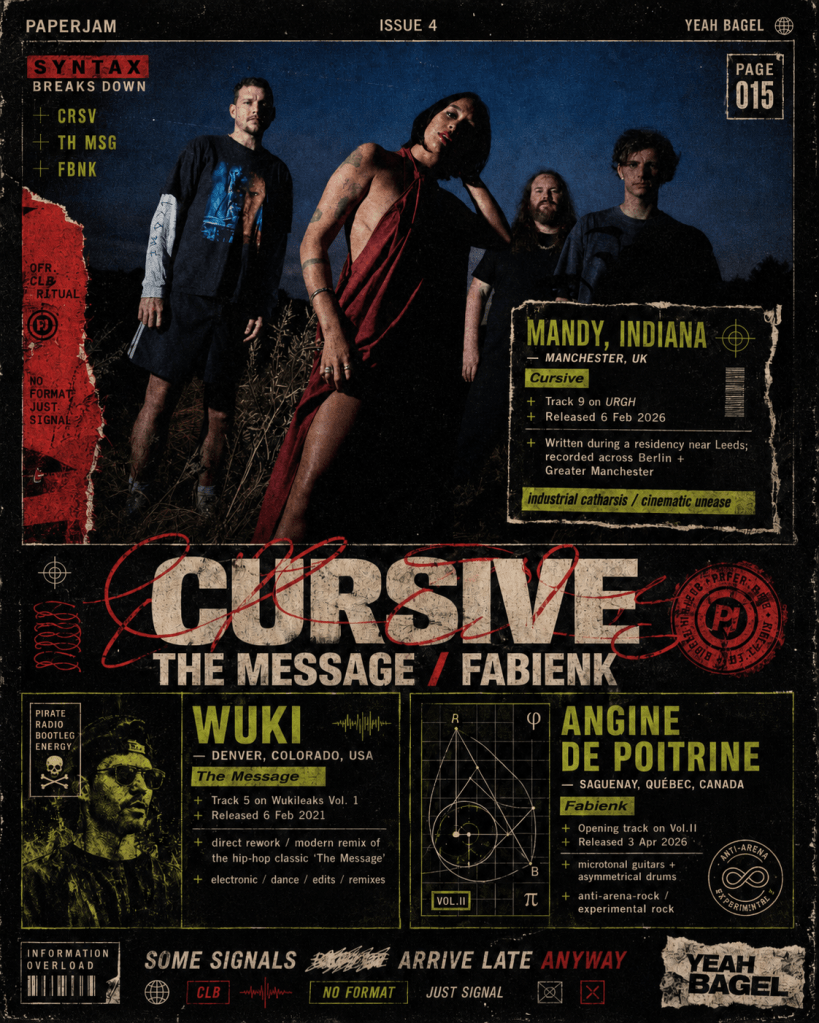
Page 15 is where syntax breaks down. Mandy, Indiana’s “Cursive” dominates, with Wuki’s “The Message” and Angine de Poitrine’s “Fabienk” as lower-third features. It is a page of loops, missing vowels, decoding marks and club-tool notes. Wuki’s track is framed not as a vague nod but as a direct modern rework of the hip-hop classic “The Message,” while Angine de Poitrine’s microtonal, asymmetrical world adds coded experimental tension. The page feels like language trying to keep dancing after the grammar has gone.
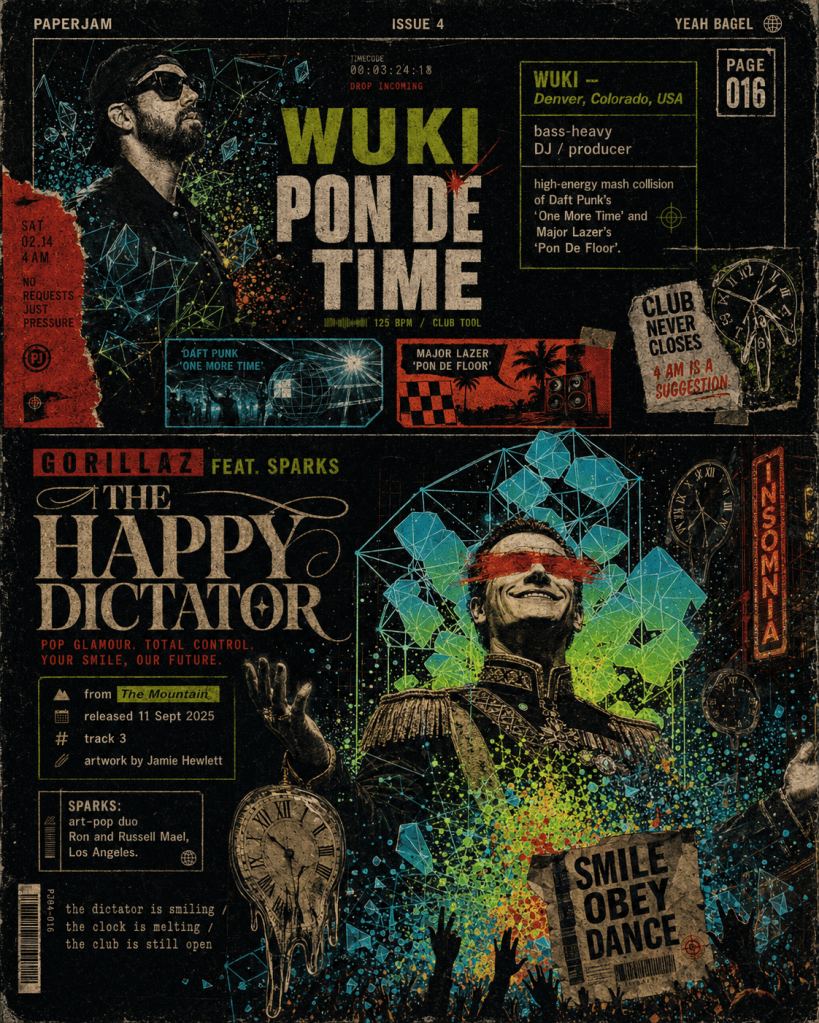
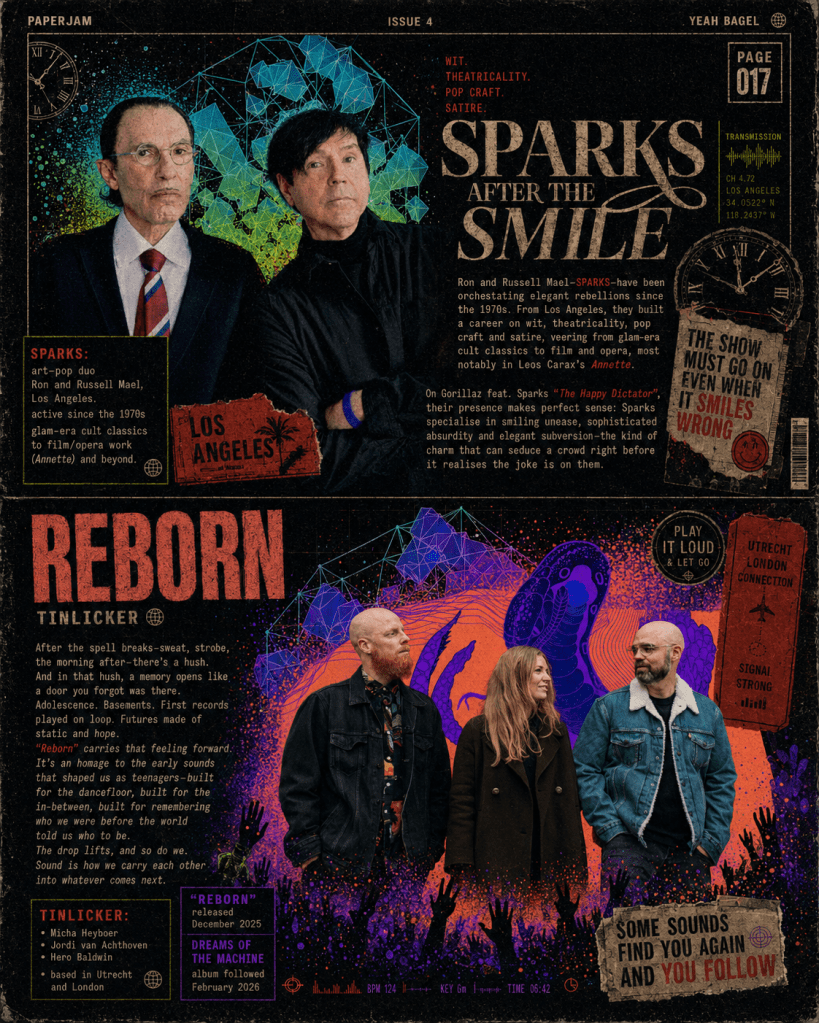
Pages 16 and 17 turn dystopian-pop. Wuki’s “Pon De Time,” a high-energy mash of Daft Punk’s “One More Time” and Major Lazer’s “Pon De Floor,” occupies the top of Page 16, before Gorillaz feat Sparks’ “The Happy Dictator” takes over with bright authoritarian absurdity. Page 17 extends the theme into a researched Sparks essay and Tinlicker’s “Reborn,” where the mood becomes crystalline, euphoric and reflective. The dictator smiles, the system fractures, and the club remains open.
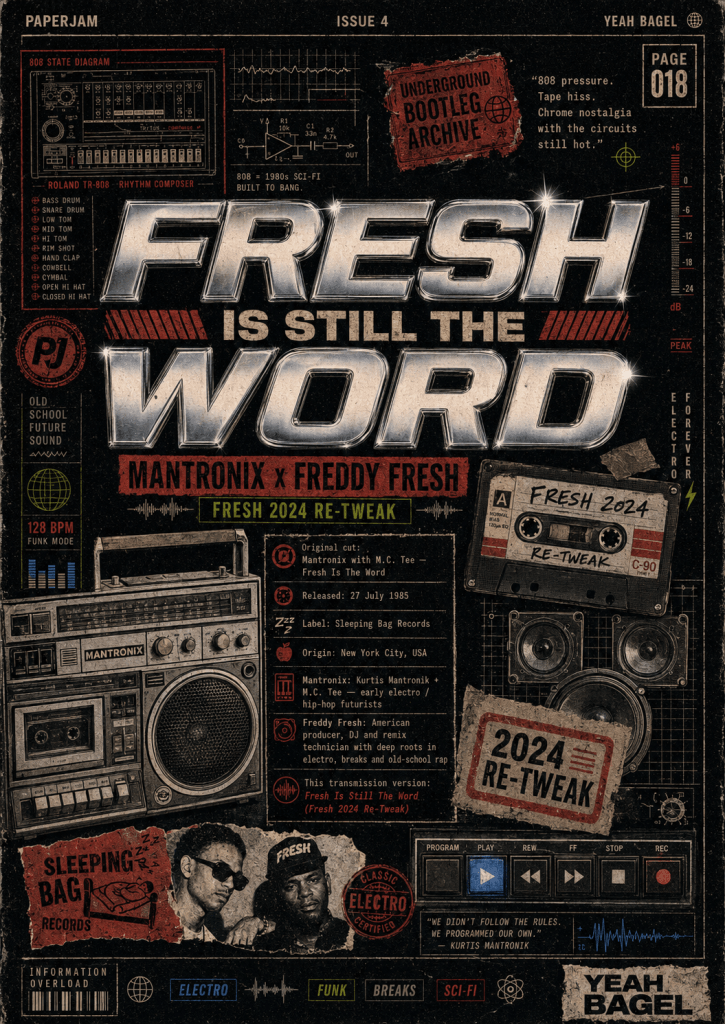
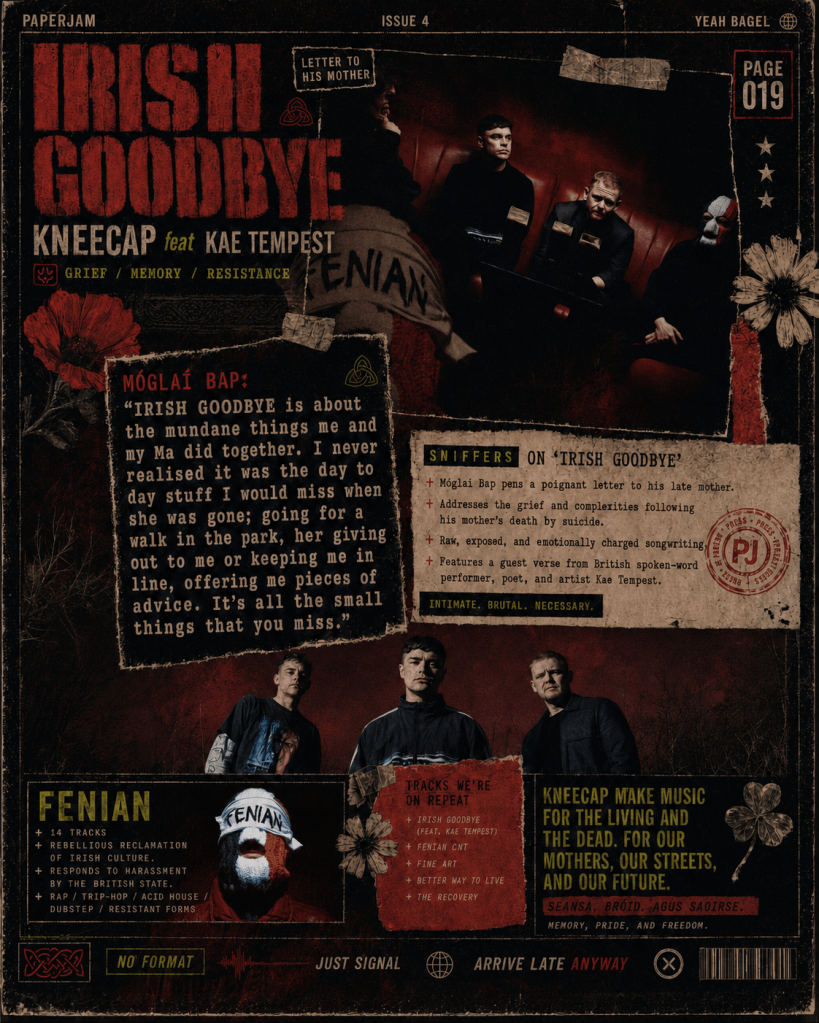
Page 18 drops into old-school electro with Mantronix x Freddy Fresh’s “Fresh Is Still The Word,” all chrome lettering, boombox grid, 808 schematic and stamped “2024 RE-TWEAK” bootleg detail. Page 19 is the emotional core: KNEECAP feat Kae Tempest’s “Irish Goodbye,” balancing grief, memory and resistance. Móglaí Bap’s letter to his late mother sits beside the wider cultural defiance of FENIAN. It is tender, furious and resolute.
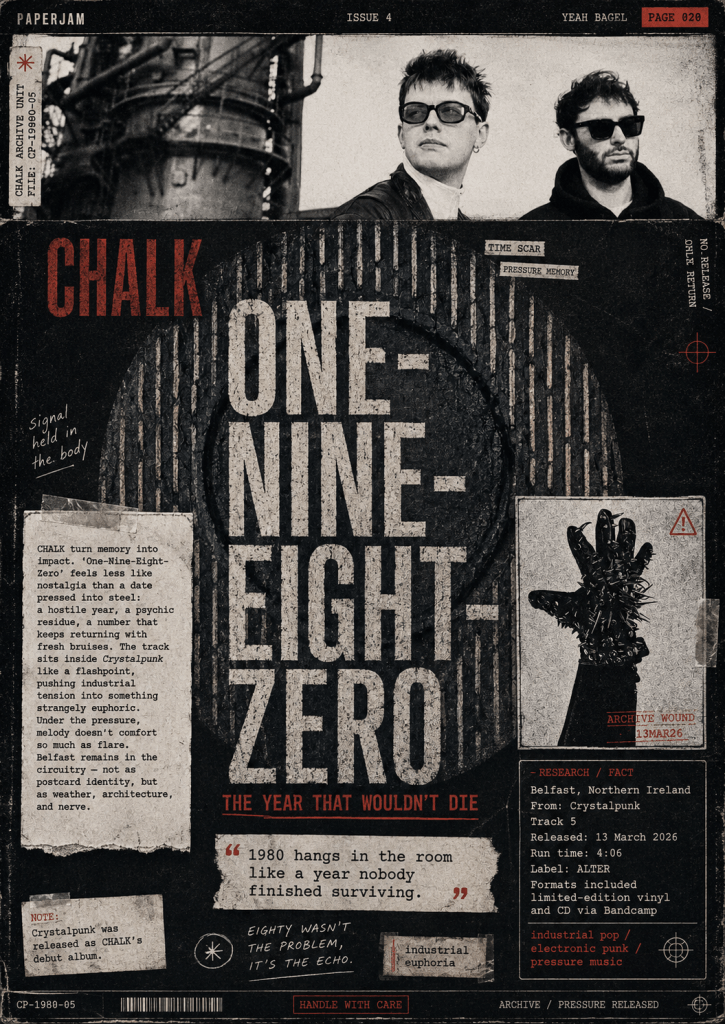
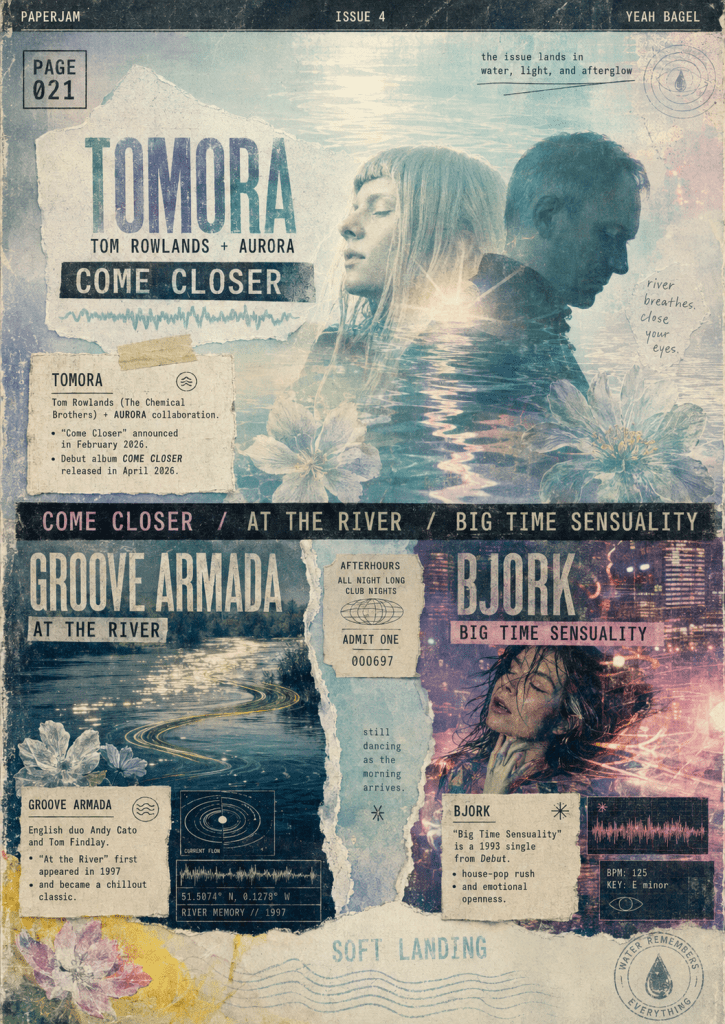
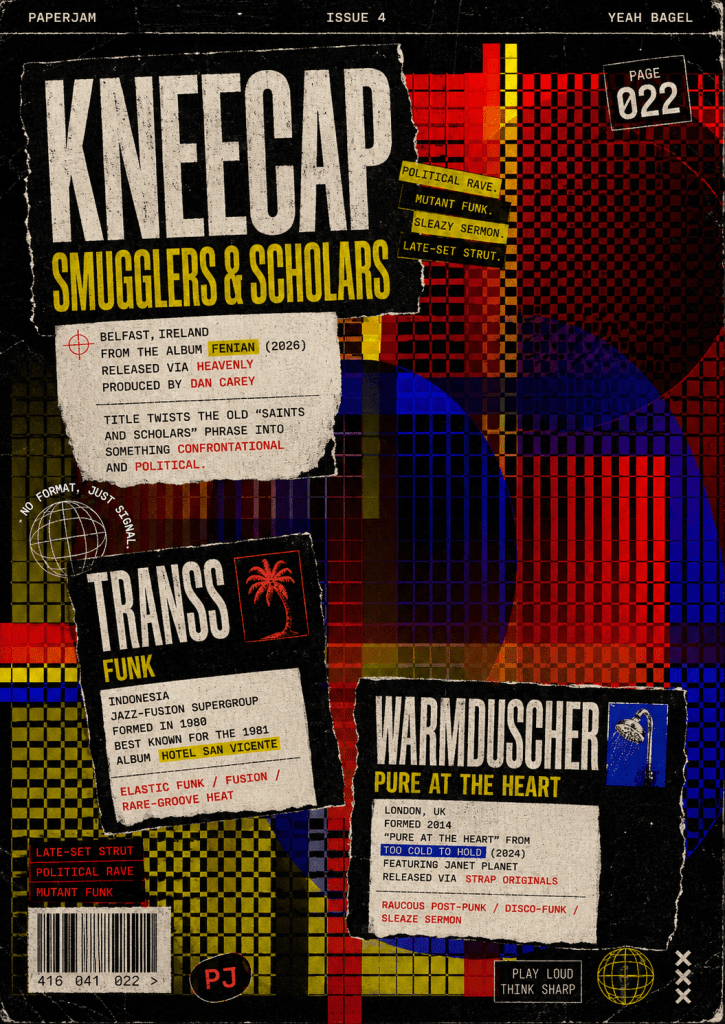
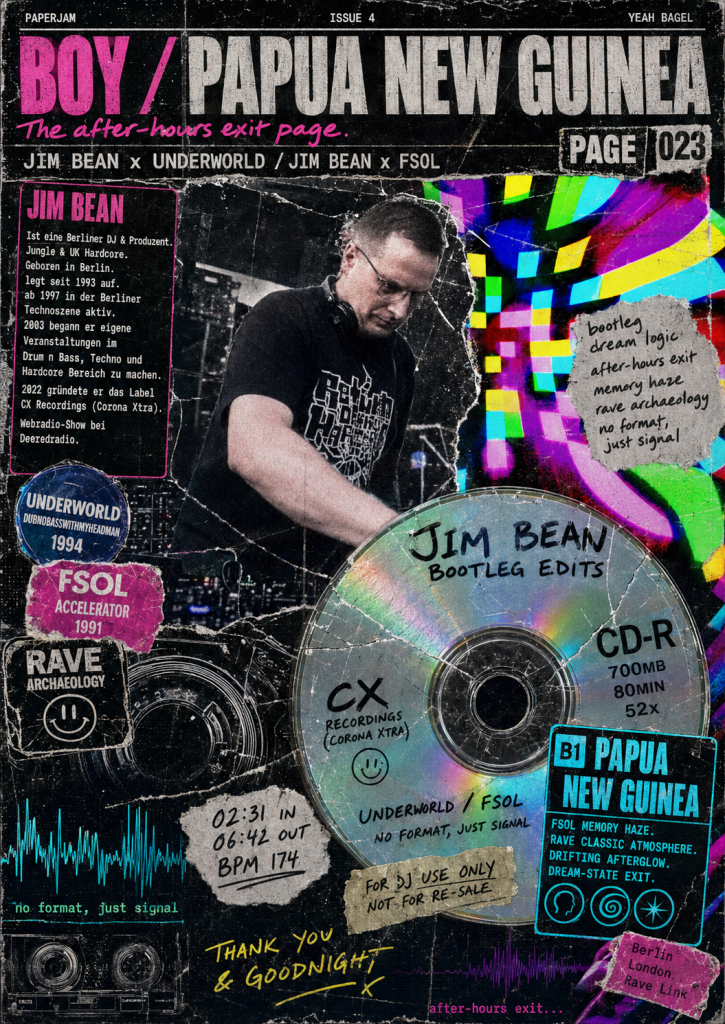
Page 20 returns to Chalk with “One-Nine-Eight-Zero,” making time itself the hostile object. The year becomes a wound, an archive stamp, an inherited civic bruise. Page 21 offers the strange soft landing: Tomora, Groove Armada and Björk, rendered in river light, 90s club afterglow, photocopied flowers and acid softness. Page 22 struts late-set through KNEECAP, Transs and Warmduscher: political rave, mutant funk, sleazy sermon. Page 23 exits through Jim Bean’s bootleg CD-R dream logic, Underworld pulse and FSOL memory haze.
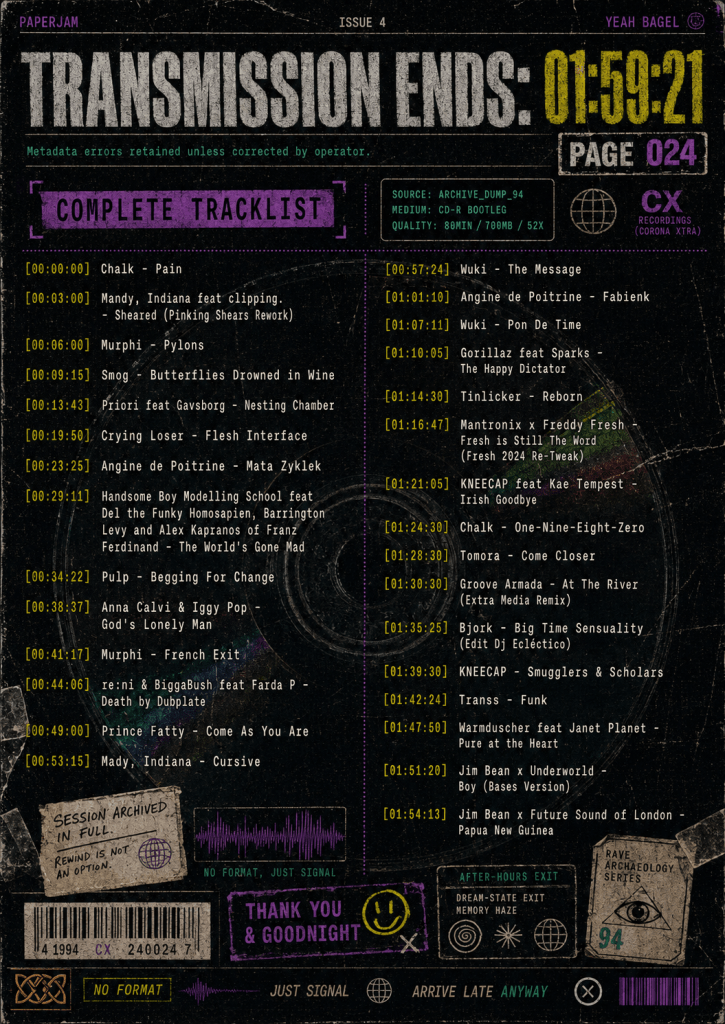
The back cover closes the archive with the full tracklist and the note: “Metadata errors retained unless corrected by operator.” That line is perfect PaperJam: funny, flawed, human, and somehow profound. Issue 04 is not tidy. It is a transmission scar. Industrial bite. Club ghosts. Rave afterglow.

ABOUT THE EDITORS
PaperJam is assembled, argued over, glued down and occasionally rescued from printer failure by husband-and-wife editorial unit Eli “Static” Mercer and Nia “Nix” Adeyemi-Mercer.
Eli is originally from Seattle: a rain-soaked zine obsessive, tape-archive scavenger and layout gremlin raised on basement shows, college radio, busted photocopiers and the noble art of making pages look like they were intercepted mid-transmission.
Nia is from East London: editor, headline assassin, pirate-radio disciple and cultural scalpel. Her background runs through market-stall bootlegs, grime clashes, protest flyers, night buses and sentences sharp enough to cut through laminated nostalgia.
Together, they make PaperJam as the printed shadow of Yeah Bagel’s Open Format Transmission: part fanzine, part archive leak, part evidence folder, part love letter to music that refuses to behave.
Their working method is simple: Eli finds the static. Nia makes it speak. Then they staple the whole thing together before the signal disappears.
