
Mandy, Indiana make music that sounds like a panic room learning to sweat.
Not panic as decoration. Not panic as some tasteful post-punk garnish sprinkled over another polite bassline for people with expensive haircuts and a working knowledge of Berlin. Their panic is structural. It lives in the walls. It comes through the ventilation system. It rattles the fixtures. It makes the lighting rig look guilty.
This is not a band asking to be liked.
This is a band asking why the door was locked in the first place.

Formed out of Manchester’s DIY murk, first under the name Gary, Indiana, then reborn as the much stranger and better Mandy, Indiana, they have always had the feel of something overheard rather than performed. A coded transmission from the room next door. A club track collapsing inside an industrial accident. A body trying to remember whether movement means dancing, escape, or both.
At the centre is Valentine Caulfield, whose French-language vocals do not sit on top of the music so much as haunt the machinery. She does not perform frontperson charisma in the usual rock-band way. There is no grandstanding, no sermon from the monitor wedge, no “how are we feeling tonight?” pantomime. Her voice is colder, sharper, more dangerous than that. It arrives like instruction, accusation, ritual, alarm. Sometimes it sounds like a witness statement being fed through broken public-address speakers. Sometimes it sounds like someone calmly explaining the end of the world while the bass bins begin to melt.

Around her, Scott Fair, Simon Catling, and Alex Macdougall build a racket that understands rhythm as threat. Guitars scrape and flare. Synths corrode. Drums do not keep time so much as interrogate it. The result is music that belongs to the dancefloor, but only if we admit the dancefloor is not always a place of freedom. Sometimes it is surveillance with better sub-bass. Sometimes it is a crowd moving beautifully under awful conditions. Sometimes it is the last warm room before the sirens.
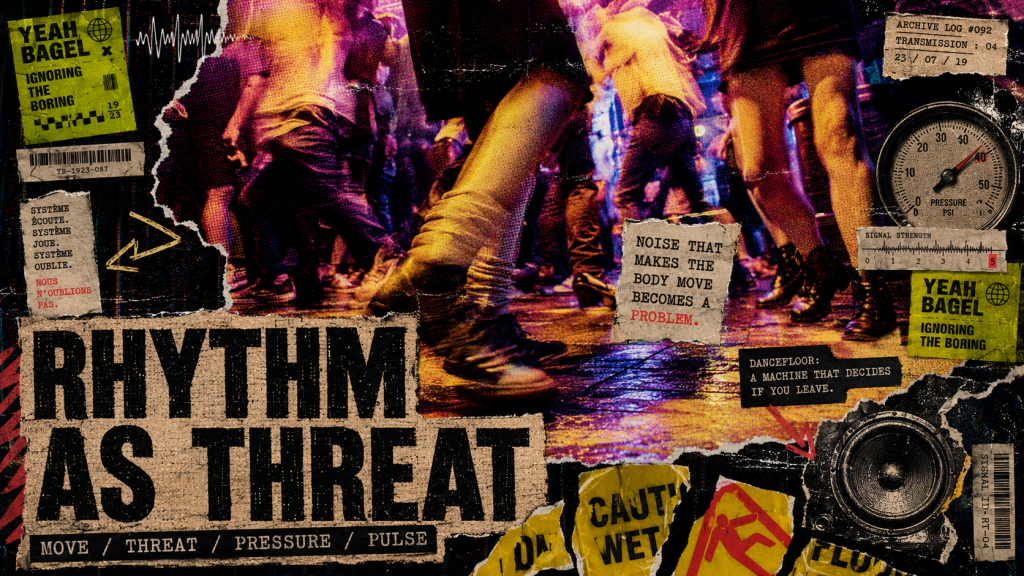
That is what made Mandy, Indiana feel immediately different from the post-punk recycling plant. They were never interested in the tidy heritage version: angular guitars, deadpan vocals, a bassline with cheekbones, another press release about urban alienation. That road is congested. Too many bands are parked there with the hazard lights on.
Mandy, Indiana came from somewhere nastier and more useful.
Their early EP, the bluntly titled “…”, already had the architecture in place: industrial pressure, club muscle, French vocals, dread with a pulse. “Bottle Episode” and “Alien 3” did not feel like songs trying to seduce a playlist editor. They felt like evidence. The sound was abrasive but not shapeless, brutal but not stupid. There was groove in it, which made the threat worse. Noise that refuses the body can become art-school wallpaper. Noise that makes the body move becomes a problem.

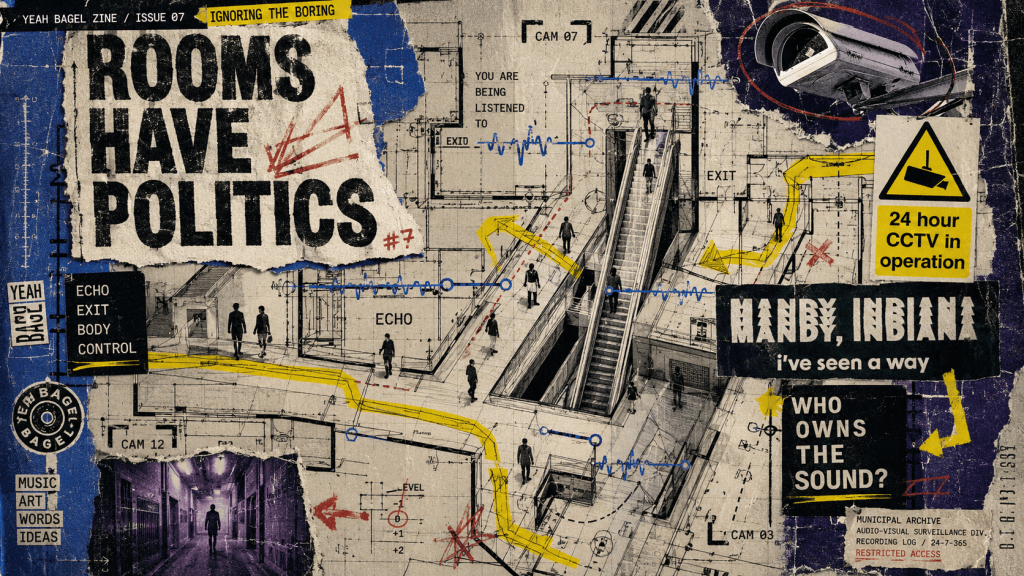
Then came i’ve seen a way, their 2023 debut album, and the scale widened. Recorded partly in caves, crypts, shopping centres, and other spaces with their own ghosts and bad acoustics, the album sounded less like a studio object than a location report from a civilisation with damp in the foundations. The band understood that rooms have politics. A cave does not echo like a rehearsal space. A shopping centre does not carry a scream the same way a basement does. These places left fingerprints all over the record.
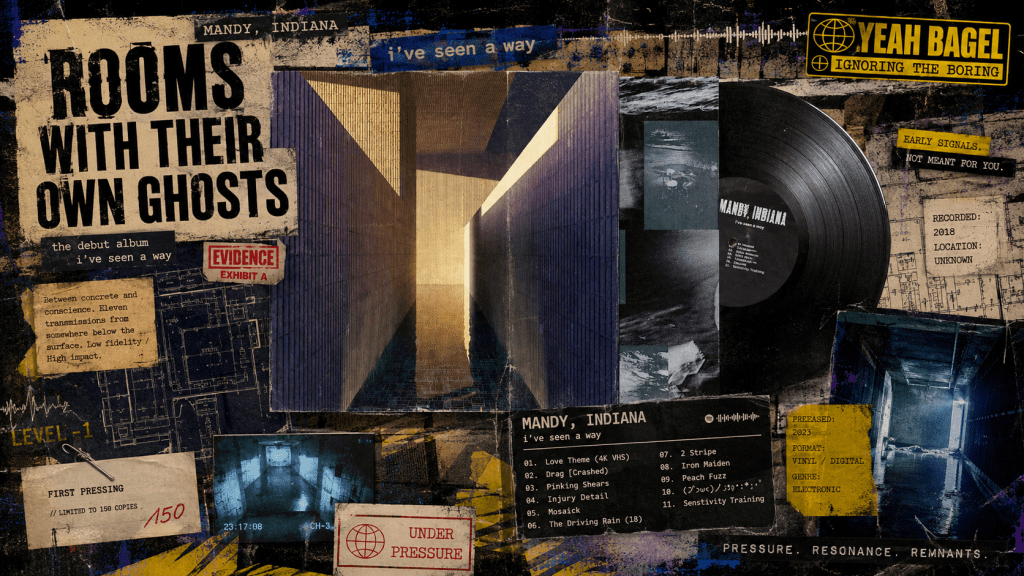
That mattered because Mandy, Indiana are not just writing about pressure; they record with pressure. Their music is full of hard surfaces, false exits, sudden drops, ugly reflections. “Injury Detail” moves like a command sequence. “Pinking Shears” cuts and jitters. “Peach Fuzz” lets something almost beautiful curdle in the light. Across the album, Caulfield’s voice becomes less a narrator than a human signal trying to survive the circuitry.
And then, in 2026, URGH arrived.
Even the title feels like the correct response to the era. Not a slogan. Not a thesis. Just the sound the body makes when language has been mugged in an alley by the news cycle.
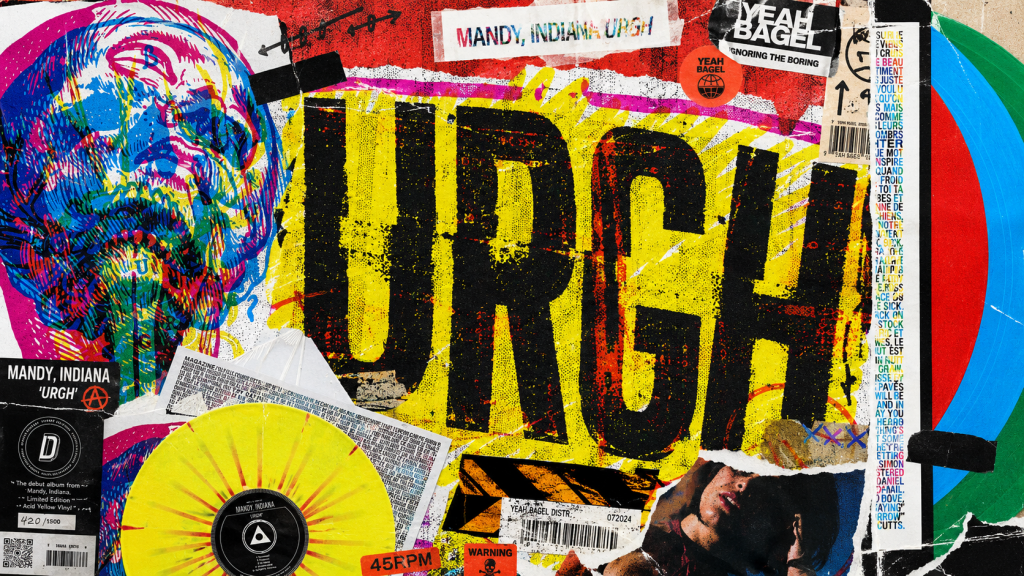
URGH is bigger, harsher, more direct, but not in the boring “heavier guitars, bigger drums” sense. It is emotionally heavier. It feels like the band have stopped circling the wound and started naming the room where it happened. The record still has the Mandy, Indiana signatures: industrial pulse, mangled electronics, club propulsion, Caulfield’s voice cutting through in French, the sense that everything is happening in a concrete corridor at 3.17am. But it is also more exposed. More personal. More furious. Less interested in giving the listener somewhere comfortable to stand.
“Magazine” is the kind of track that makes the air change shape. “Try Saying” and “Life Hex” take the band’s rhythmic violence and give it a sleeker, stranger momentum. “Sicko!”, with billy woods appearing like a witness from another damaged district, opens a side door between noise-rock and underground rap without turning either into novelty. And “I’ll Ask Her” lands with the blunt force of something that has refused to remain unsaid.
This is where Mandy, Indiana’s anger becomes important. A lot of contemporary music gestures at rage because rage is marketable now. Rage photographs well. Rage makes good vinyl variants. Rage can be turned into a tote bag before the blood is dry. Mandy, Indiana do not sound like they are performing outrage for the content furnace. They sound like they are trying to process what happens when the private injury and the public catastrophe start using the same staircase.
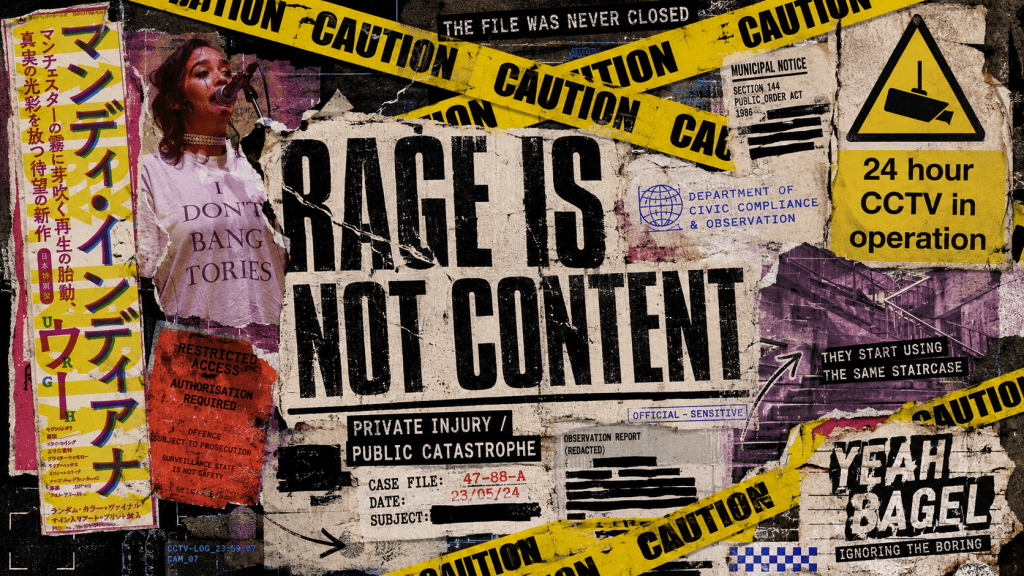
Their music understands that violence is not always cinematic. Sometimes it is administrative. Sometimes it is social. Sometimes it is the polite shrug after harm has been reported and filed somewhere nobody intends to look. Sometimes it is the architecture of a city. Sometimes it is the algorithm deciding that your despair has strong engagement potential.
That is why the club element matters. Mandy, Indiana do not reject pleasure. They contaminate it. They know dancing can be survival, but they do not romanticise it into escape. The beat does not rescue you. The beat gives you a way to stay upright while the room shakes. It is not liberation by default. It is rehearsal. It is alarm practice. It is the body refusing to become paperwork.
There is something deeply Yeah Bagel about that.
Because the best open-format music does not behave like a genre museum. It behaves like a border incident. It lets techno scrape against punk, industrial noise against chanson ghosts, no wave against warehouse sweat, political disgust against the ancient stupid thrill of drums. Mandy, Indiana belong in that kind of transmission because they do not ask whether the joins are neat. They ask whether the thing still moves when the lights fail.
And it does.
It lurches. It convulses. It stalks. It flashes its teeth in the strobe.
What makes the band compelling is not merely that they are loud or abrasive. Plenty of groups can kick over a metal bin and call it catharsis. Mandy, Indiana understand arrangement. They understand space. They know when to let a sound rot in the corner and when to drag it into the centre of the room. They know that repetition can be a trap, a spell, or a weapon depending on who is holding it. They know that a voice in another language can make anglophone listeners stop treating lyrics like furniture and start listening to tone, pressure, fracture, breath.
There is beauty here, but it is not offered politely. It appears in the cracks: a synth line gleaming through concrete dust, a rhythm locking into the hips before the brain has approved the paperwork, a vocal phrase that catches against the machinery and suddenly sounds unbearably human. Mandy, Indiana’s music is not anti-pop because it hates hooks. It is anti-obedience because it knows hooks can be dangerous too.
In a weaker band’s hands, all of this would become theatre of doom. Black clothes, red lights, big statements, small ideas. Mandy, Indiana avoid that by sounding genuinely unstable, not in the lazy chaos-for-chaos sense, but in the sense of matter changing state. Their songs feel like they could become a rave, a riot, a panic attack, or a prayer depending on the temperature of the room.
That uncertainty is the point.
Mandy, Indiana are making music for a world where the emergency is no longer an interruption. It is the background hum. The trick is not to pretend the hum is gone. The trick is to find the frequency inside it, turn it up, and make everyone in the room feel the walls answering back.
They do not offer comfort.
They offer motion.
And sometimes motion is the first honest thing a body can do.