

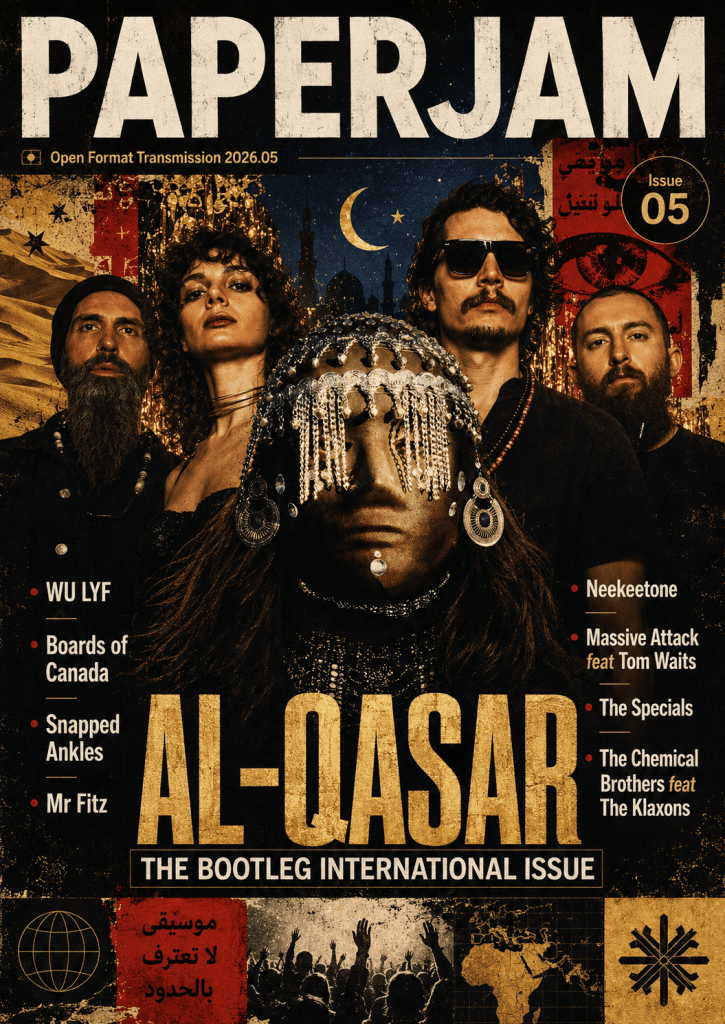
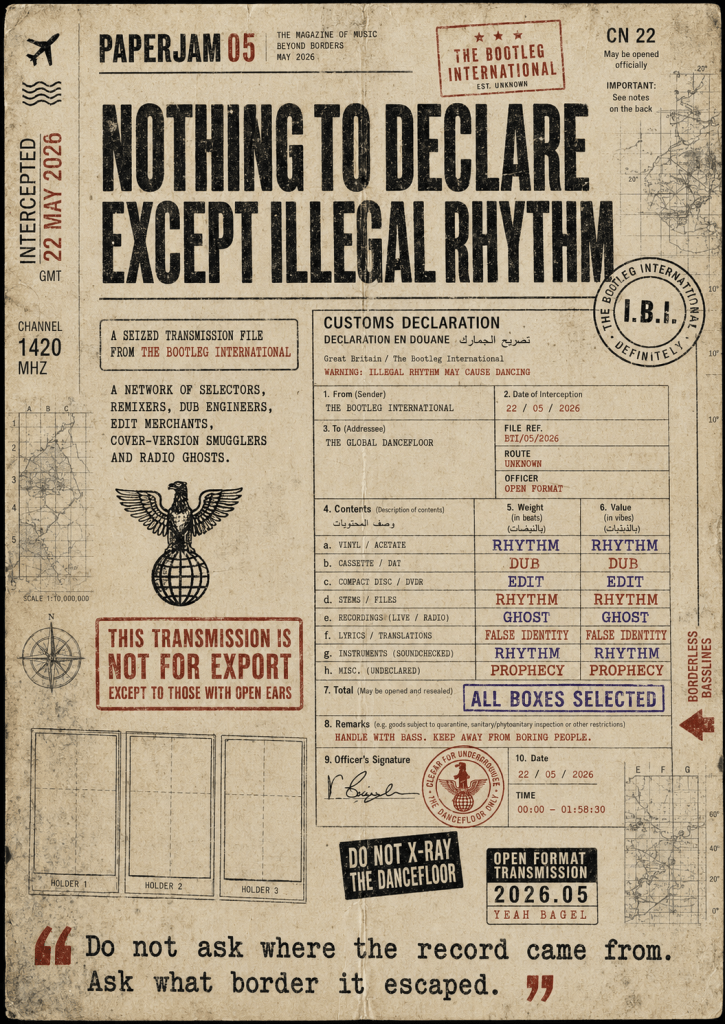
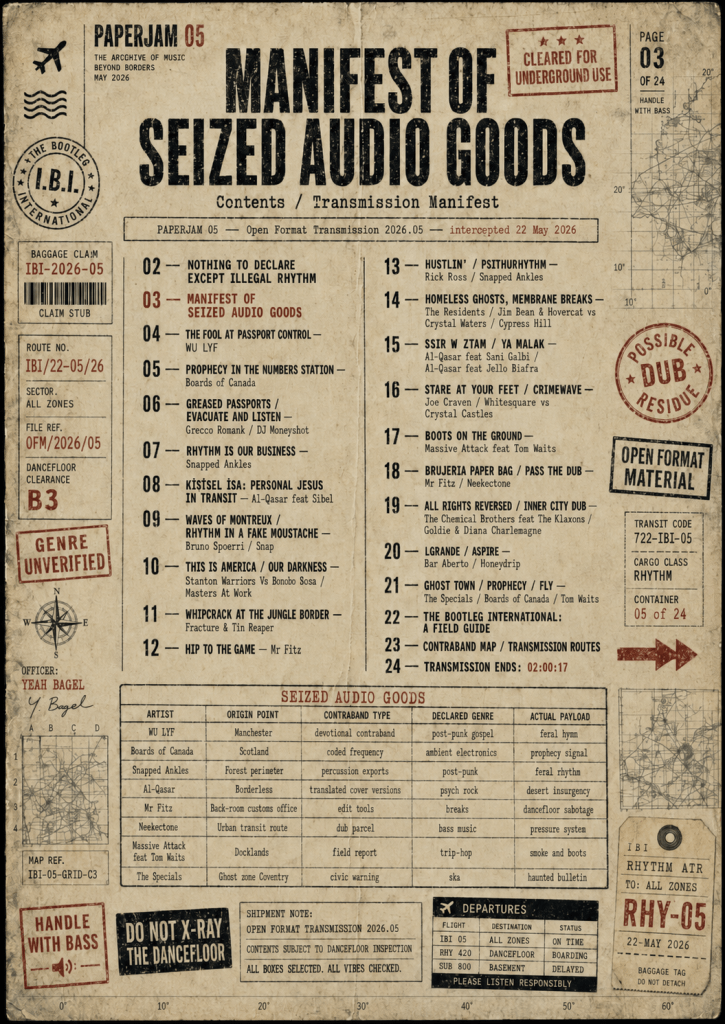
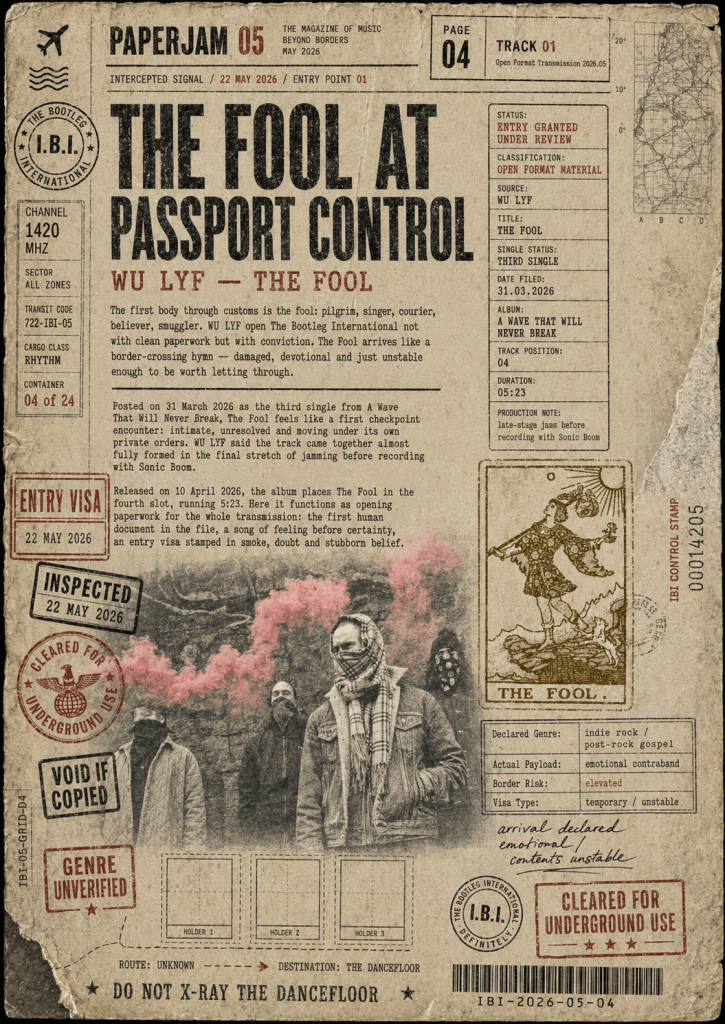
PaperJam 05 is the printed artefact of Yeah Bagel’s Open Format Transmission 2026.05, first broadcast on 22 May 2026. Its central concept is The Bootleg International: a semi-mythic network of selectors, remixers, dub engineers, edit merchants, translators, cover-version smugglers and radio ghosts. The issue treats Yeah Bagel’s two-hour transmission not simply as a playlist, but as a seized movement of sound across borders. Every track is given papers, inspected, stamped, misfiled, smuggled, translated, re-routed and released into circulation.
The issue opens with the customs logic already corrupted. The inside front cover, “Nothing to Declare Except Illegal Rhythm,” frames the whole transmission as a fake customs declaration in which every box has been stamped with rhythm, dub, edit, ghost, prophecy or false identity. From the outset, the zine argues that bootleg culture is not a minor footnote to music history. It is one of music’s great migration systems. Songs survive by changing clothes. Records travel better under assumed names. Genres are less like nations than bad border policies.
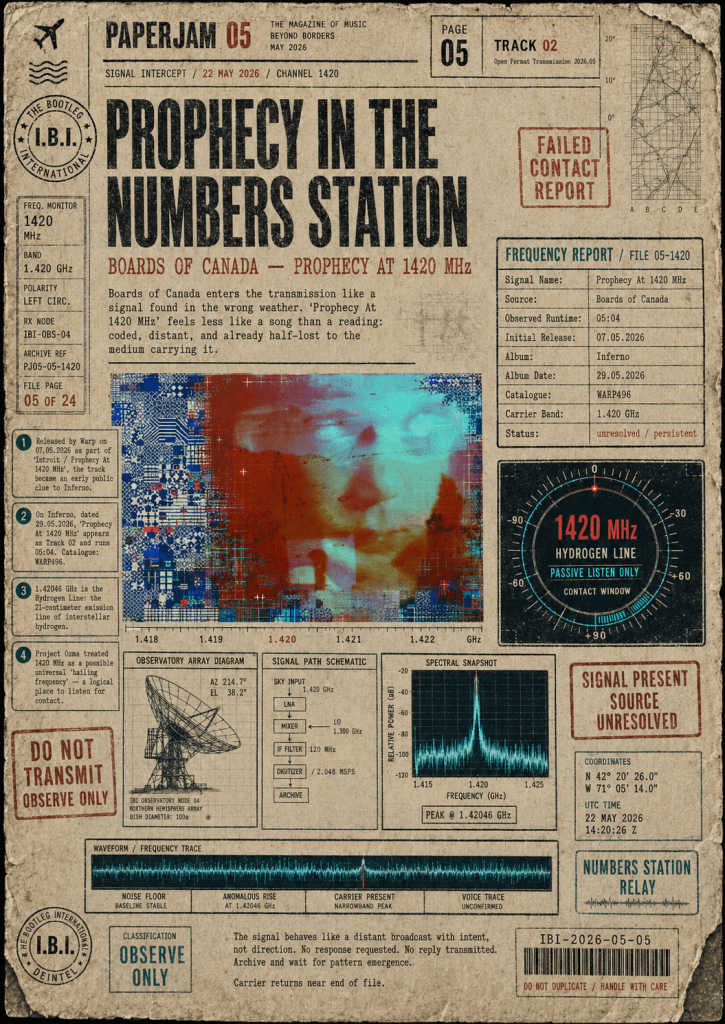
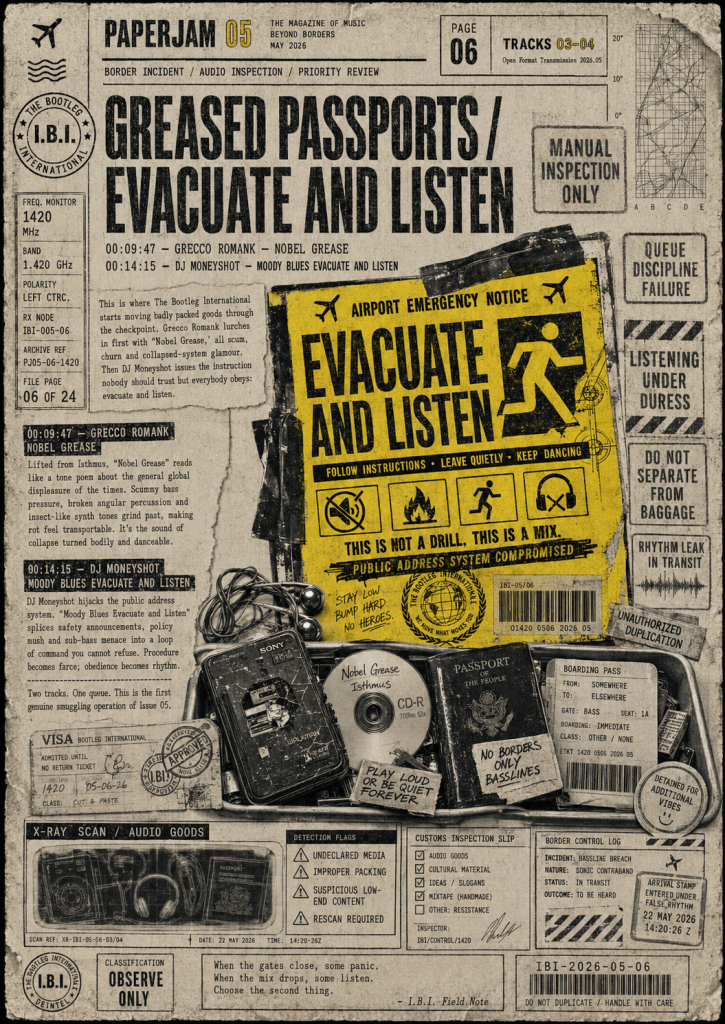
The early run of the issue begins at passport control. WU LYF’s “The Fool” becomes the ceremonial door-kick: a pilgrim figure, a singer with no clean paperwork, a band arriving as emotional contraband. Boards of Canada’s “Prophecy at 1420 MHz” follows as the frequency beneath the issue, a coded numbers-station signal that returns near the end, closing the loop. Grecco Romank and DJ Moneyshot then push the issue into photocopier chaos: grease, evacuation instructions, bootleg humour, security-bin collage, cracked Walkmans and false documents. The first stretch of the transmission is presented as a border queue that has learned how to jump itself.
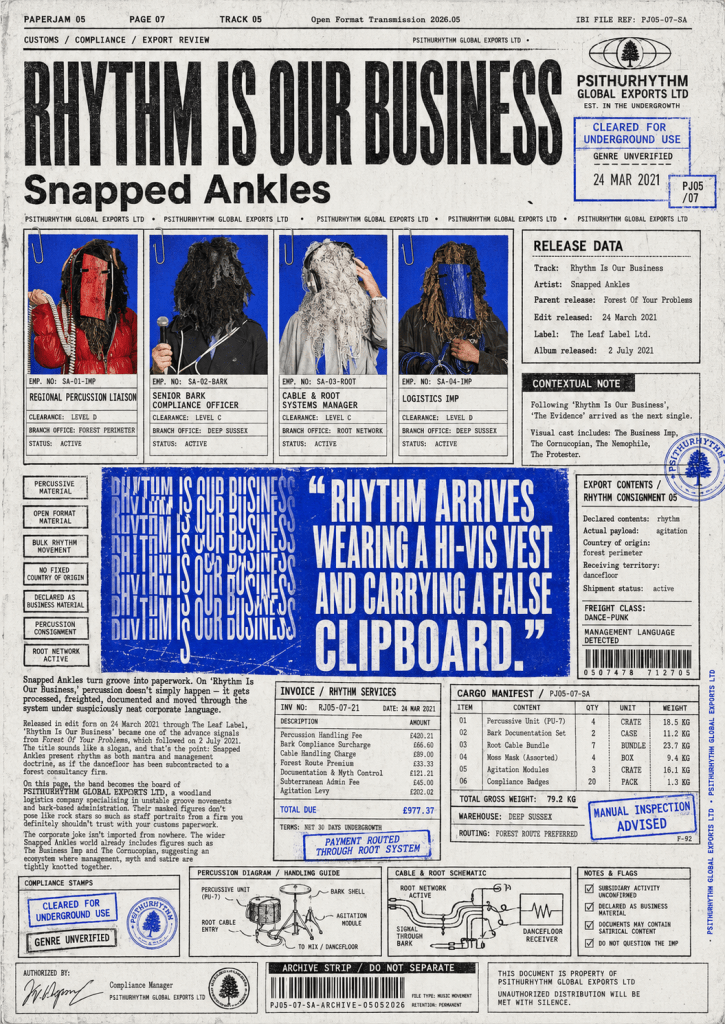
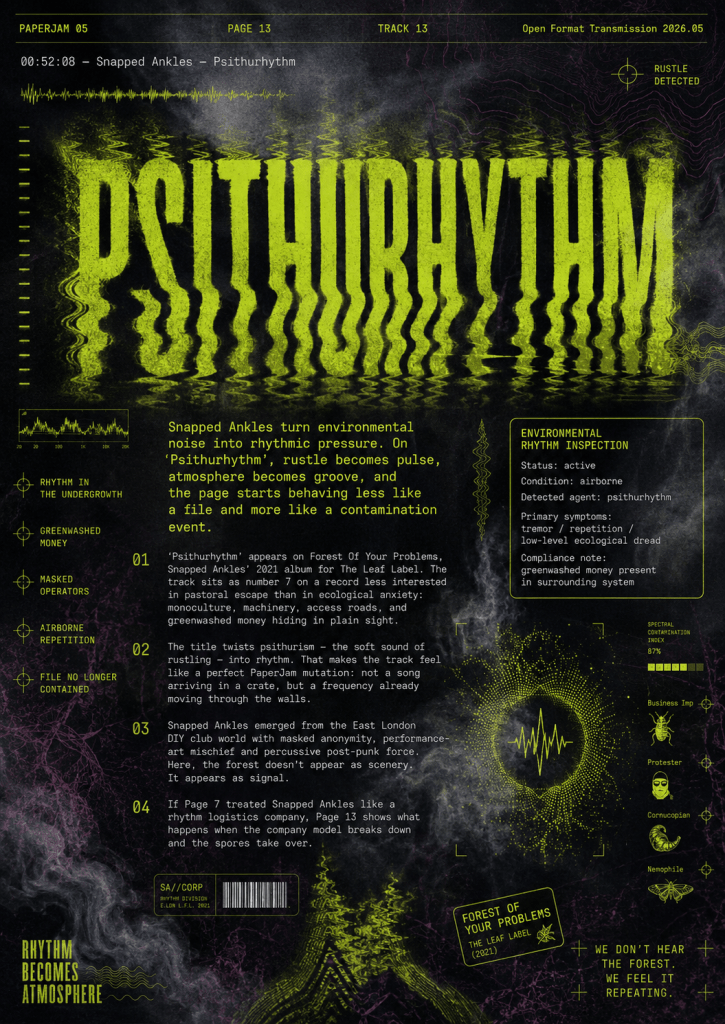
Snapped Ankles provide the issue’s first corporate hallucination. “Rhythm Is Our Business” turns the band into a forest logistics company trafficking percussion through woodland subsidiaries, while “Psithurhythm” later breaks the format open into full-colour ecological pressure. Together, the two Snapped Ankles pages show the issue’s range: first bureaucracy, then rupture. The rhythm begins as commodity, then becomes atmosphere. Trees are not used as cosy decoration. They appear as managed systems, greenwashed money, monoculture stress and masked DIY club ritual.
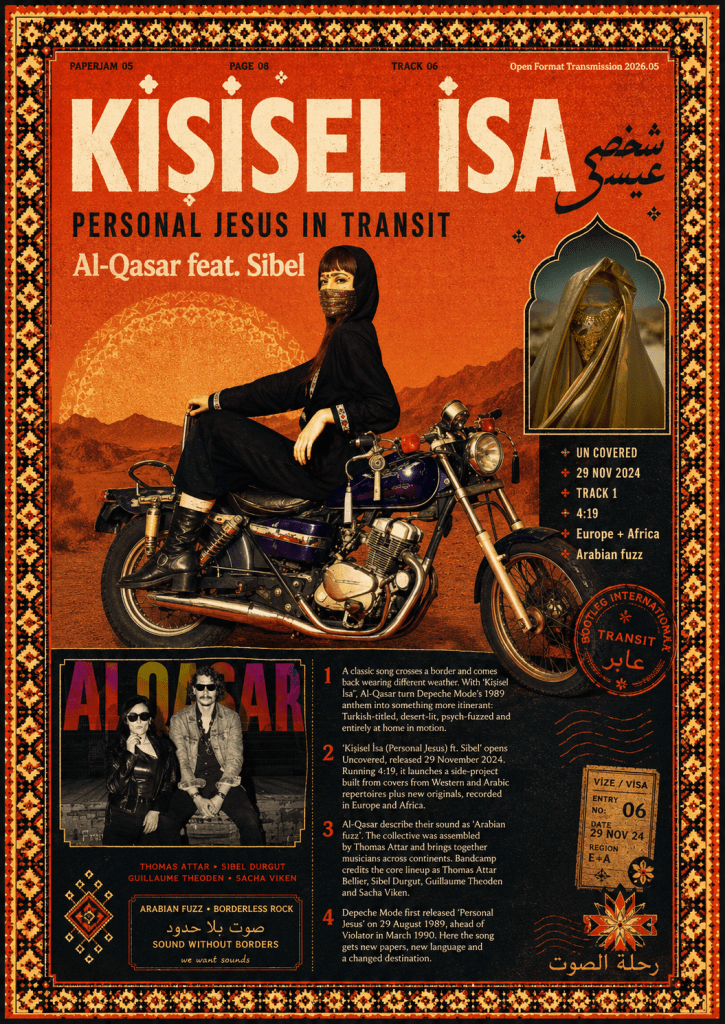
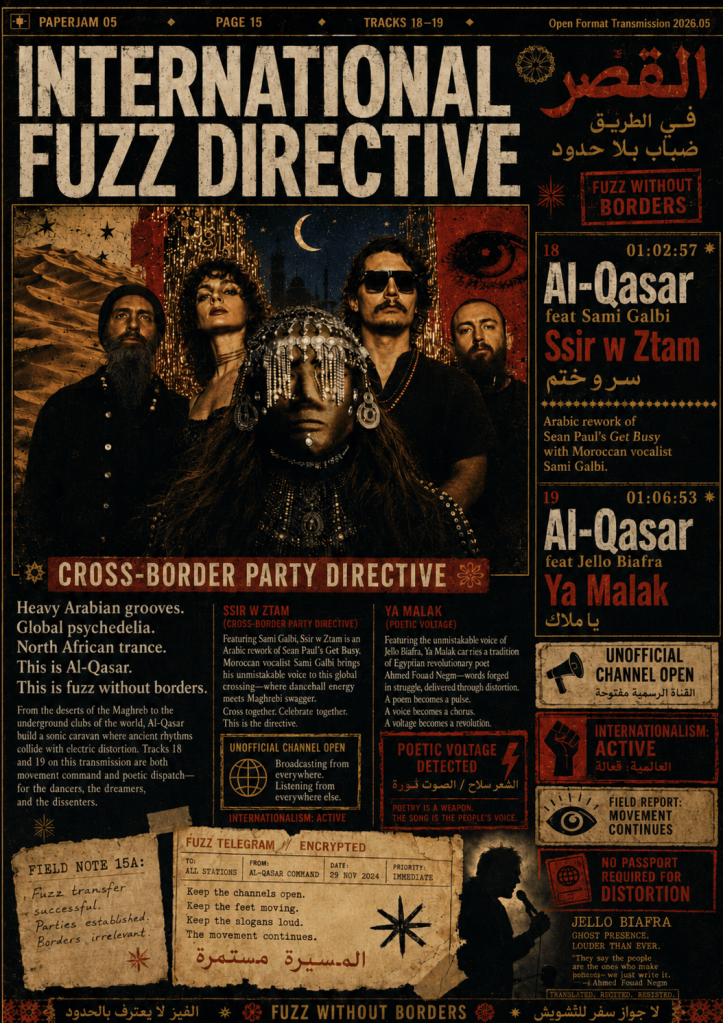
Al-Qasar sit at the blazing centre of the issue. They are the cover stars and the strongest expression of the issue’s internationalist heart. The first Al-Qasar page, built around “Kişisel İsa,” presents Depeche Mode’s “Personal Jesus” re-routed through Turkish language, desert psych and fuzz ritual. It briefly breaks from the seizure-file aesthetic into something sacred, glamorous and severe. The second Al-Qasar feature, “International Fuzz Directive,” expands the world further through “Ssir w Ztam” and “Ya Malak.” “Ssir w Ztam” is framed as “Get Busy” reborn in Arabic with Moroccan vocalist Sami Galbi, a cross-border party command. “Ya Malak,” featuring Jello Biafra, brings political voltage and revolutionary undertow. The page’s stamp, “Fuzz Without Borders,” could stand as the whole issue’s motto.
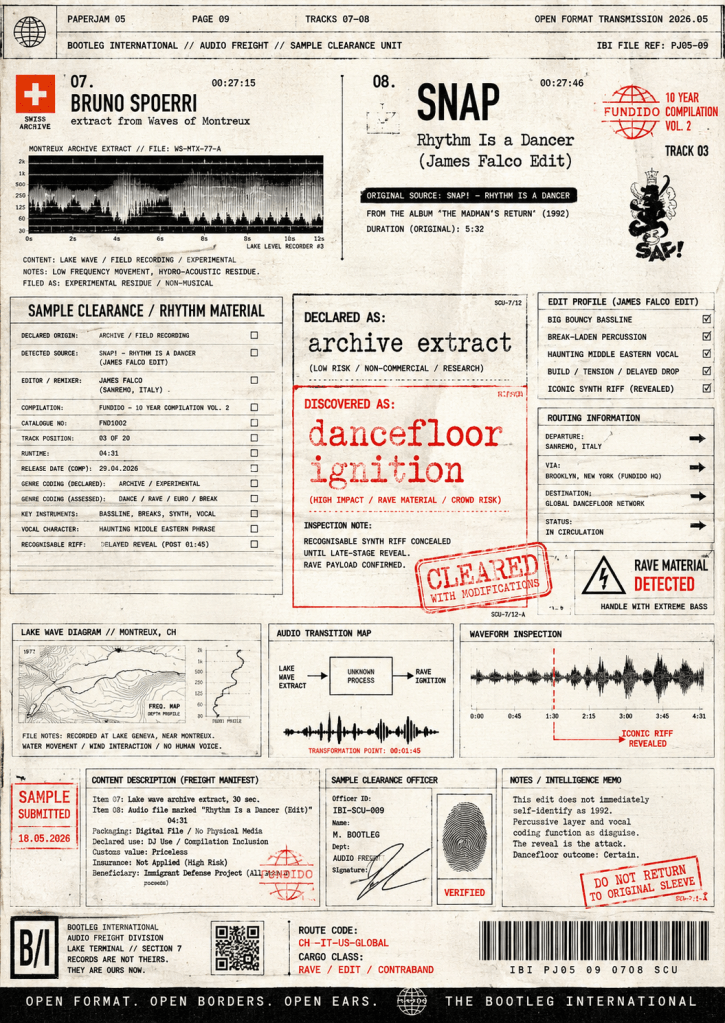
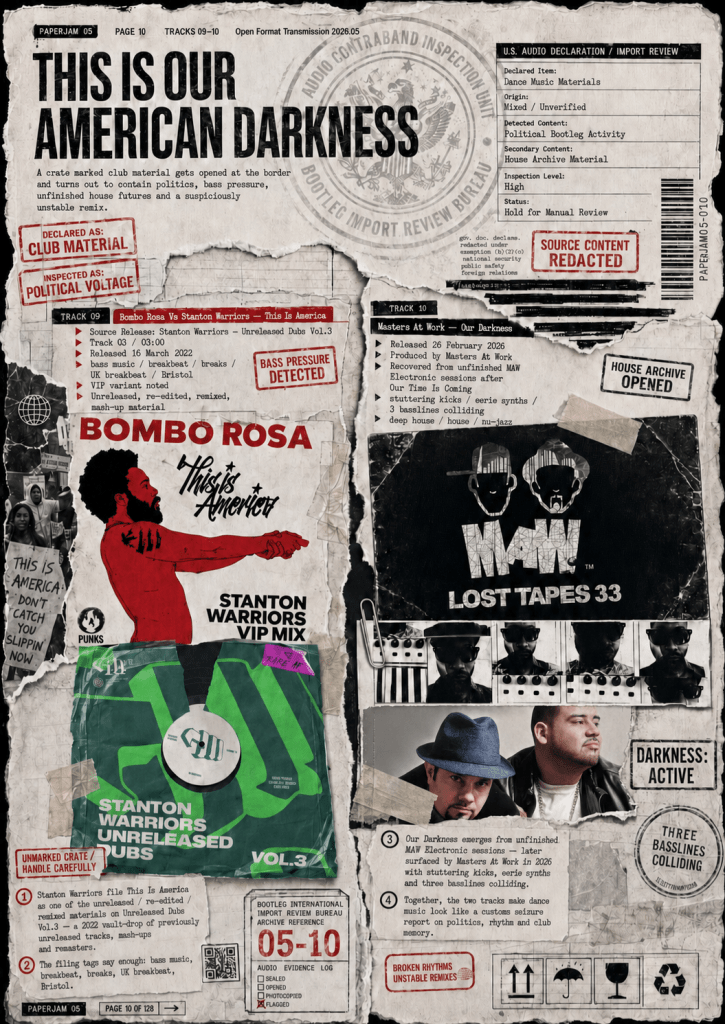
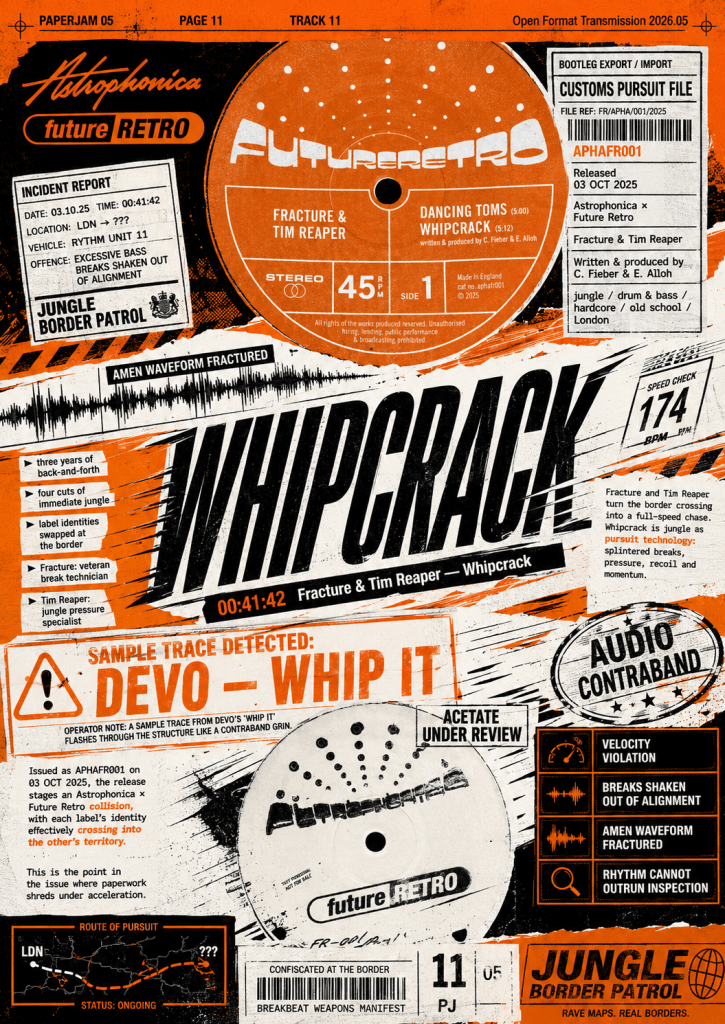
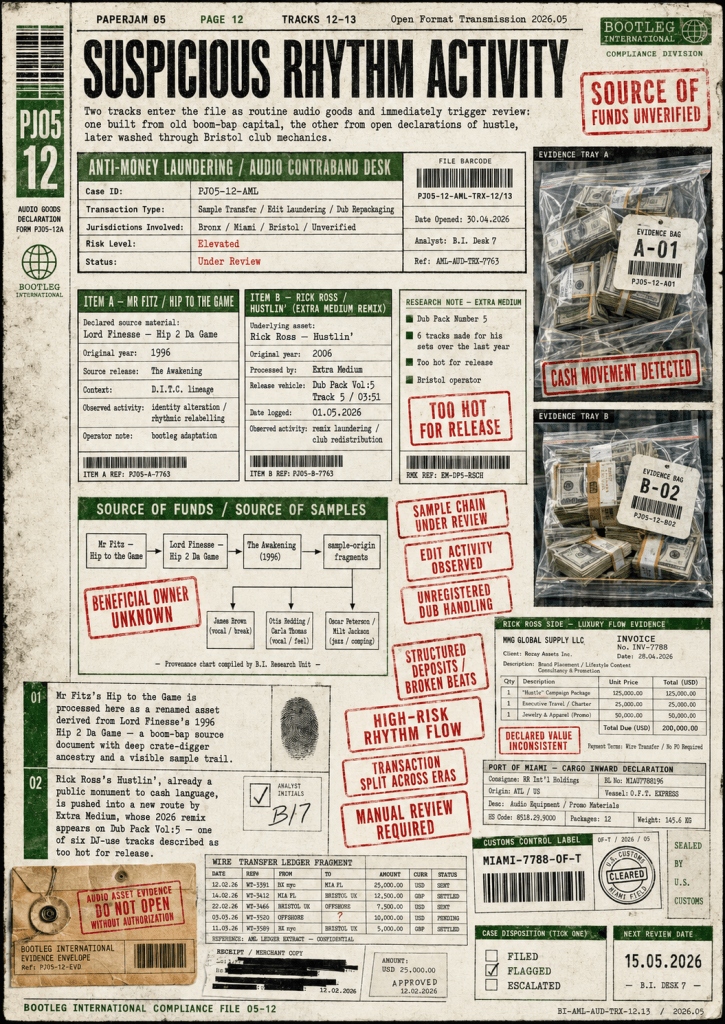
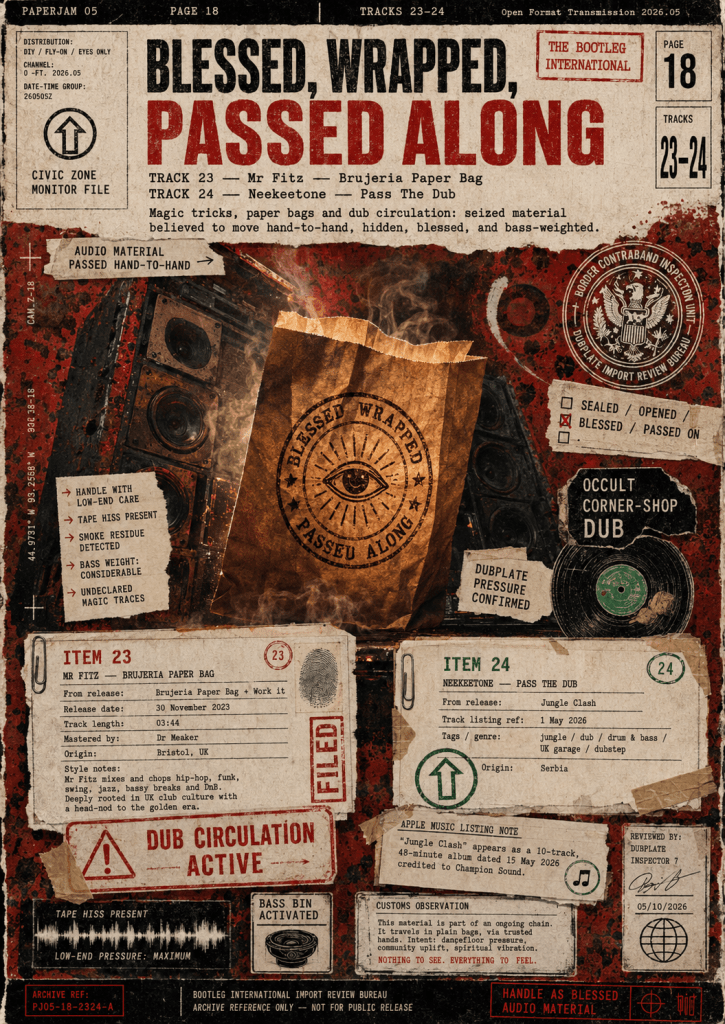
The middle pages explore how bootleg logic mutates familiar material. Bruno Spoerri’s “Waves of Montreux” gives way to Snap!’s “Rhythm Is a Dancer,” treated as a tiny archive extract igniting into pop-rave energy. Stanton Warriors and Bombo Rosa collide with Masters At Work in “This Is Our American Darkness,” a customs report on politics, bass pressure and house archive material. Fracture and Tim Reaper’s “Whipcrack” becomes a kinetic jungle border, with breaks splintering the page into diagonal strips and Future Retro orange. Mr Fitz and Rick Ross become an anti-money-laundering case file, where old boom-bap capital, Miami hustle language and Bristol bass edits are investigated as suspicious rhythm activity.
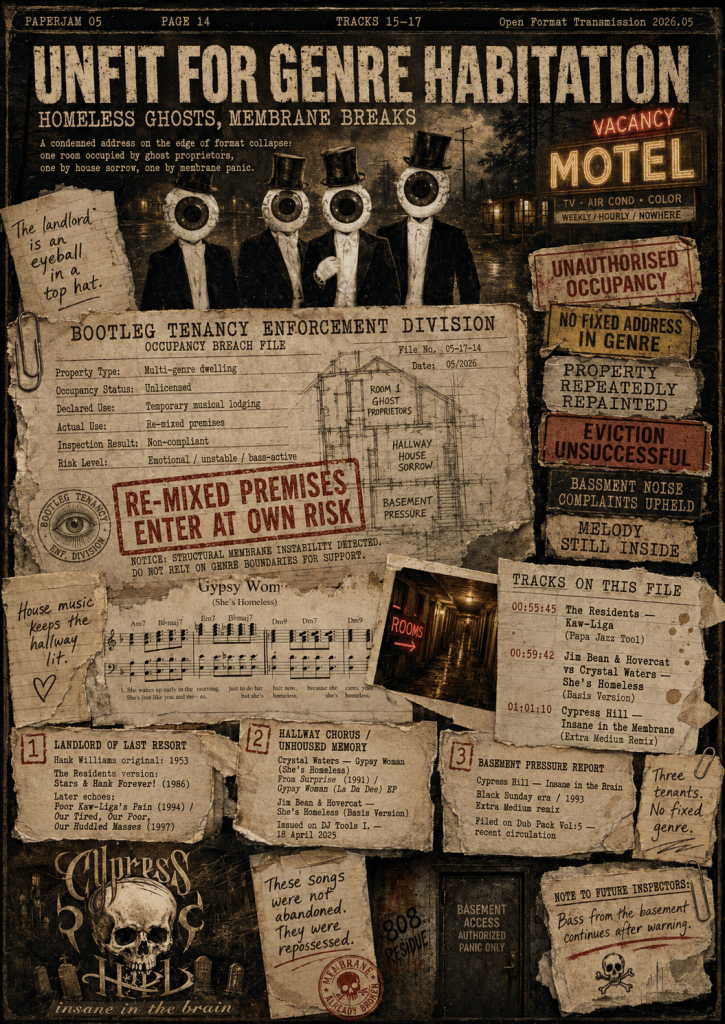
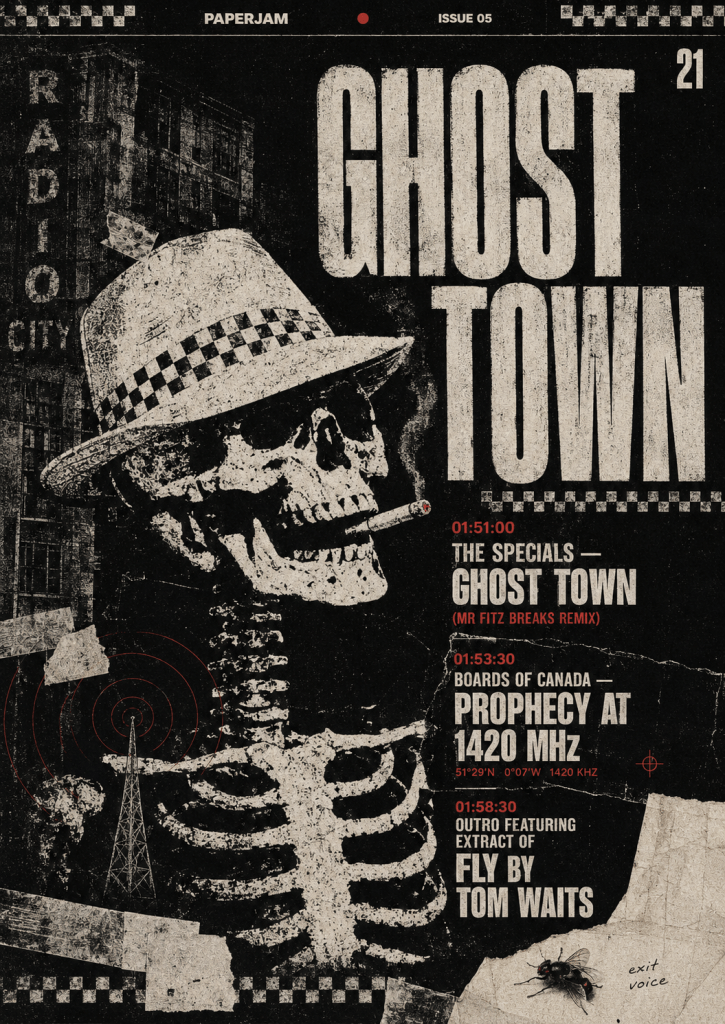
The issue also has a strong haunted-building strain. The Residents, Crystal Waters and Cypress Hill are grouped under “Unfit for Genre Habitation,” a fake eviction notice for songs that have been repainted, occupied, evicted and reoccupied. The Residents’ “Kaw-Liga” becomes oddball Americana as ghost landlord. Crystal Waters’ “She’s Homeless,” via Jim Bean and Hovercat, becomes the emotional hallway. Cypress Hill’s “Insane in the Membrane,” remixed by Extra Medium, becomes basement pressure. Later, The Specials’ “Ghost Town” leads the final descent, joined by the returning Boards of Canada prophecy and an outro featuring Tom Waits’ “The Fly.” The transmission disappears into static with a small fly at the bottom of the page, a cracked-wing exit voice.
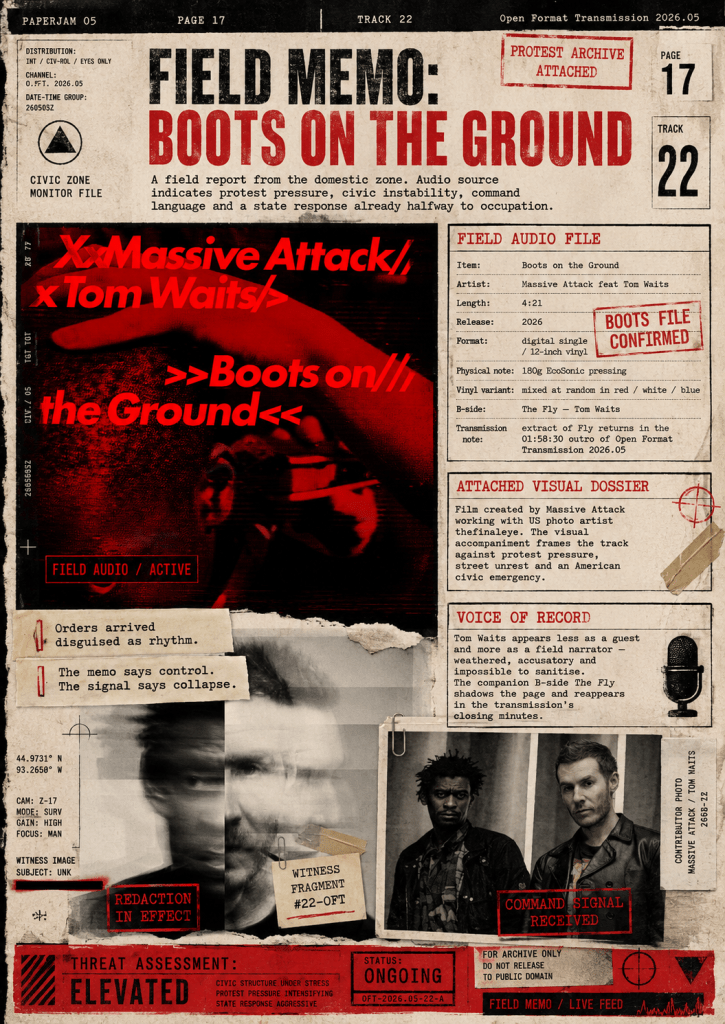
Massive Attack and Tom Waits give the late issue its hardest political page. “Field Memo: Boots on the Ground” is styled as a classified military memo, dense red and black, grim and official. It treats the track as a field audio file from a domestic war zone, with protest archive attached. The page links Massive Attack to political transmission and Tom Waits to a commanding, weathered voice. It also notes that “The Fly” returns in the transmission’s outro, making the page echo forward into the ending.
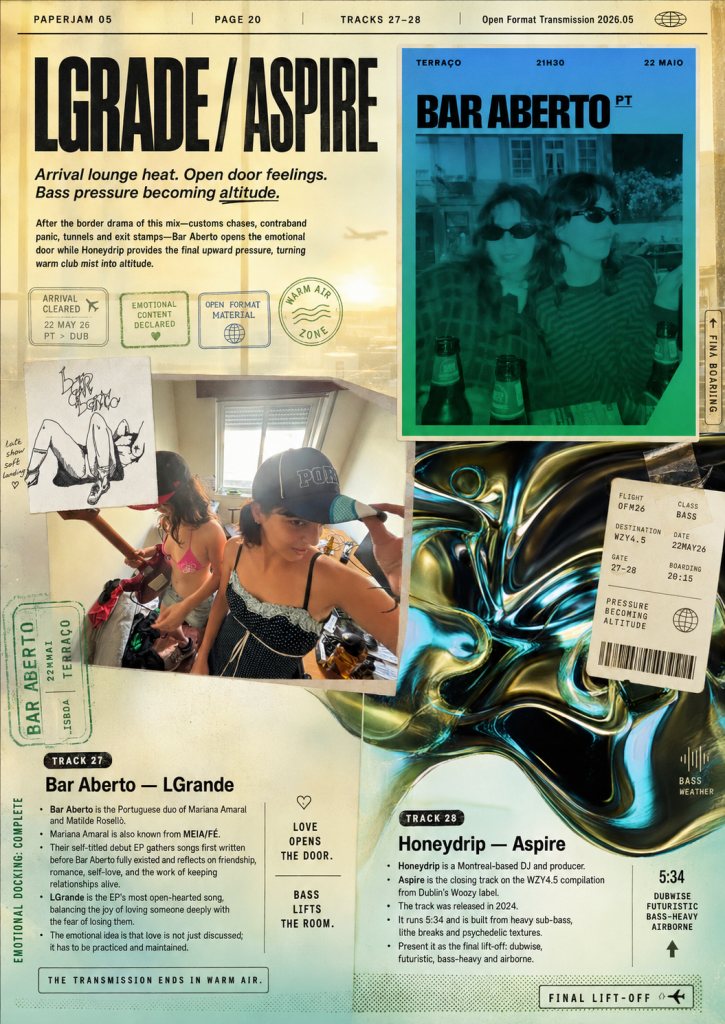
The issue then softens before the final haunted exit. Bar Aberto and Honeydrip’s page, “LGrande / Aspire,” is a warm afterhours arrival lounge. Bar Aberto bring the emotional open door: love as practice, maintenance, friendship, romance and courage. Honeydrip’s “Aspire,” closing Woozy’s WZY4.5 compilation, brings heavy sub-bass, lithe breaks and psychedelic lift. The page changes the mood from customs chase to humidity, glass, dawn and pressure becoming altitude. It lets the issue breathe before it vanishes.
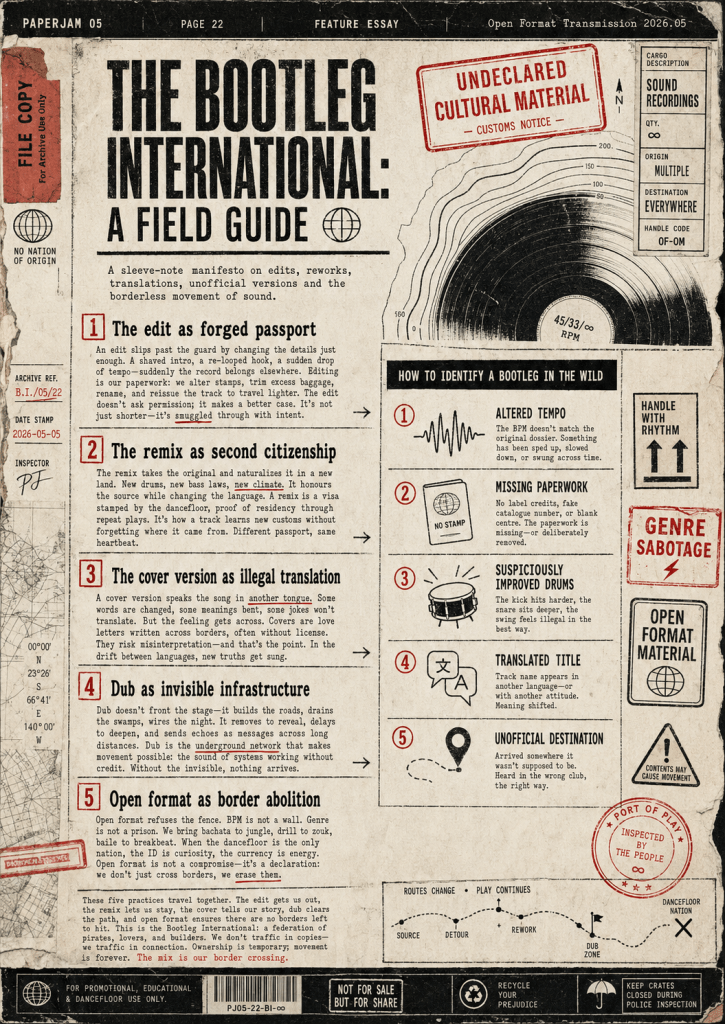
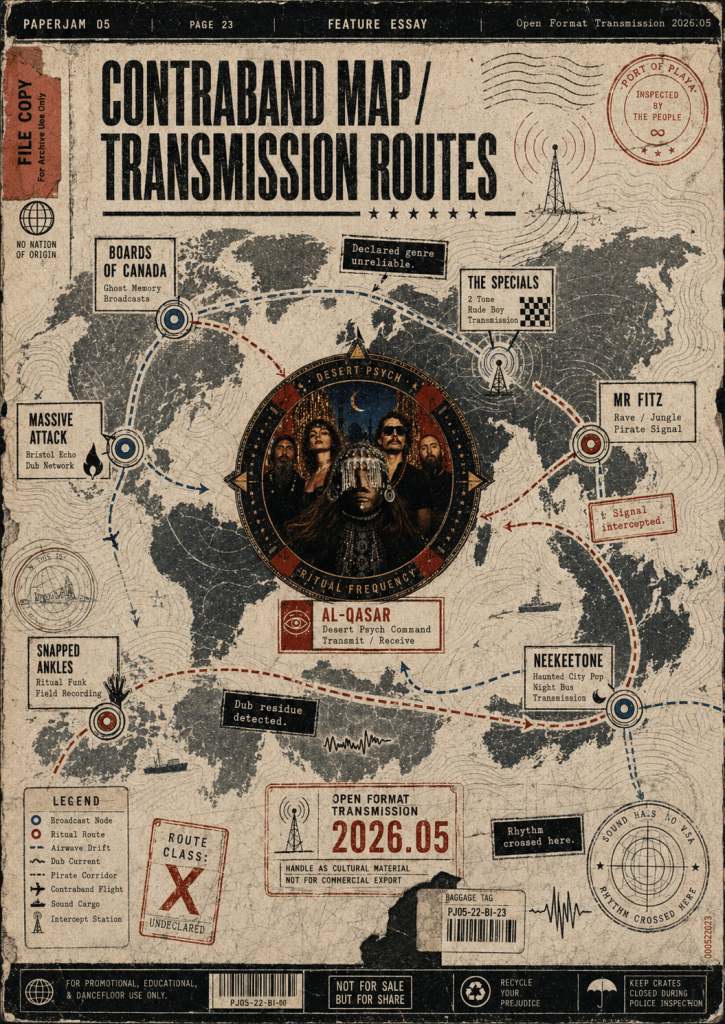
Pages 22 and 23 explain the whole system. “The Bootleg International: A Field Guide” is a manifesto found inside a record sleeve, setting out five principles: the edit as forged passport, the remix as second citizenship, the cover version as illegal translation, dub as invisible infrastructure and open format as border abolition. The following “Contraband Map / Transmission Routes” plots the issue as a world of radio bursts, customs stamps and sonic routes: desert psych, UK pirate memory, dub, jungle, rave, hip hop, electro, haunted city pop and radio prophecy.
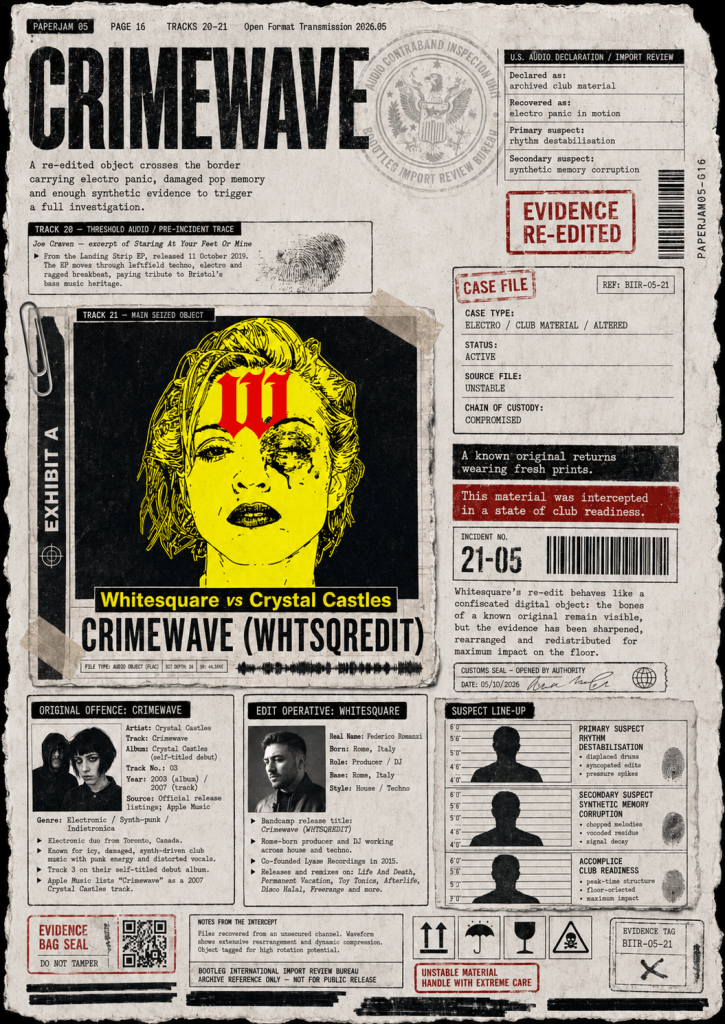
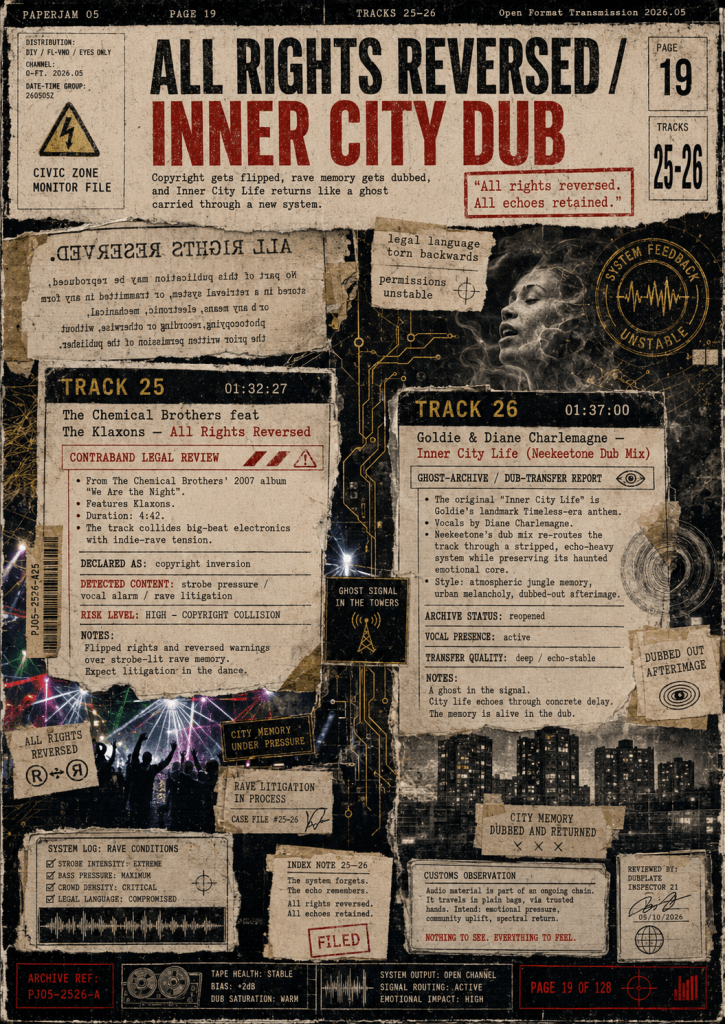
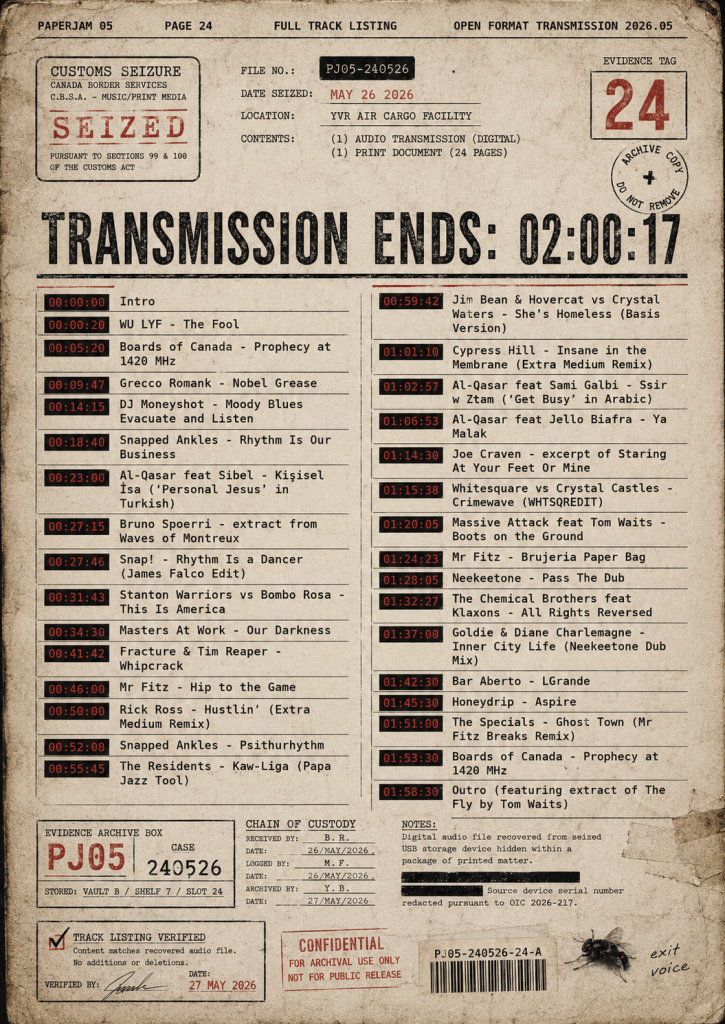
The back cover closes the file in a two-column archive tracklist. It corrects the issue’s known gremlins: Kaw-Liga, Sami Galbi, WHTSQREDIT, Diane Charlemagne, The Fly, WU LYF, Snap!, Rhythm Is Our Business and Klaxons. Transmission ends at 02:00:17, but the final listed audio event begins at 01:58:30. The archive is sealed, stamped and marked with a fly. The case is closed, but the signal is still moving.

ABOUT THE EDITORS
PaperJam is assembled, argued over, glued down and occasionally rescued from printer failure by husband-and-wife editorial unit Eli “Static” Mercer and Nia “Nix” Adeyemi-Mercer.
Eli is originally from Seattle: a rain-soaked zine obsessive, tape-archive scavenger and layout gremlin raised on basement shows, college radio, busted photocopiers and the noble art of making pages look like they were intercepted mid-transmission.
Nia is from East London: editor, headline assassin, pirate-radio disciple and cultural scalpel. Her background runs through market-stall bootlegs, grime clashes, protest flyers, night buses and sentences sharp enough to cut through laminated nostalgia.
Together, they make PaperJam as the printed shadow of Yeah Bagel’s Open Format Transmission: part fanzine, part archive leak, part evidence folder, part love letter to music that refuses to behave.
Their working method is simple: Eli finds the static. Nia makes it speak. Then they staple the whole thing together before the signal disappears.
