
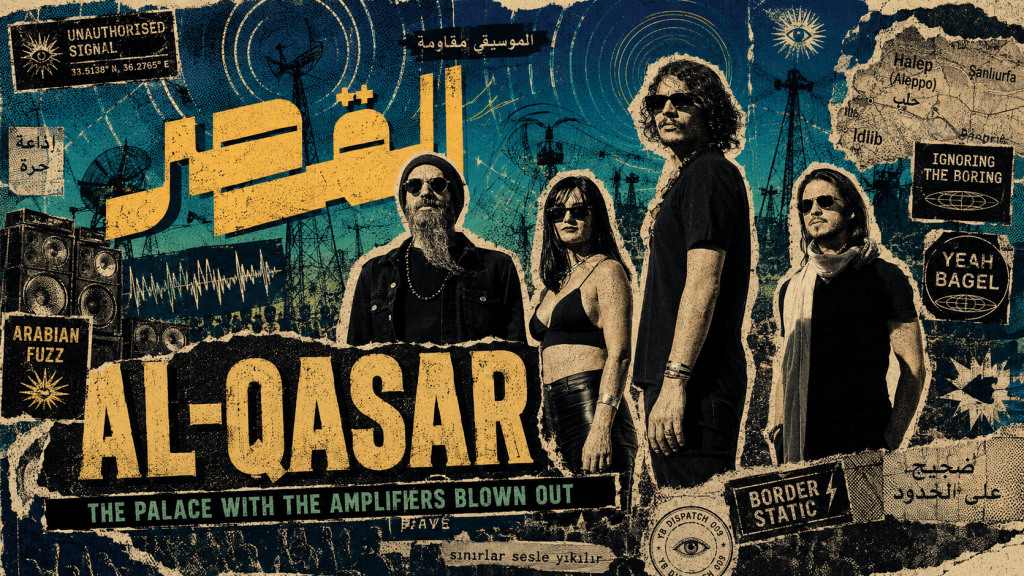
The Riff Arrives Wearing Different Papers
Some bands arrive with a sound. Al-Qasar arrive with a border incident.
They do not make fusion in the polite, hotel-lobby sense. Nothing here has been gently blended for the neutral listener. Their music sounds assembled at a checkpoint after midnight: fuzz guitars, electric saz, Arab scales, North African trance rhythms, garage-rock voltage, punk suspicion, wedding-band euphoria, desert-blues dust, psychedelic collapse, all of it shoved into the same vehicle and waved through before anyone can ask for the correct documentation.
Al-Qasar call it Arabian fuzz, which is accurate in the same way “storm warning” is accurate. It tells you something is coming, but not how hard the windows will rattle.
The first mistake would be to treat them as a novelty of ingredients. The second would be to file them under some weary “global sounds” drawer and move on. Al-Qasar are more interesting than that. They are not exotic decoration placed on top of rock music. They are a corrective. A reminder that rock’n’roll was never clean, never singular, never owned outright by the people who wrote the loudest histories about it. Their sound does not politely ask to be included in the lineage. It turns up with a soldering iron and starts rewiring the family tree.
Born in Barbès
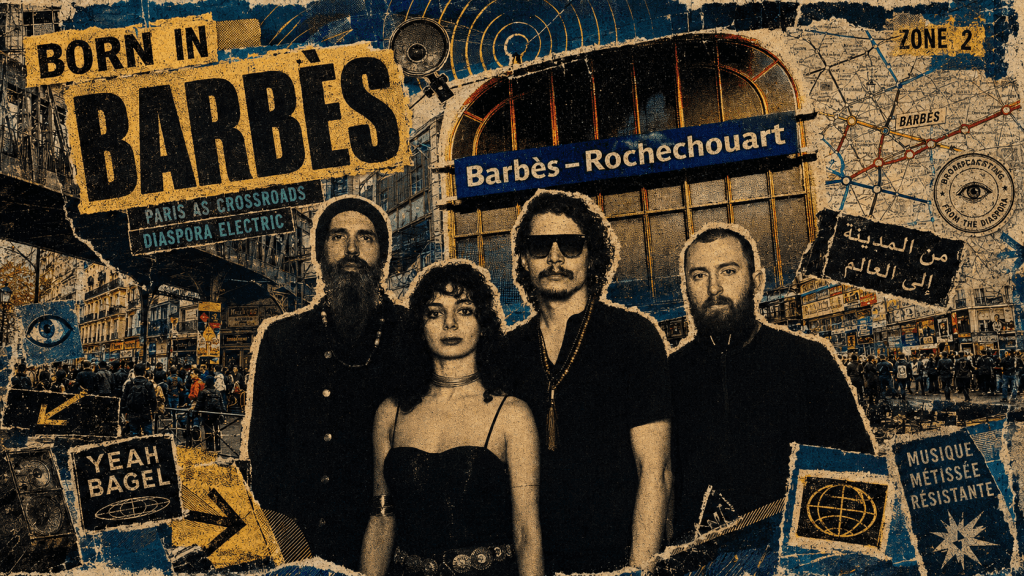
Al-Qasar began in Barbès, the Paris neighbourhood where different histories brush past each other in the street without asking permission. It is a good birthplace for a band built on collision. Barbès is not postcard Paris. It is not the museum Paris, the perfume-ad Paris, the Paris that gets sold back to tourists in cream paper bags. It is layered, noisy, diasporic, practical, alive. The kind of place where music does not have to choose one ancestry because the pavement itself refuses to.
At the centre of Al-Qasar is Thomas Attar Bellier, the producer and multi-instrumentalist who gathered musicians across borders, scenes and traditions to make something that sounds less like a project than a moving neighbourhood. The personnel and guest list have stretched across France, Morocco, Algeria, Egypt, Sudan, Lebanon, Mali, Tunisia, Turkey, the United States and beyond. But the point is not passport bingo. The point is what happens when each musical language is allowed to keep its teeth.
There is electric saz in the architecture. There are percussion patterns that do not merely keep time but pull the room into a circle. There are basslines that move with the blunt authority of a generator starting up. There are guitars that know exactly how much distortion is needed to turn beauty into a public disturbance.
Al-Qasar’s music is full of invitation, but never submission. It beckons, then it pushes. It opens the door, then the room tilts.
Arabian Fuzz as Method
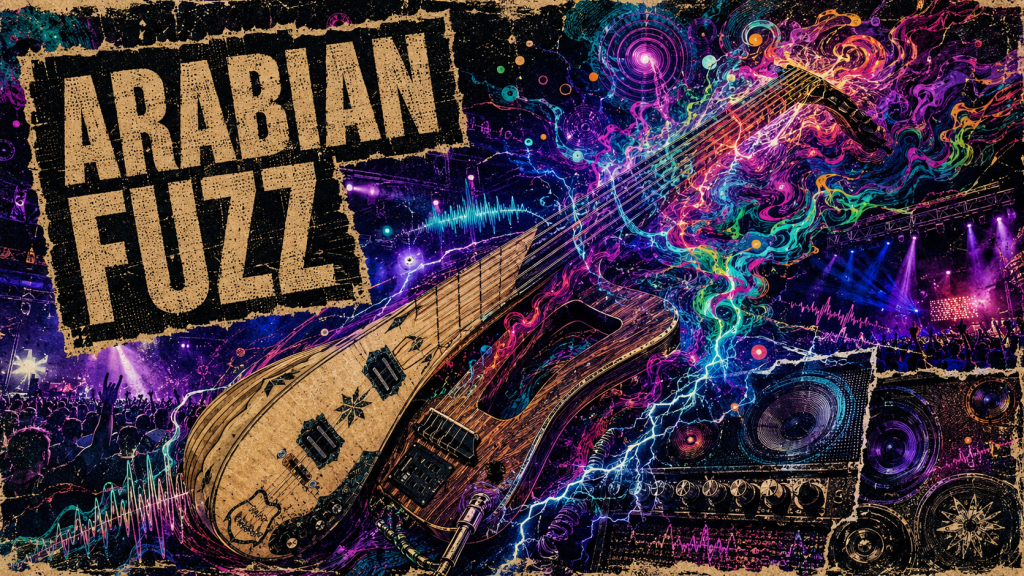
“Arabian fuzz” works because it sounds both specific and slightly illegal.
The phrase carries the smell of valves overheating. It gives a name to the band’s habit of running traditional instrumentation through rock’s filthier circuitry without sanding down either side. In Al-Qasar’s hands, fuzz is not just an effect pedal. It is a historical condition. A way of making the past audible without embalming it. A way of letting heritage behave badly.
That matters. Because too often, music from outside the usual Anglo-American centre is expected to perform authenticity like a costume drama. Keep the oud pure. Keep the groove legible. Keep the language picturesque. Keep the rebellion tasteful. Keep the politics translated into something the market can chew.
Al-Qasar refuse the assignment.
Their songs do not preserve tradition under glass. They drag it into the amplifier stack and let it sweat. They understand that tradition was never still in the first place. Folk music moved because people moved. Scales travelled. Rhythms crossed seas, borders, empires, weddings, revolutions, pirate radio signals and cheap cassette decks. Al-Qasar do not modernise the old. They expose the fact that the old was always moving.
This is why their music can feel ancient and futuristic at the same time. It is not retro-futurist as styling. It is retro-futurist as evidence. The future is not ahead of us in a chrome hallway. Sometimes it is hidden in a bendir pattern, a saz riff, a protest poem, a distorted bassline, a wedding rhythm played at riot volume.
Who Are We? and the Question That Won’t Sit Still
Al-Qasar’s full-length debut, Who Are We?, did not ask its title question softly.
It came on like a manifesto with dust in its boots. Released in 2022, the album captured the band’s core argument: identity is not a single line, but a pressure system. The songs writhe and roar, but they are not chaos for chaos’ sake. They are carefully built machines. Bass, percussion and drums form the road. Saz, oud and guitar throw sparks over the top. Vocals rise not as decoration but as command, grief, flirtation, warning, prayer.
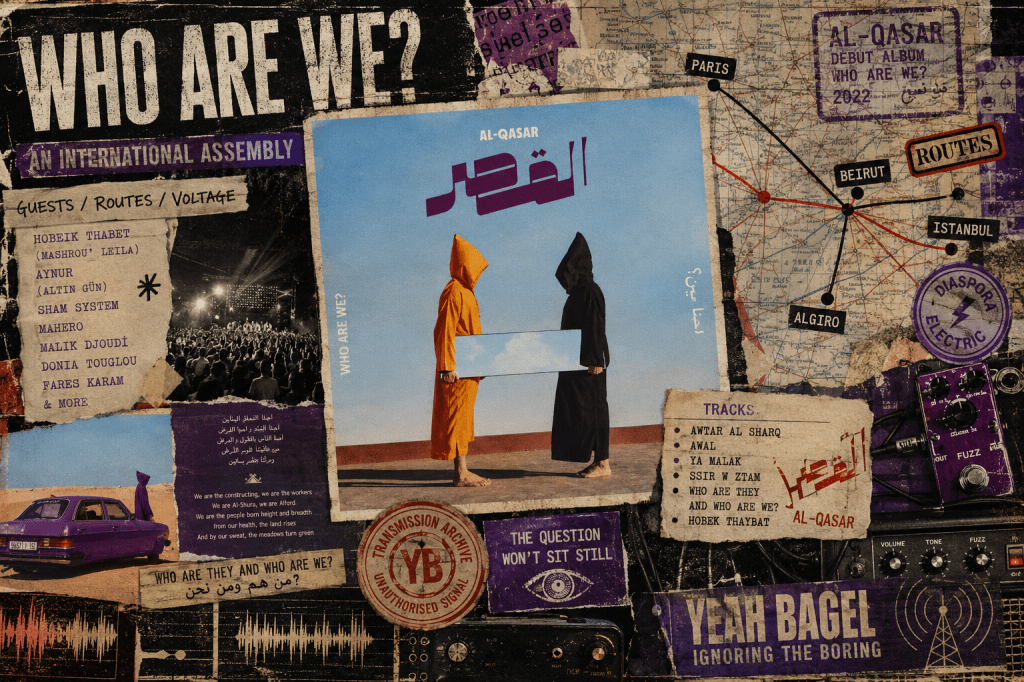
The guest list made the record feel less like a debut and more like an international assembly convened after the amplifiers had already caught fire. Lee Ranaldo of Sonic Youth appears on the opening tracks, threading guitar atmosphere through Moroccan-rooted grooves. Alsarah brings Sudanese depth and political charge. Mehdi Haddab, the oud insurgent associated with Speed Caravan and other border-blurring projects, helps light up “Barbès Barbès.” Hend Elrawy gives “Mal Wa Jamal” emotional gravity.
Then there is “Ya Malak,” the album’s great punk rupture, featuring Jello Biafra.
On paper, Jello Biafra joining a Middle Eastern psych-rock collective sounds like the sort of collaboration that could collapse under its own press-release weight. In practice, it makes brutal sense. His voice has always been built for alarm systems. Here it becomes part of a larger critique, a cracked English-language transmission of revolutionary poetics into a song already loaded with friction.
“Ya Malak” does not feel like a guest spot. It feels like an interruption that the song had been expecting all along.
The Politics Are in the Wiring
Al-Qasar are political because the music refuses the fantasy of separation.
The politics are not always delivered as slogans. They are in the choice of language. In the refusal to flatten Arabic, Turkish, Bambara, Nubian and North African musical histories into market-friendly seasoning. In the insistence that rock music can be decentralised without being diluted. In the sound of a band making cultural mixture feel lived rather than branded.
This is important because hybridity, in the wrong hands, becomes tourism. Al-Qasar’s music is not tourism. It does not pass through styles snapping photos. It builds a temporary republic out of them. It knows that the city is already mixed, the dancefloor is already mixed, the diaspora is already mixed, the record collection is already mixed. The band are simply honest enough to let the music show the traffic.
That honesty gives the songs their charge. Al-Qasar do not make borderless music because borders have vanished. They make border-crossing music because borders remain ugly, useful to power, and constantly contradicted by human life. The groove knows this. The groove keeps moving anyway.
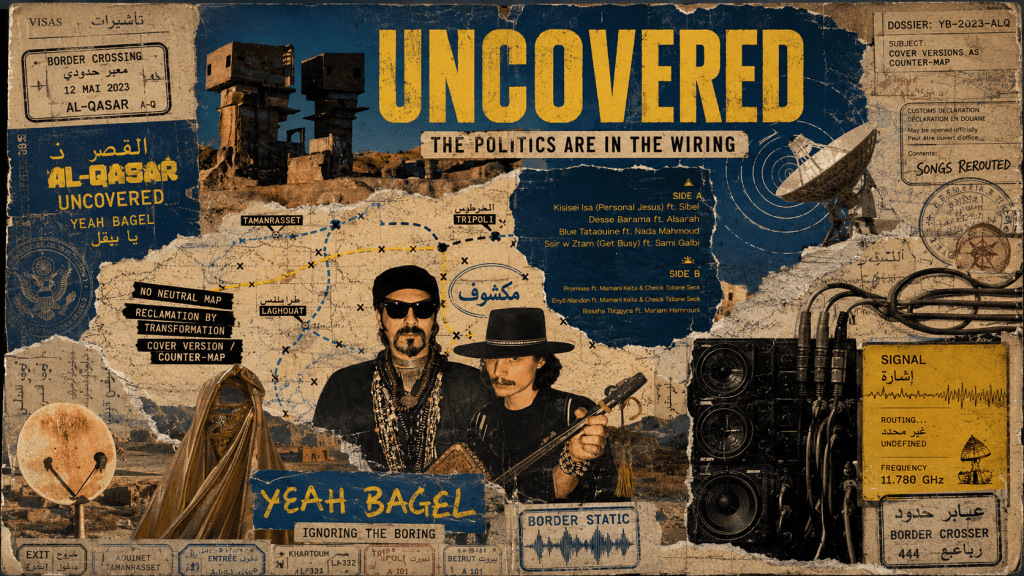
Uncovered: The Cover Version as Counter-Map
By the time Al-Qasar reached Uncovered, the band had found a new kind of weapon: the cover version.
But Uncovered is not a covers album in the usual tribute-act sense. It is not a respectful bouquet placed beneath the statue of Western pop. It is more like a series of raids. Familiar songs are taken apart, translated, re-routed, dressed in new rhythm, sent through different geographies, and returned altered enough to make the original look slightly embarrassed by its old passport photo.
Depeche Mode’s “Personal Jesus” becomes “Kişisel İsa,” sung in Turkish by Sibel, its famous riff reborn through electric saz. Sean Paul’s “Get Busy” becomes “Ssir w Ztam,” carried by Sami Galbi into a zone where dancehall, raï and chaabi start swapping voltages. Elsewhere, Arab folk repertoire and West African song forms enter the same circuitry, not as archival objects but as living engines.
This is where Al-Qasar’s intelligence becomes especially clear. A lazy cover version says: you know this song, here it is again. Al-Qasar say: you thought you knew this song, but that was only one route through it.
The result is not parody. It is not novelty. It is reclamation by transformation. The songs become maps with the centre redrawn.
Open Format Transmission 2026.05: Three Palace Keys
On Yeah Bagel’s Open Format Transmission 2026.05, Al-Qasar appear not once, but three times: “Kişisel İsa,” “Ssir w Ztam,” and “Ya Malak.”
That matters. One track would have been a postcard. Three tracks become a corridor.
Placed inside the transmission, the trio acts like a compact guide to the Al-Qasar method. “Kişisel İsa” comes first as the recognisable door: Depeche Mode’s devotional machine re-sung, re-strung, re-sited. The familiar riff is still there, but it no longer belongs to the same church. It has been moved into another body, another language, another night.
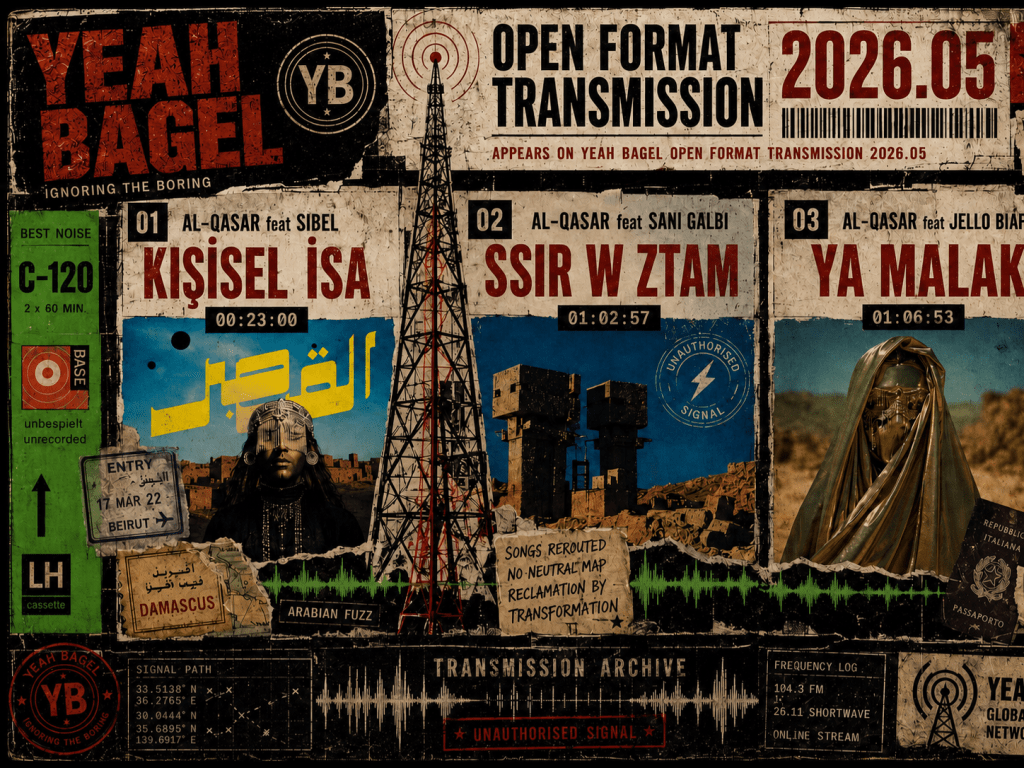
“Ssir w Ztam” is the dancefloor breach. “Get Busy” is already one of pop’s great command phrases, pure kinetic instruction. Al-Qasar and Sami Galbi turn it into something dustier, heavier, more communal. It becomes less club command than street procession, less instruction than ignition.
Then “Ya Malak” arrives with Jello Biafra and changes the weather. After the cover-version mutations, this one opens the deeper political chamber. It connects Al-Qasar’s fuzzed-out pleasure principle to protest, poetry and fury. The band’s party has never been apolitical, but “Ya Malak” makes the wiring visible. Under the rhythm, there is history. Under the riff, there is accusation. Under the celebration, there is a refusal to forget.
Together, the three selections give Open Format Transmission 2026.05 a crucial passage of transcontinental electricity. They are not simply “world psych” dropped into an eclectic mix. They are structural beams. They connect post-punk, dancehall, Arabic psychedelia, Turkish-language reinterpretation, punk dissent and North African rhythmic logic into one glowing circuit.
This is exactly where Yeah Bagel’s open-format instinct earns its name. Not random eclecticism. Not genre tourism. Transmission as argument. Selection as essay. The playlist says: these things belong together because the world that made them is already tangled.
Al-Qasar fit that philosophy perfectly. They do not sit between categories. They make the categories look underbuilt.

Not a Bridge, a Blast Site
The laziest compliment you can give a band like Al-Qasar is to call them a bridge.
Bridges are tidy. Bridges imply two stable sides and a noble structure between them. Al-Qasar sound more like what happens after the bridge has been bombed, rebuilt, painted, occupied by dancers, wired for sound, and turned into a night market.
They are not smoothing differences. They are amplifying them until the differences start producing heat. That is the thrill. The music does not say, “We are all the same.” It says, “We are not the same, and listen how much power appears when the difference is allowed to move.”
This is why Al-Qasar feel so necessary now. In a moment when culture is endlessly sorted, packaged, recommended, flattened and monetised, they make music that resists the shelf. Too psych for heritage purists. Too rooted for rock tourists. Too political for the background playlist. Too joyous for the doom merchants. Too alive to behave.
The palace in the name is not marble. It is not royal. It is not sealed off from the street. It is a palace made from amplifiers, rugs, cables, hand drums, old poetry, borrowed riffs, overheated mixers and passports with bent corners.
The door is open.
Inside, everything is shaking.
On Yeah Bagel Open Format Transmission 2026.05
00:23:00 Al-Qasar feat Sibel – Kişisel İsa (‘Personal Jesus’ in Turkish)
01:02:57 Al-Qasar feat Sani Galbi – Ssir w Ztam (‘Get Busy’ in Arabic)
01:06:53 Al-Qasar feat Jello Biafra – Ya Malak
