
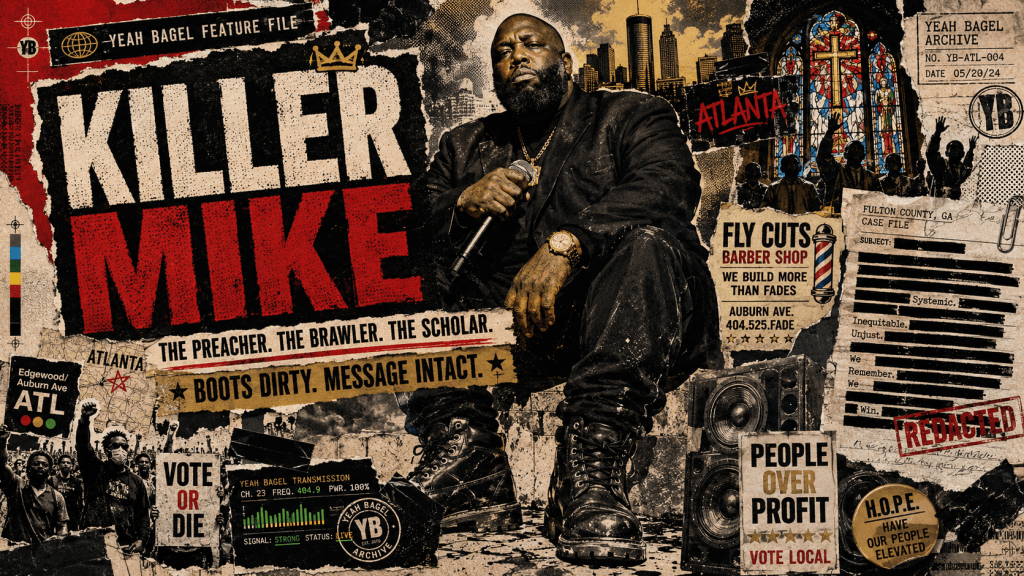
The Boy Who Invented a Superhero
Before Killer Mike became a political detonator, a Run The Jewels warhead, a Grammy-hoarding grown man in a Sunday-best suit, he was Michael Render from Atlanta. Not Atlanta as a brand, not Atlanta as airport shorthand, not Atlanta as a streaming-category mood board. Atlanta as neighbourhood, family, church, strip mall, barber chair, porch argument, bassline, police siren, Black enterprise, old wisdom, bad choices, good jokes and gospel leakage from a room down the hall.
He has spoken about the name Killer Mike as something invented young, a superhero identity before it was a rap name. That matters. Plenty of rappers adopt armour. Mike built his armour early, then spent the rest of his life proving there was a complicated human being inside it.
That tension is the motor. Killer Mike has always sounded huge, but his best work is not huge because it floats above ordinary life. It is huge because it drags ordinary life into the courthouse, the pulpit, the campaign office, the trap house, the family kitchen and the riot line, then asks everyone present to explain themselves.
He comes from a city where hip-hop did not need permission from New York or Los Angeles to become a capital. Atlanta did not merely produce him. Atlanta argued with him, fed him, contradicted him, embarrassed him, crowned him, challenged him and gave him a language where the sacred and profane could ride in the same car.
Dungeon Family Weather
Killer Mike first broke through in the gravitational field of OutKast, which is a polite way of saying he entered public rap life near a burning spaceship.
His recording debut on Stankonia placed him inside one of the great Southern rap laboratories. Then came “The Whole World,” the OutKast collaboration that helped put his voice in front of a wider audience and eventually became part of Grammy history. You could hear it early: the voice was not interested in sneaking in. Mike arrived with the force of someone kicking a door open, then asking why the door was there in the first place.
The Dungeon Family world gave him an important inheritance. It proved that Southern rap could be surreal, deeply local, politically awake, churchy, filthy, futuristic and funny without choosing a single lane. Killer Mike took that permission and sharpened it into something heavier. Where André 3000 could drift into cosmic theatre and Big Boi could make precision funk look effortless, Mike often sounded like the man outside the building with a bullhorn, a ledger and unfinished business.
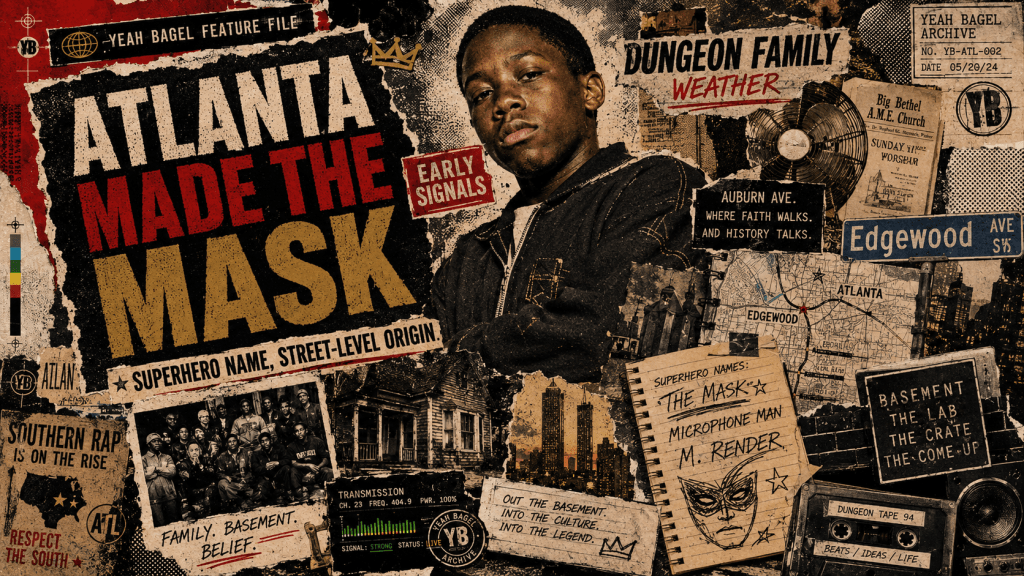
His debut album Monster arrived in 2003. The title was not subtle, and neither was the intent. The record announced him as a solo force, but it also revealed the challenge that would follow him for years: how does an artist this forceful fit inside an industry that prefers its radicals pre-packaged, its Southern rappers flattened into stereotype, its politics optional and its anger monetised but not obeyed?
For a while, the answer was: awkwardly. The major-label machinery did not quite know what to do with him. He had hits, credibility, co-signs and volcanic ability, but not a simple marketing box. He was too political for pure party-rap, too funny for dour backpack righteousness, too street for liberal lecture rooms, too thoughtful for the cartoon thug slot, too Southern for old coastal prejudices, too independent-minded to become anyone’s house weapon.
So he kept moving.
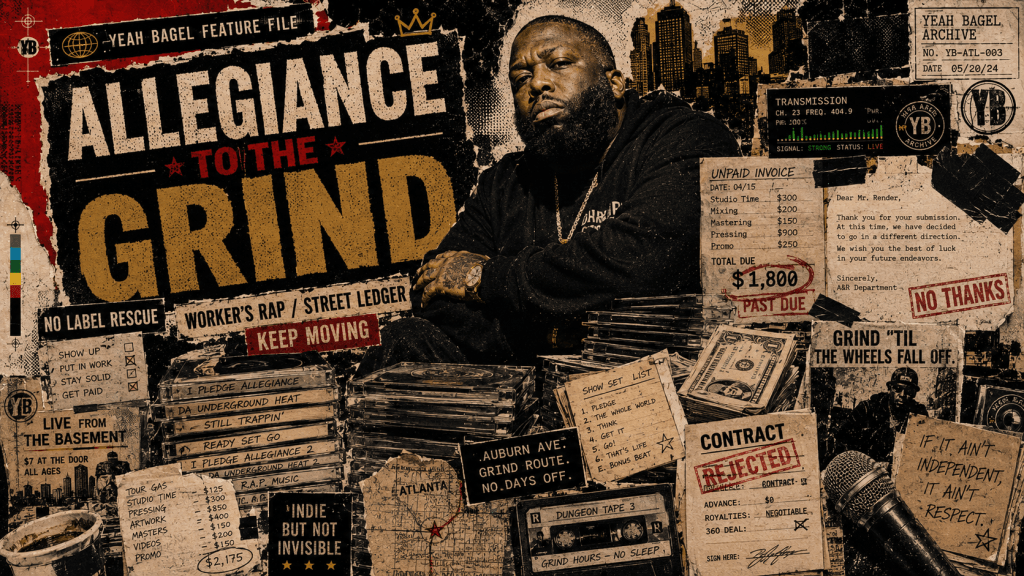
Grind Time, Or How To Survive The Machinery
The mid-2000s Killer Mike is essential because it is where the mythology gets less glossy and more useful. The I Pledge Allegiance to the Grind era is the sound of an artist refusing to disappear after the industry’s first bright light swings away.
This is where Mike becomes less a prospect and more a worker. The title itself says everything: not allegiance to fame, not allegiance to radio, not allegiance to the approval of taste-making rooms, but allegiance to the grind. In that phrase is dignity, stubbornness and exhaustion. The grind is not romantic. The grind does not sparkle. The grind is the thing you do when nobody is clapping and the rent still wants its chorus.
Killer Mike’s independent years gave him a thicker skin and a deeper thesis. He became the kind of rapper who could speak about hustling without pretending capitalism was a video game. He could rap about money, but money in his music often had fingerprints on it: landlords, bosses, banks, prisons, cops, churches, families, funerals.
He was never merely saying “get paid.” He was asking who printed the money, who got locked out of the bank, who got used as collateral, who got told to be patient, who got told their rage was bad manners.
That is why his politics never sit cleanly in a single comfortable box. Killer Mike can sound like a Black nationalist, a libertarian uncle, a church deacon with a dirty mouth, a labour organiser, a gun-rights absolutist, a Sanders surrogate, a small-business evangelist, a street-corner philosopher and an Atlanta loyalist, sometimes in the same week. That messiness has made him magnetic and frustrating. It is also part of why he matters. He is not an ideology poster with the corners taped down. He is a public argument with a bass drum under it.
R.A.P. Music: The Fuse Finds The Flame
Then came El-P.
The meeting of Killer Mike and El-P now feels inevitable, which is how you know it was strange at the time. One was Atlanta thunder with Dungeon Family roots. The other was a New York underground producer-rapper with machines full of rust, paranoia and damaged circuitry. On paper, it could have been a culture-clash novelty. In practice, it became one of the great late-career accelerants in modern rap.
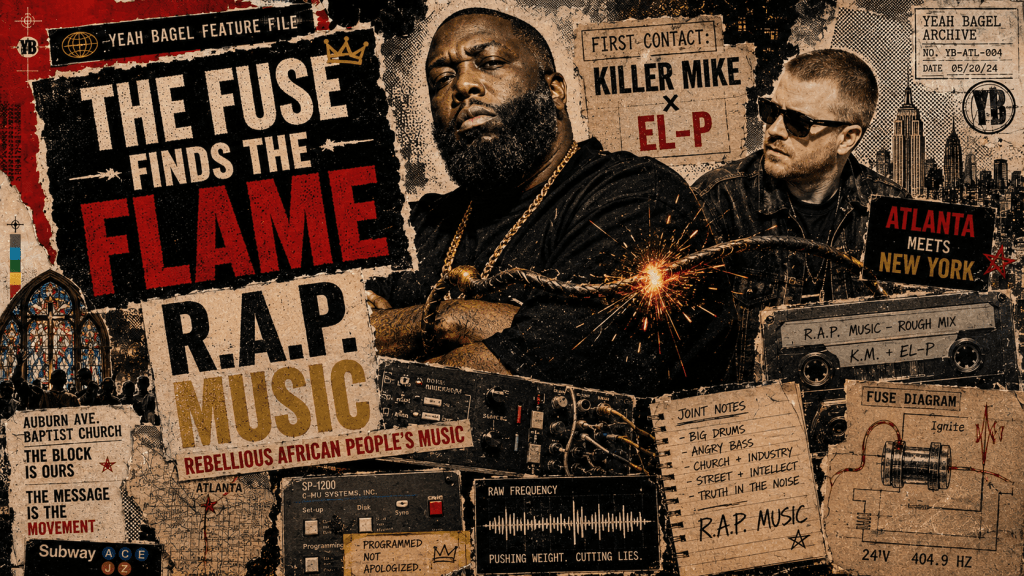
R.A.P. Music, released in 2012 and produced by El-P, did not sound like a comeback so much as a detonation in a locked room. The title stood for Rebellious African People’s Music, and the album treated rap not as entertainment product but as ancestral technology. Mike sounded newly focused, not softened but clarified. El-P’s production gave him a city of broken metal to stomp through. Every snare felt like a shutter being kicked in.
The record mattered because it reintroduced Killer Mike not as a veteran cameo or Southern cult figure, but as one of the most urgent MCs alive. It was political without becoming pamphlet-thin. It was furious without losing swing. It was intellectual without losing blood. It had jokes, threats, sermons and conspiracy-board intensity. It made you feel that rap, in the right hands, could still be a public emergency broadcast.
More importantly, it created the conditions for Run The Jewels.
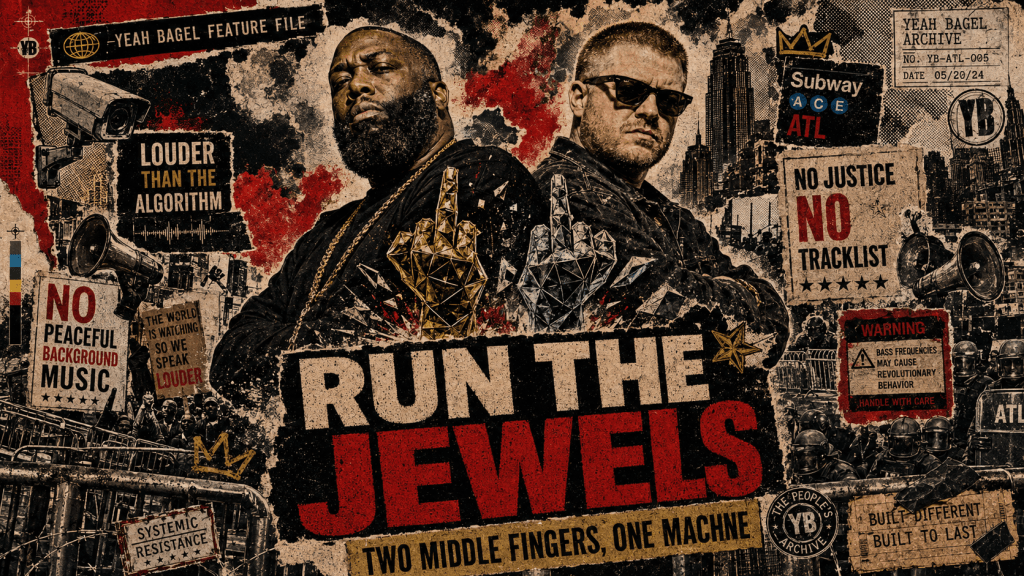
Run The Jewels: Two Middle Fingers, One Machine
Run The Jewels could have been a side project. Instead, it became a black-and-white fist logo stamped across the decade.
Mike and El-P found in each other a rare chemistry: two grown men with underground scars, industry bruises and no patience left for soft shoes. Their dynamic worked because it was not based on similarity. It was based on voltage. El-P brought dystopian architecture, cyberpunk panic, gallows humour and New York abrasion. Mike brought Southern command, preacherly force, revolutionary swagger and the ability to make a punchline land like a brick through stained glass.
Together, they became something leaner than either artist alone. The Run The Jewels records moved like armoured cars covered in graffiti. The music was loud, but not dumb. Funny, but not unserious. Violent in image, but often tender underneath. At their best, RTJ made solidarity sound like two men laughing in the face of a collapsing state, because crying would waste breath.
The timing helped, though “helped” feels too mild for such grim material. The 2010s gave Run The Jewels a political climate that made their anger feel not stylised but necessary. Police violence, austerity, surveillance, Trumpism, algorithmic rot, corporate rainbow-washing, liberal cowardice, right-wing carnival barking, all of it seemed to be waiting for the RTJ sound: huge drums, sirens, paranoia, jokes sharp enough to cut cable.
By RTJ4, released in 2020, the duo were no longer cult heroes. They were a major act without sanding down the edges that made them dangerous. Their work had become protest music for people allergic to acoustic piety. No campfire, no soft focus, no “we shall overcome” with stock footage. More like: we might not overcome, but we will name the beast properly before it eats us.
Citizen Mike, Problem Mike, Human Mike
The problem with becoming a political rapper is that eventually people start demanding you become a political solution. Killer Mike has never been that simple.
His activism has been real and visible: speeches, interviews, voting-rights advocacy, police-reform arguments, economic empowerment campaigns, support for Black-owned banks, small-business evangelism, public grief after killings, public fury after injustice. He has used celebrity not just to sell virtue but to push ideas about ownership, community infrastructure and political engagement.
He has also frustrated people who wanted a cleaner hero. His views on guns, policing, capitalism, local politics, electoral strategy and power can sit uneasily beside one another. At times he sounds radical enough to frighten cable news. At other times he sounds like the man cable news calls when it needs rage translated into civic responsibility. That contradiction is not a footnote. It is central.
Killer Mike’s public self is built from competing institutions: church, street, family, business, rap, Black radical tradition, Atlanta boosterism, American individualism, community obligation. He believes in systems and distrusts them. He preaches collective uplift and personal responsibility. He can roar against empire while talking like a neighbourhood capitalist. He is not always easy to flatten into a clean Yeah Bagel wall poster, unless the poster has five layers, two rips, a correction stamp and somebody shouting from behind it.
That is what keeps him interesting. He is not the fantasy of political purity. He is the sound of political life in the mud.
MICHAEL: The Mask Comes Home
After a decade of Run The Jewels dominance, MICHAEL arrived in 2023 like a man taking off armour in front of the congregation.
The album was not Killer Mike abandoning the superhero. It was Michael Render asking what the superhero had cost. The record went back to Atlanta, family, grief, church, memory and moral inheritance. It was grand, sometimes overstuffed, sometimes magnificent, full of choir light and funeral shadow. It sounded like someone walking through old rooms and finding that every object still had a witness statement attached.
Then came the Grammys. In 2024, MICHAEL won Best Rap Album, while “Scientists & Engineers” won Best Rap Song and Best Rap Performance. For an artist who had spent years being too much of one thing and not enough of another for the industry’s comfort, it was a strange kind of coronation. The same institutions that once struggled to file him had to give him trophies.
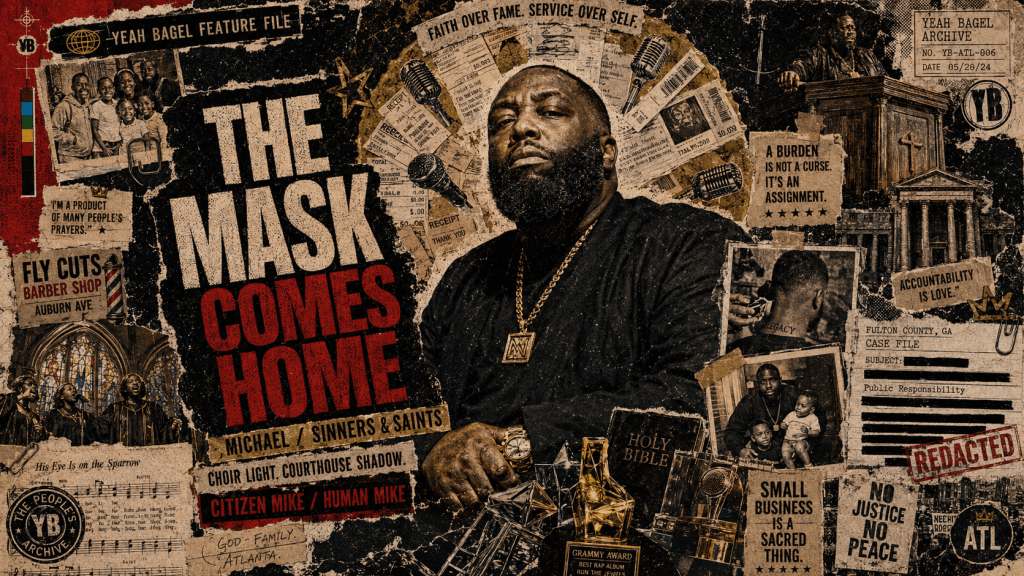
Of course, because this is Killer Mike’s life and not a tidy award-season montage, the night also came with chaos and headlines. Triumph and disorder arrived in the same suit. That too felt grimly on-brand: the preacher wins the room, then the room tries to cuff the preacher.
The following year’s Songs for Sinners & Saints, credited to Michael & The Mighty Midnight Revival, pushed the gospel impulse further. It was an epilogue to MICHAEL, but also a reminder that Mike’s music has always had church in it, even when it was cussing outside. His voice belongs to rap, but its architecture is often Baptist: call, response, testimony, rebuke, confession, altar call, collection plate, somebody’s auntie fanning herself in the third row.
Killer Mike Today: Heavy Crown, Dirty Boots
By 2026, Killer Mike occupies a rare position. He is both elder and instigator. Decorated but not domesticated. Mainstream-recognised but not quite house-trained. He can appear in Grammy records, gospel settings, activist panels, rap festivals, political controversies and underground-adjacent collaborations without seeming like a tourist in any of them.
That reach matters. Hip-hop has always had room for young fire, but it has not always known what to do with middle-aged force. Killer Mike has become one answer: age not as softening, but thickening. His voice now carries history. Not nostalgia, exactly. More like sediment. You hear earlier Atlanta in it, earlier fights, earlier betrayals, earlier jokes, earlier funerals, earlier campaigns, earlier mistakes.
He is not the future of rap. That would be too small and too silly. He is one of the people insisting rap has a past it can use, a present it can bite, and a civic function it should not abandon just because the platforms prefer mood music.
Which brings us, beautifully and strangely, to KNEECAP.
Smugglers & Scholars: Belfast Meets Atlanta In The Bass Fog
KNEECAP’s “Smugglers & Scholars” already sounded like a title Killer Mike could walk into wearing boots.
The phrase plays with Ireland’s old self-image as the land of saints and scholars, then drags it through borders, contraband, rebellion and working-class survival. It is a title about knowledge under pressure. Culture moved hand to hand. Language kept alive despite state violence. Books, songs, slogans, jokes and substances crossing lines they were never meant to cross. A people refusing to ask permission to remember themselves.
KNEECAP’s FENIAN era has been built from that kind of friction. The Belfast trio rap in Irish and English, weaponising humour, rave energy and republican provocation against the polite machinery that would prefer them grateful, quiet or safely exotic. The album arrived amid controversy, public condemnation, legal pressure and accusations that only seemed to make the band’s central argument louder: when power calls your language, rage or solidarity dangerous, sometimes the danger is the point.
The Killer Mike version of “Smugglers & Scholars” was released in May 2026 as a new version of the FENIAN track. Publicly, there does not yet appear to be a detailed origin story for the collaboration. No neat tale of a studio hang, no widely reported anecdote about who DM’d whom first, no mythic pub summit with a laptop balanced next to a pint. What is clear is the artistic logic. KNEECAP did not need a random American guest. They needed a voice that understood rap as resistance, language as weapon, community as battleground and history as something carried in the body.
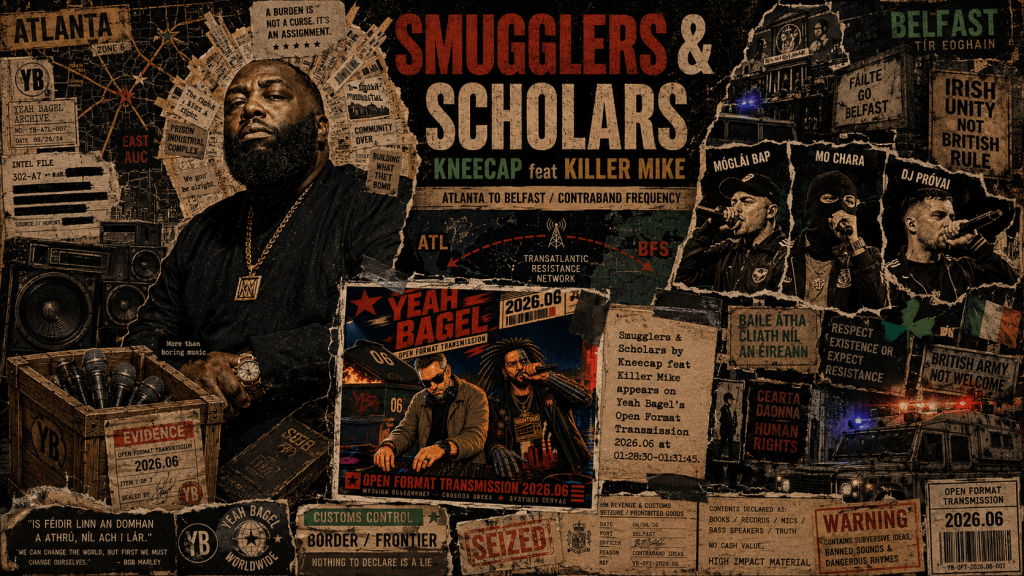
Killer Mike makes sense here because he has spent his career smuggling scholarship into riot music. He can sound like a street preacher, a political theorist, a corner-store philosopher and a man ready to flip a table, often within sixteen bars. KNEECAP, meanwhile, are scholars disguised as vandals and smugglers disguised as party-starters. Their best trick is making language politics feel like a bassline.
On “Smugglers & Scholars,” the meeting point is not geography. It is method. Atlanta and Belfast are not the same struggle, and flattening them into one would be lazy poster politics. But the collaboration works because both artists understand that culture under pressure develops hidden routes. A banned language becomes a chorus. A neighbourhood becomes a syllabus. A beat becomes a tunnel. A joke becomes a shield. A verse becomes a brick with a library card tucked inside.
For Killer Mike, the appearance feels less like a cameo than a late-career alignment. He has always been interested in the politics of self-determination, ownership, memory and resistance. KNEECAP bring those concerns into a different colonial history, a different language fight, a different island of ghosts and police lights. Mike does not have to become Irish to belong on the track. He just has to recognise the weather.
That is the story of Killer Mike in miniature. The boy who invented a superhero became the man who keeps finding rooms where the superhero is useful, then letting Michael Render walk in behind him with the heavier truth. From Atlanta to OutKast, from Monster to the grind, from El-P’s steel trap beats to Grammy gospel, from barbershop politics to Belfast bass pressure, Killer Mike has never been only one thing.
He is the preacher and the brawler. The businessman and the bomb-thrower. The citizen and the critic. The sinner and the choir director. The smuggler and the scholar.
And when he turns up on a KNEECAP track in 2026, it does not feel like a detour. It feels like another checkpoint on the same long road: boots dirty, voice raised, paperwork missing, message intact.
Smugglers & Scholars by KNEECAP feat Killer Mike appears at 01:28:30-01:31:45 on Yeah Bagel Open F0rmat Transmission 2026.06.
