
The Bird That Refused the Bin
There is something beautifully wrong about calling a band Pigeon.
In Britain, the pigeon gets treated like a flying receipt. A grey civic nuisance. A chip-shop satellite. A living scrap of pavement punctuation. It is there in every square, under every railway arch, watching the city pretend it is cleaner, richer, more civilised than it is.
But in other places, the pigeon is not a joke. It is a messenger. A pet. A traveller. A creature that knows routes through weather, war, hunger and distance. A bird that returns.
That gap is where Pigeon begin.
The Margate five-piece make music from the borderlands of belonging: West African rhythm, post-punk velocity, cosmic funk, disco pressure, synth wobble, guitar scrape, migratory memory. Their debut album OUTTANATIONAL does not politely blend genres. It lets them crash into each other, sweat on each other, argue under the lights, then somehow leave together at 3am with their arms around one another.
At the centre is Falle Nioke, vocalist, percussionist, spirit conductor, multilingual transmitter. But Pigeon are not merely a vehicle for one voice. They are a room of moving parts, a group that sounds like it found its shape by trusting the jam before the map. Drums and bass lock into something stubborn and bodily. Keys flicker like faulty arcade machines in a seaside arcade after closing. Guitar lines arrive clipped, wiry, sometimes sweet, sometimes with elbows out. Nioke’s voice then cuts through it all, not as decoration, but as weather.
He does not sit on top of the band. He moves through it.
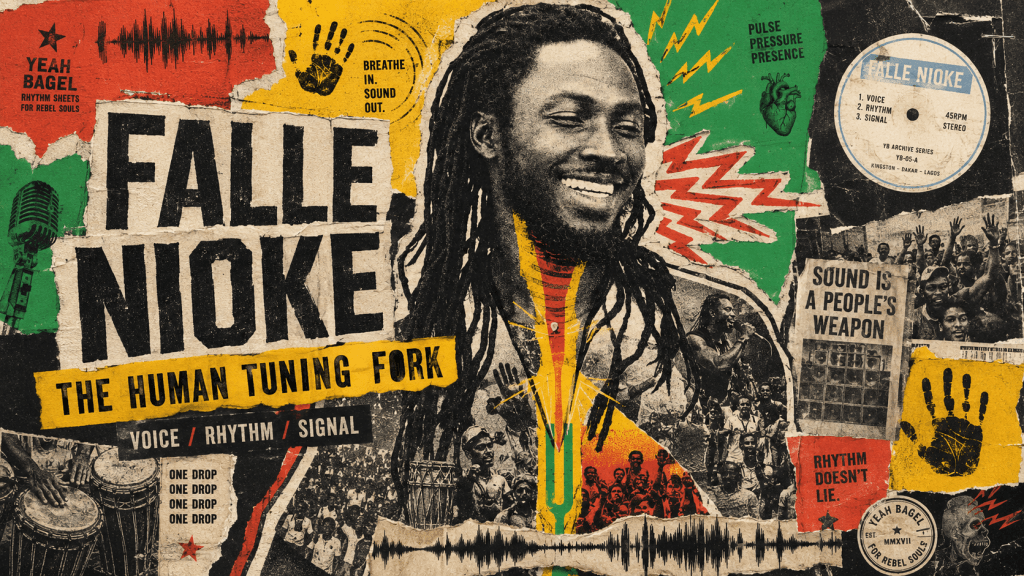
Falle Nioke, The Human Tuning Fork
Falle Nioke’s voice has the quality of something that has travelled too far to be casual about arrival. It can lift into falsetto, harden into declaration, bend into chant, soften into invitation, then suddenly flare like a street preacher catching the busker’s electricity.
There is no clean separation between singer and percussionist here. Nioke’s delivery often feels rhythmic before it is linguistic. The syllables carry body memory. Even when a listener does not understand every language passing through the song, the shape of meaning is there: insistence, joy, warning, grief, flirtation, release.
This matters because Pigeon’s music is not simply “global” in that supermarket playlist way where everything becomes nice, vaguely spicy wallpaper. It is sharper than that. It is music made by people who have arrived from elsewhere, lived through elsewhere, carried elsewhere into the room. It understands that migration is not a tasteful influence. It is paperwork, weather, love, suspicion, memory, language, rent, accents, food, jokes, silence, police, basslines.
Nioke’s solo work moves differently, but the same pulse is there. On “LDN Girl,” he turns towards the UK club scene with warmth rather than cynicism. The track is glossy, danceable, afrobeats-indebted, built around romance and recognition, but it is not just a love song to a woman. It is a love song to a city through a woman, to the energy of Brixton, Notting Hill Carnival, and the strange glamour of London when it decides, briefly, to open itself.
The phrase “London Girl” could have become postcard cheese in the wrong hands. Nioke makes it feel lived in. Less slogan, more smile across a crowded room.
Margate Is Not Miami, Unless You Close Your Eyes
Pigeon’s OUTTANATIONAL carries Margate inside it, which is important because Margate is a town that knows about faded glory, sudden reinvention, damp walls, art-school optimism, boarded windows, sea air and cheap euphoria. It is a place where the old English seaside fantasy has peeled back enough to show the scaffolding underneath.
That makes it a useful home for this music. Pigeon sound coastal, but not breezy. Their songs feel like they have salt in the cables. There is a holiday-town shimmer, but also the hard thud of survival behind the amusements.
On “117,” the band lean into their more experimental pressure. The groove does not announce itself with nightclub certainty. It seems to assemble in front of you, piece by piece, as if someone is wiring a machine while it is already running. Bass moves with purpose. Percussion snaps and bubbles. The track has that particular Pigeon trick of sounding loose and locked at the same time, like a band falling downstairs in perfect formation.
There is encouragement in it too, but not the beige wellness kind. The feeling is more hard-won: keep moving because stillness is where the bad thoughts park their vans.
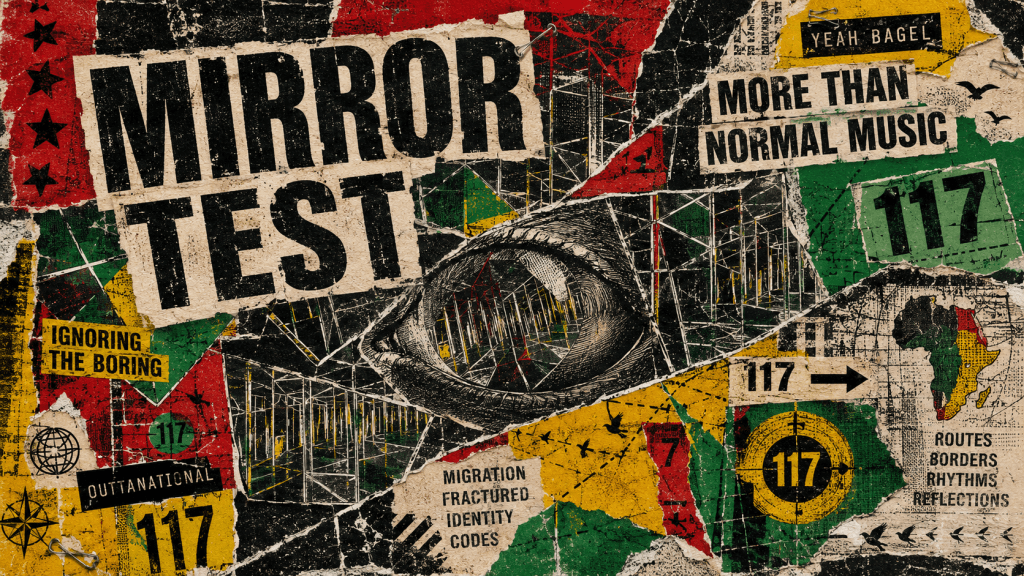
“Mirror Test” takes a different route. The title is almost too perfect for a band called Pigeon, because the mirror test is one of those scientific measures humans use to decide which animals have enough self-recognition to deserve our awe. The joke, of course, is that humans keep failing their own version of it. Nations fail it. Music scenes fail it. Cities fail it. Britain fails it hourly.
Pigeon pass by refusing the test entirely. They do not ask, “Who am I in your mirror?” They ask, “What happens if the mirror starts dancing?”
Outtanational, Not International
The word OUTTANATIONAL is doing a lot of work. It does not mean international. International still assumes nations are the primary units, neat blocks on a map shaking hands in a conference room. Outtanational suggests escape from that filing system. Outside the national. Beyond the passport booth. Past the suspicious little stamp.
That is why Pigeon are so useful now. They offer something more vivid than the usual genre romance. This is not post-punk “meeting” Afrobeat as a marketing angle. It is a band trying to invent a room where all its members can stand without becoming smaller.
The result is music that feels communal without being soft. It has bite. It has humour. It has hips. It has a sense of friction that never quite resolves, which is exactly why it works. The best cross-cultural music does not sand everything smooth. It lets the joins show. It lets the screws glint.
Pigeon’s rhythms do not behave like museum pieces. They are alive, urban, coastal, immediate. They are made for bodies, but not only for escape. They are made for bodies carrying histories that cannot be checked into the cloakroom.
The Solo Signal
Set against Pigeon’s collective blast, Falle Nioke’s “LDN Girl” feels like a second signal from the same transmitter. The band gives him the architecture of collision. The solo track gives him space to glow.

There is sweetness in “LDN Girl,” but it is not flimsy. It carries the old pop magic of a specific person becoming a whole place. The woman is not just a subject. She is a map. Through her, London becomes rhythm, Carnival, club heat, street-level glamour, romance with trainers on.
The track also understands something about the UK that the UK often forgets about itself: its culture is at its best when it stops guarding the door. London’s greatest musical moments have almost always come from arrival, mixture, mutation, stolen equipment, pirate signals, immigrant kitchens, warehouse speakers, bus routes, market streets, basement studios, someone’s cousin with a cracked laptop and excellent taste.
Nioke’s “LDN Girl” sits in that lineage without shouting about it. It does not need a lecture. It has a chorus.
Groove As Proof of Life
There is a tendency, especially in respectable music writing, to treat groove as less serious than gloom. If a record makes people dance, the assumption is that it must be avoiding the hard stuff. Pigeon and Falle Nioke make that idea look ridiculous.
Groove can be argument. Groove can be memory. Groove can be a method of staying human inside systems designed to make humans feel temporary. A bassline can carry history. A drum pattern can refuse borders. A chorus can smuggle dignity through a hostile room.
This is where Pigeon and Nioke meet most powerfully. Their music is not escapism in the sense of looking away. It is escape as action. Escape as movement. Escape as refusal to be fixed in place by someone else’s category.
The pigeon returns. The migrant arrives. The singer translates without shrinking. The band locks in. The mirror fogs. The seaside arcade starts glowing again. Somewhere between Margate and London, between Guinea and the UK, between post-punk angles and West African rhythmic gravity, Pigeon and Falle Nioke build a sound that does not ask permission to belong.
It simply lands.
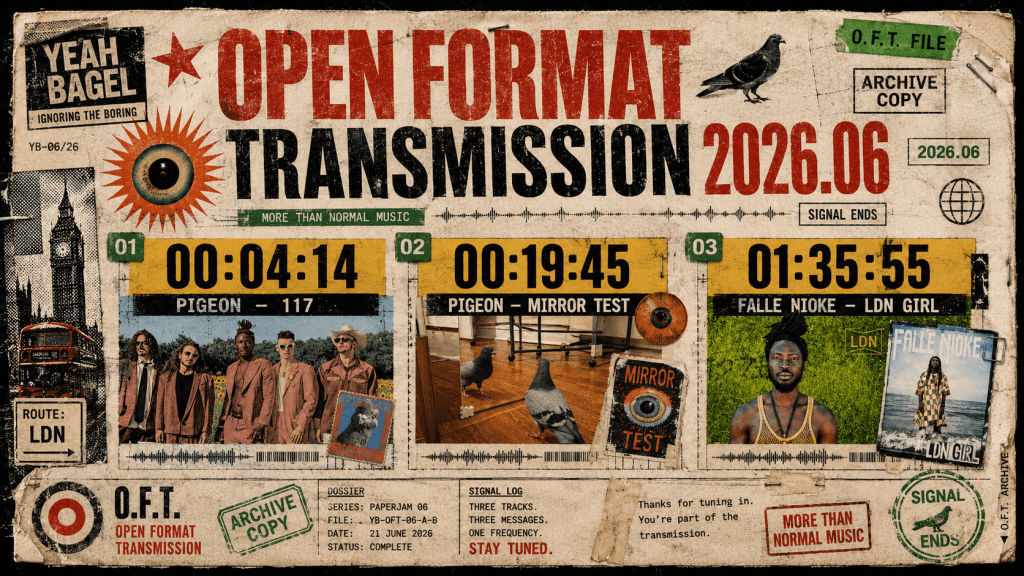
Pigeon’s “117,” Pigeon’s “Mirror Test,” and Falle Nioke’s “LDN Girl” appear on Yeah Bagel’s Open Format Transmission 2026.06:
00:04:14 Pigeon – 117
00:19:45 Pigeon – Mirror Test
01:35:55 Falle Nioke – LDN Girl
