
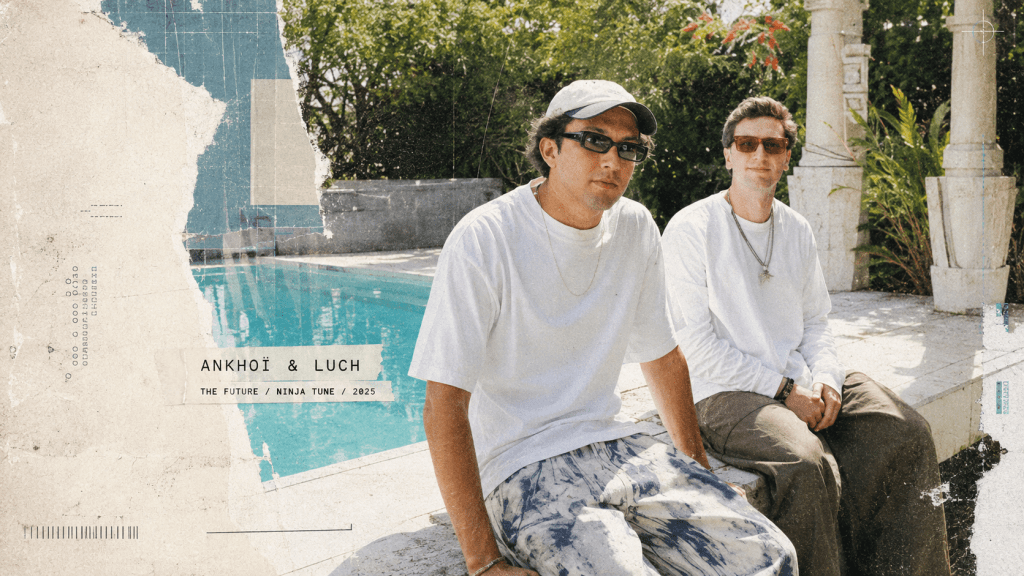
Ankhoï and Luch made a house record about moving forward. The interesting part is that it doesn’t sound entirely convinced that forward is where we’re going.
There’s a peculiar melancholy buried inside the idea of the future.
For most of pop culture, the word arrives dressed in chrome. Tomorrow means faster, brighter, newer: another machine, another skyline, another immaculate electronic dawn.
Ankhoï and Luch’s “THE FUTURE” isn’t particularly interested in any of that.
Its central thought is considerably stranger.
The future’s not what it used to be.
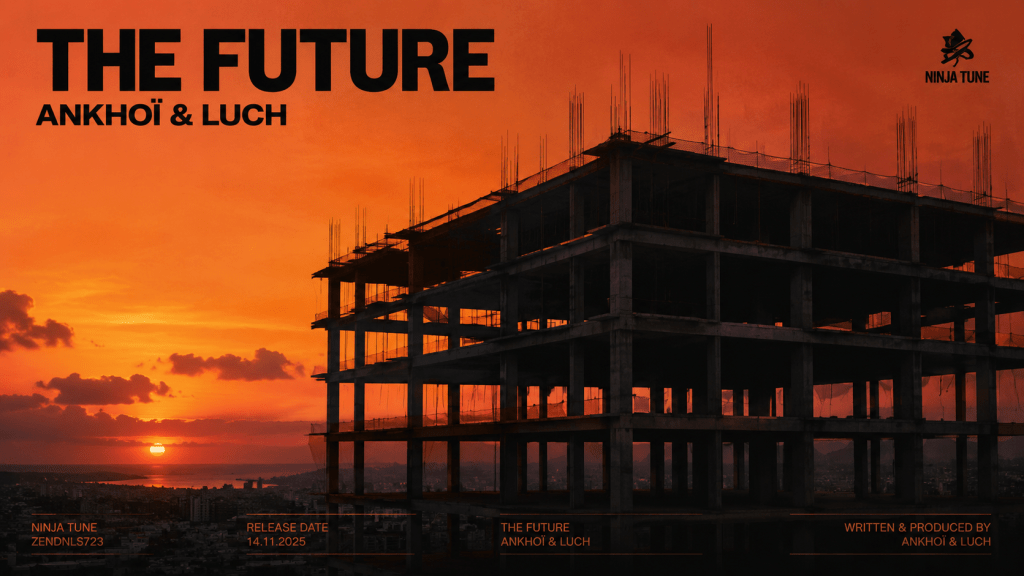
That line sits at the centre of a compact electronic record built for movement but haunted by change. Released through Ninja Tune on 14 November 2025, “THE FUTURE” was the first release on the label for both French-Moroccan producer Ankhoï and Mexico City-raised, Miami-based producer Luch. Ninja Tune says the track had already gathered support from Keinemusik and Adriatique before release.
But the interesting thing isn’t really who played it.
It’s where the idea came from.
AFTER THE STORM
Luch traces the beginnings of “THE FUTURE” to a journey through Acapulco after a hurricane.
He was travelling to play a show and working on the piece that would become the track with Ankhoï. Watching the city rebuild pushed his thoughts towards how suddenly circumstances can change. That experience, he says, shaped the record.
Ninja Tune doesn’t identify the hurricane in its release material, so there is no need to manufacture specificity where none exists. What matters for the record is the image: a city rebuilding itself while someone on their way to a nightclub is making dance music about what comes next.
That’s already enough.
It also explains why “THE FUTURE” carries an emotional weight that its architecture doesn’t immediately advertise.
At 122 BPM, this is unmistakably dance music. Its credits list Ankhoï and Luch as producers, with Luch also credited for mixing and mastering. Antony Burnett and Cleopatra Blay receive vocal performance credits, while the composition is credited to Anas El Mzaouak, Alex Burnett and Daniel Grossman.
Yet the song doesn’t behave like a triumph.
Its short vocal circles around two people apparently moving in opposite directions. One advances. The other returns. The relationship can’t simply be rearranged into something workable.
Then comes that phrase again:
the future’s not what it used to be.
Not the future looks bad.
Not there is no future.
Something more unsettling.
The thing we were promised still exists. It just doesn’t resemble the picture anymore.
ANKHOÏ: FEELING FIRST
That emotional ambiguity makes particular sense when you look at Ankhoï’s path into electronic music.
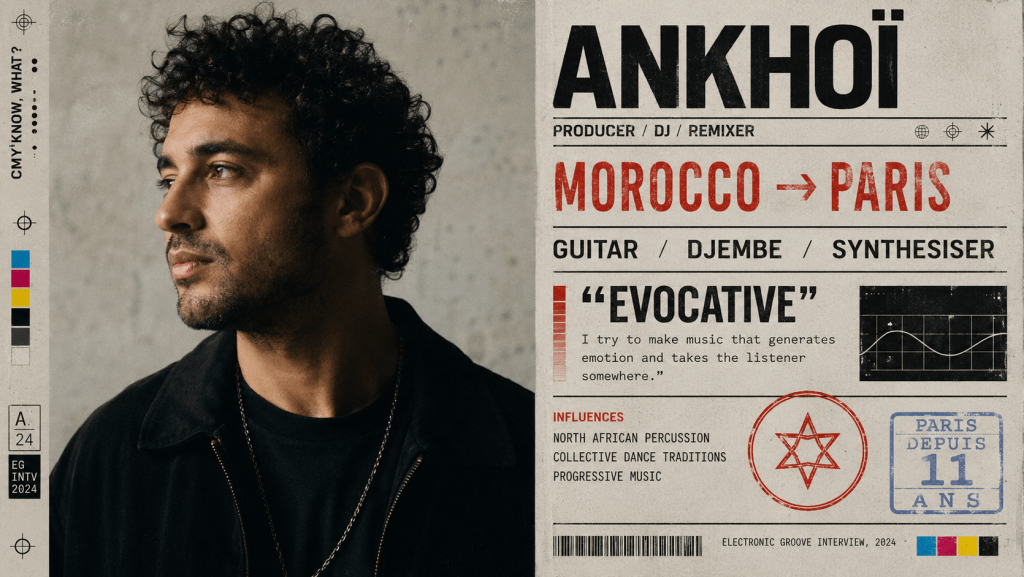
Born in Morocco, he has said his serious relationship with music began around the age of twelve, when his parents gave him a guitar and a djembe. He played in local folk groups while at school before discovering progressive music and electronic instruments at fifteen, eventually moving towards DJing and production.
Paris became the other important geographical point in the story. In a 2024 interview with Electronic Groove, Ankhoï said he had then been living there for eleven years and had developed his sound and produced almost all of his music in the city.
Morocco, though, remained audible.
He specifically identified the bendir, a North African frame drum, as a likely influence on the noisy and distorted percussion that appears in his productions. More broadly, he connected his approach to the Moroccan tradition of collective dancing and singing at gatherings: music as something shared rather than merely observed.
That combination helps explain “THE FUTURE”.
Ankhoï has described the word he wants associated with his music as “evocative”, saying that he tries to make records that generate emotion and take listeners somewhere. He has also resisted the idea of settling into one fixed signature sound.
Even his approach to remixing reveals the same instinct. Rather than simply rebuilding records as club tools, he has said he looks for music from other genres and cultures that already affects him, then tries to preserve its essence while creating another context for it.
His remix of Mayra Andrade’s “Afeto” grew from discovering Andrade’s work while in Brazil. His reworking of Keinemusik’s “Before the Flood” became another important release, and by 2024 Electronic Groove was describing his music as moving between progressive house, Afro-influenced house and melodic techno.
So when Luch brought him the vocal idea for “THE FUTURE”, Ankhoï says he connected immediately with its emotion and its theme of transformation. Their goal became fairly simple to articulate and much harder to execute: make something you can feel deeply without sacrificing the dancefloor.
That sentence might as well be the Ankhoï manifesto.
LUCH: THE PRODUCER WHO STARTED EARLY
Luch arrives at the same record from a different direction.
His name is Daniel Grossman. His own site dates the project to Mexico City in 2001 and identifies him as the founder of Gozar Records.
Resident Advisor’s biography gives the remarkable early chronology: DJing at eight, producing at twelve and working around Mexico City’s club scene by fourteen. At eighteen he signed with Honua Publishing.
His career has also extended considerably beyond records carrying the Luch name.
Honua Music describes Grossman as a producer, DJ, songwriter and multi-instrumentalist based in Miami, with songwriting and production credits including Anyma featuring Sevdaliza’s “Fortuna” and several Latin releases, alongside collaborations with artists including Jonas Blue, CNCO, Gabito Ballesteros and Santa Fe Klan.
Resident Advisor characterises the Luch sound as sitting where melodic house, Afro house and indie dance intersect, with vintage synthesisers, organic sounds, deep grooves and tropical textures recurring through the project.

In 2026 that project expanded further through Gozar Records. Luch’s official site identifies him as its founder, and by July Electronic Groove was describing his collaboration with Orsay, “Between Us”, as the label’s sixth release.
There is something fitting, then, about “THE FUTURE” sitting between these two producers.
Ankhoï repeatedly talks about emotional narrative.
Luch’s background suggests somebody who has spent most of his life understanding how records physically function.
One reaches towards feeling.
The other has been studying machinery since childhood.
“The Future” needs both.
FOUR LINES, ONE LARGE IDEA
The song itself is strikingly economical.
Its released edit runs just under two and a half minutes, while a 7:28 extended version followed on 15 December 2025.
The lyric consists of only four lines, according to the official metadata reproduced by Shazam. Rather than continually developing a narrative, those lines repeat until they become almost architectural.
That’s important.
Because repetition changes the meaning.
Hear a sentence once and it is information.
Hear it repeatedly over a house rhythm and it becomes a thought you can’t get rid of.
The future’s not what it used to be.
At first it sounds clever.
Then romantic.
Then melancholy.
Eventually it starts to feel political without ever becoming a political song.
The genius of the phrase is its grammatical impossibility. The future has never been anything. It is definitionally something that hasn’t happened yet.
What changes is our imagined version of it.
That’s the territory the record occupies.
The distance between what you thought was coming and what actually arrived.
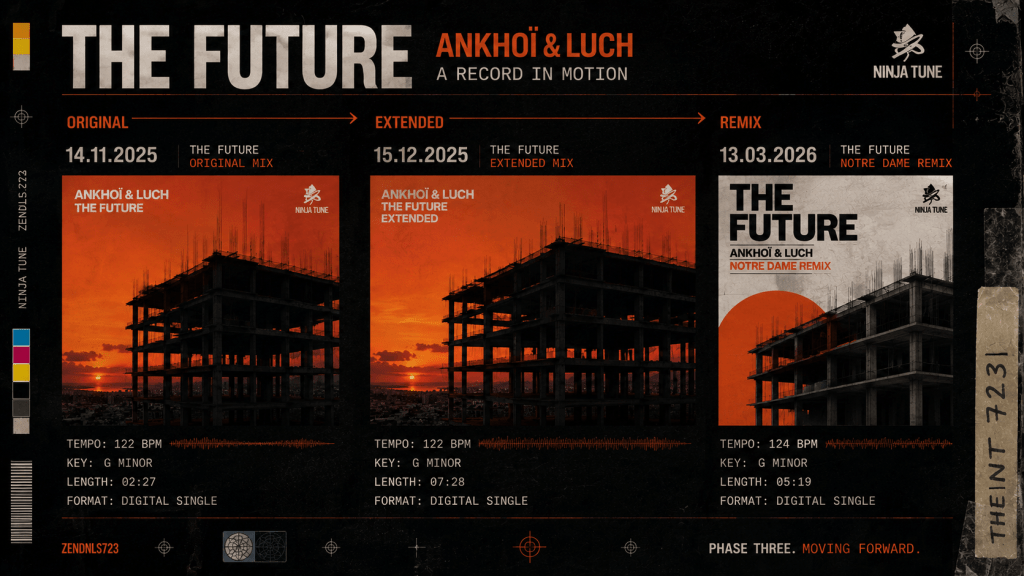
TOMORROW, REMIXED
“The Future” didn’t stop moving after its November release.
A club-length extended version followed in December, then French producer Notre Dame delivered an official remix through Ninja Tune in March 2026. Ninja Tune described the original as having gathered significant electronic-scene support following months of anticipation.
For Ankhoï, it also became the beginning of an ongoing relationship with Ninja Tune. The label’s current artist page lists “THE FUTURE”, its extended version, the Notre Dame remix and the subsequent single “Do You Think Of Me?” among his releases there.
Luch, meanwhile, continued developing his own Gozar ecosystem.
Which makes “THE FUTURE” feel increasingly like a crossroads rather than an isolated collaboration.
Two artists approaching house music from different histories meet at precisely the point where their obsessions overlap: groove, atmosphere, memory and emotional movement.
And somewhere underneath it all sits an image of buildings going back up in Acapulco.
Construction after destruction.
A record made for bodies moving forward while its lyric keeps looking backwards.
Maybe that’s why “THE FUTURE” works.
Dance music has always had an unusually intimate relationship with tomorrow. New machines. New scenes. New drugs. New identities. New ways for strangers to assemble in dark rooms and temporarily imagine another version of the world.
But tomorrow isn’t necessarily utopia.
Sometimes it is simply whatever survives today.
Ankhoï and Luch don’t try to resolve that contradiction.
They put a kick drum underneath it.
And keep moving.
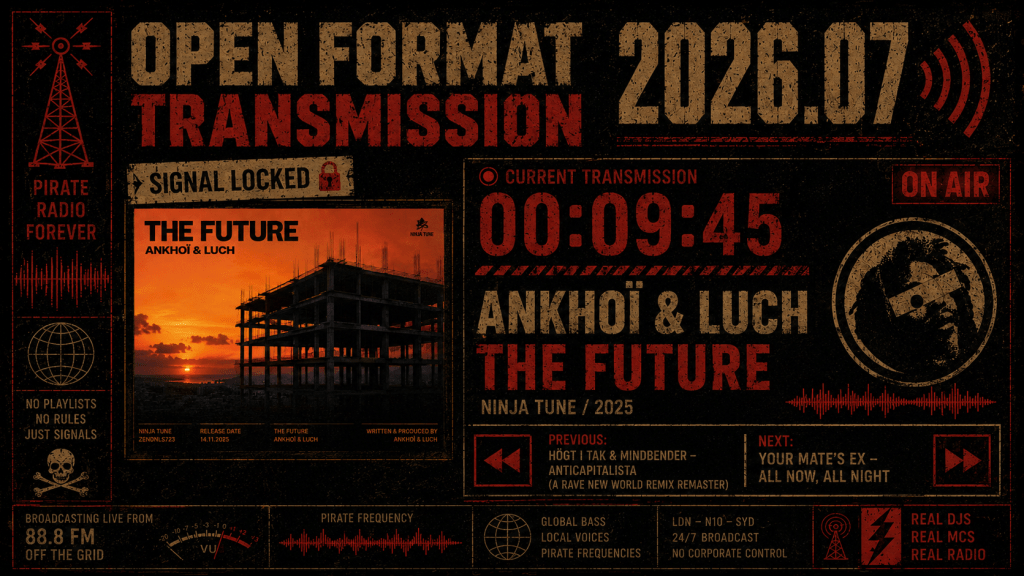
"THE FUTURE" by Ankhoï and Luch was released 14 November 2025 as a digital single on Ninja Tune as their label debut. It appears on Yeah Bagel's Open Format Transmission 2026.07 at 00:09:45
