
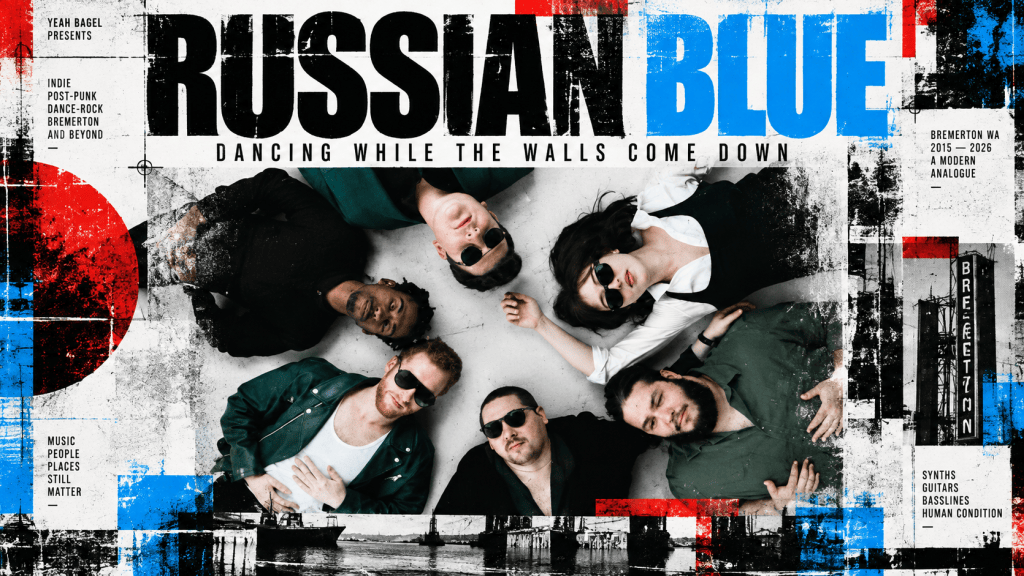
There are records that invite you to dance because everything is fine.
Then there are records that understand dancing might be what you do when everything emphatically isn’t.
Russian Blue belong to the second category.
The Bremerton, Washington band’s A Modern Analogue is built from basslines that keep moving, guitars that twitch and scrape, synthesizers glowing somewhere between indie rock and the remains of a nightclub, and songs sufficiently self-aware to occasionally turn around and inspect themselves while they are happening.
It is music with its shirt stuck to its back.
It is also music preoccupied with shame, doubt, memory, art and the uncomfortable business of being observed while trying to make something meaningful.
Released on 24 January 2026 through Pegasus Theory, A Modern Analogue contains nine tracks across 37 minutes. The label describes it as sitting between disco-punk and indietronica, with early LCD Soundsystem an acknowledged sonic reference. KEXP heard something similar, comparing its 2000s dance-rock charge to both early LCD Soundsystem and TV on the Radio.
Those comparisons are useful.
They are not the whole story.
Because Russian Blue have been travelling towards this particular dancefloor for more than a decade.
STARTING IN A SCHOOL AUDITORIUM
Russian Blue began in Bremerton in 2015.
Colin Weaver initially formed a band with two high-school friends, a configuration that survived for only a couple of months. Weaver and guitarist Ike Mow subsequently resurrected the idea for their school talent show, recruiting Justino Arthaud-Baza on drums. Their first original song was called “All About Me”, performed by three teenagers on what Weaver later remembered as an intimidatingly large auditorium stage.
It was an unglamorous beginning for a group that would gradually become part of Bremerton’s local musical furniture.
Zara Brann joined in 2019 after an unlikely apprenticeship involving their high-school production of School of Rock. Brann had played Katie in the musical, learning bass with Weaver’s help, and subsequently had roughly three months to learn around 16 Russian Blue songs before an album-release show.
By then the band had released Hug the Wall in 2019. But the Russian Blue that emerged afterwards was changing.
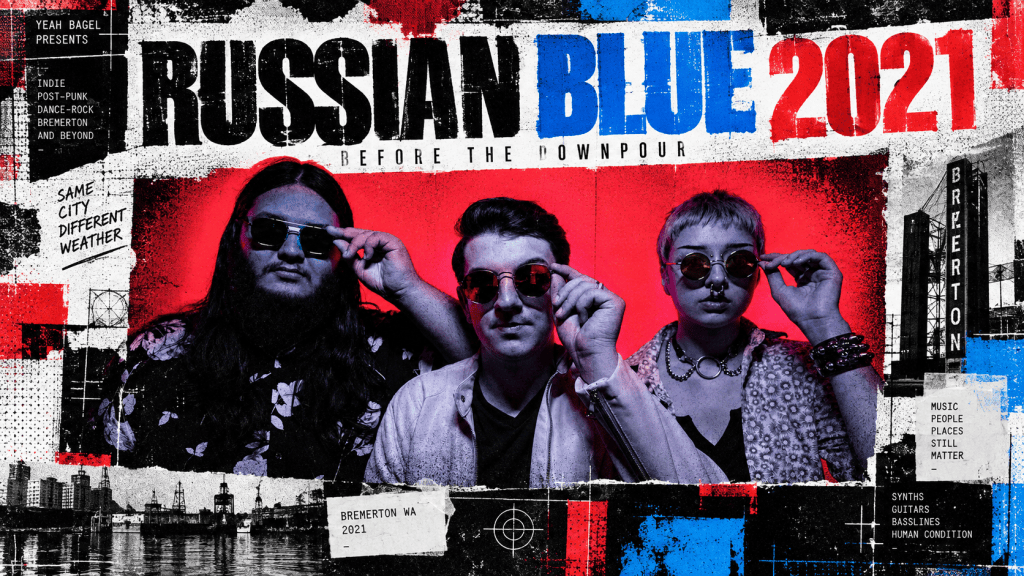
The pandemic interrupted plans for a 2020 tour across Washington and Oregon, with further dates intended for Utah and California. Like countless bands, Russian Blue ended up replacing physical shows with livestreams. At the same time, their personnel and musical ambitions were shifting. Mow departed, while Weaver was increasingly interested in writing material that was more personal and emotionally exposed.
That change produced 2022’s The Downpour, Perpetual.
By November of that year, the group consisted of Weaver, Arthaud-Baza, Brann and guitarist Jordan Eller. Weaver was writing the songs, singing and playing guitar and keyboards. He told the Kitsap Daily News that the post-pandemic band wanted its performances to become “more emotional, more powerful”, both for themselves and their audience.
Brann provided an even better description of the band’s emerging identity: imagine New York garage rock colliding with 1980s post-punk, then put a deeply unhappy man with clever indie-rock lyrics on top.
Which is almost annoyingly accurate.
THEN SOMEBODY FOUND THE DRUM MACHINE
By A Modern Analogue, something else has entered the bloodstream.
Movement.
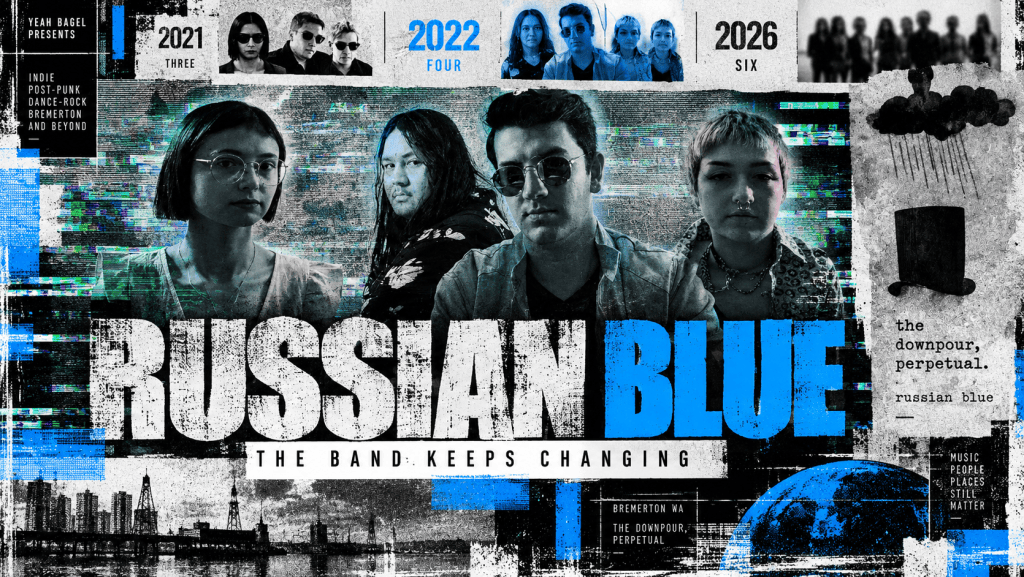
Russian Blue’s own Bandcamp still describes the project broadly as an indie/alternative-rock group with an “eclectic and often unpredictable sound”, while Pegasus Theory calls the current incarnation a synth-driven post-punk sextet. Apple Music locates the band in Bremerton; KEXP likewise identifies them as a six-piece.
But genre taxonomy becomes slightly inadequate once A Modern Analogue starts moving.
KEXP called it a record of nostalgic 2000s dance-rock, pointing towards the rhythmic adventurousness of early LCD Soundsystem and TV on the Radio. That description came with something more significant than a neat comparison: KEXP identified Russian Blue as a noteworthy emerging act from Kitsap County.
The station subsequently put some numbers behind the enthusiasm.
For the week of 6–12 February 2026, A Modern Analogue reached No. 5 on KEXP’s overall Top 90 and No. 2 on its Northwest chart. It remained in KEXP’s charts in subsequent weeks, including Northwest placements in March.
For a band whose singer once joked that they could pack rooms in their “little navy town” while being irrelevant everywhere else, that feels significant.
The radius is widening.
A MODERN ANALOGUE
There is a particularly good contradiction sitting inside the album title.
Modern.
Analogue.
New and old, machine and body, forward motion and inherited damage.
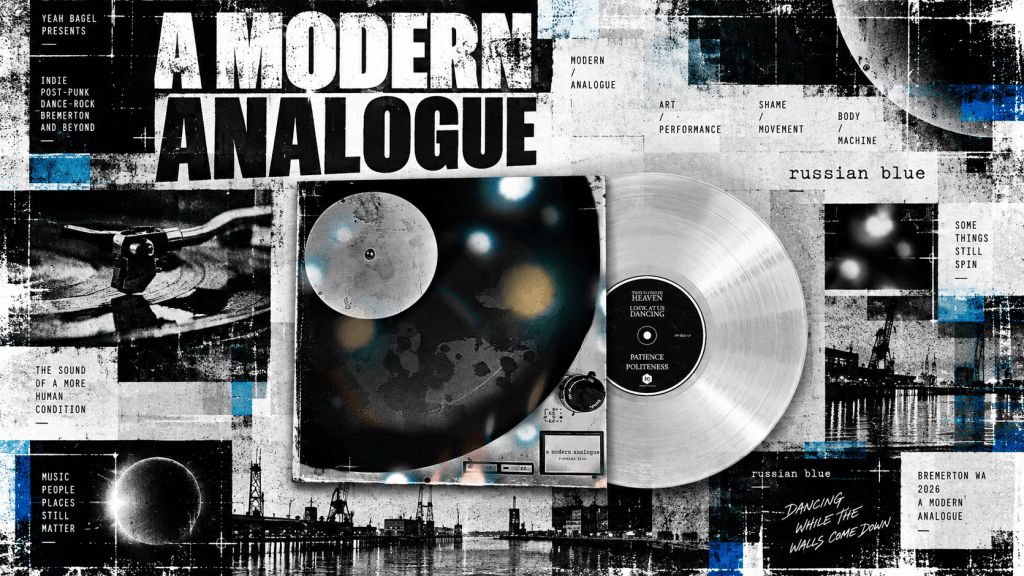
Pegasus Theory describes A Modern Analogue as deliberately conceived as an album rather than a collection of streaming-ready singles. Songs move through unconventional structures; motifs recur; arrangements change shape; ideas travel between tracks. The stated lyrical territory is equally interconnected: creativity and performance, shame, self-doubt and inherited generational trauma.
That makes the record’s dance-rock machinery more interesting.
These aren’t uncomplicated escape songs.
The rhythm is often the mechanism by which Russian Blue can approach things that would otherwise be unbearable to stare at.
Sometimes the body has to start moving before the brain will tell the truth.
And that is where the two Russian Blue tracks appearing on Open Format Transmission 2026.08 become especially revealing.
LEID
Oddly, the album begins with something that sounds as though it has already arrived halfway through an argument.
“Leid” is track one.
It runs 3:20 and was also issued as a single on 5 January 2026, shortly before the album.
The lyric is fractured and self-interrogating. Its narrator is trying to explain something while simultaneously questioning the explanation, bouncing between injury, ridicule, usefulness and the suspicion that language itself isn’t quite up to the job.
The repeated question is essentially whether what is happening should be taken literally.
Which is a dangerous question to ask on the first track of an album this slippery.
There is something important here about Russian Blue’s writing. Weaver does not always appear interested in presenting emotional experience as a solved equation. The songs can retain the confusion of being inside the event.
That tendency has history.
Back in 2021, Weaver talked about filling ten notebooks with lyrics and wanting Russian Blue’s music to address difficult subjects with greater intention. The band were already moving away from what Brann characterised as their earlier, more youthful material towards something more personal, serious and emotional.
Five years later, A Modern Analogue feels less like the abandonment of that project than its mutation.
The sadness learned to dance.
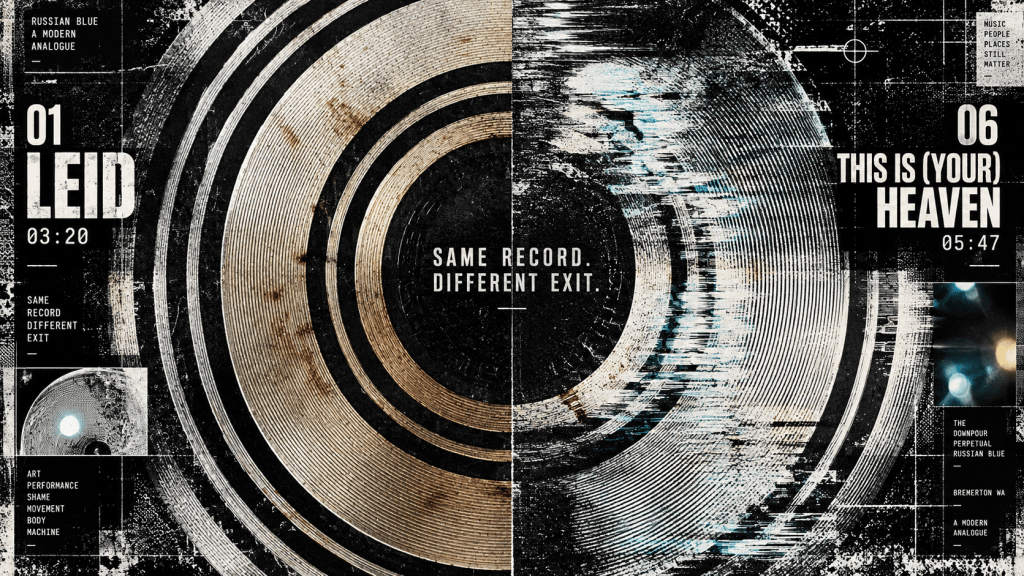
THIS IS (YOUR) HEAVEN
And then there is the record’s sixth track.
“This Is (Your) Heaven” lasts 5:47, making it one of A Modern Analogue’s longest pieces.
The title alone contains a tiny piece of typographical sabotage.
Not simply This Is Your Heaven.
This Is (Your) Heaven.
Those parentheses put the ownership under suspicion.
The song circles performance, observation, self-consciousness and the need for somebody else to witness what you are doing. Eventually its supposed heaven is revealed as distinctly underwhelming, and the song starts pushing towards the possibility that liberation might require getting out of your own way.
The album’s official description matters here. Pegasus Theory says its narrator repeatedly speaks directly to the listener while wrestling with the relationship between creating art and the shame and self-doubt attached to doing it.
“This Is (Your) Heaven” turns that tension into something physical.
It keeps going.
It repeats.
It worries at itself.
The groove becomes both propulsion and trap.
There is an intriguing lineage here. In 2021 Russian Blue openly named Interpol, The Strokes, Yeah Yeah Yeahs and The Walkmen among their influences, placing themselves in the lineage of the New York post-punk revival and, behind it, British post-punk.
A Modern Analogue feels like someone subsequently opened another door in that particular record collection.
Behind it were cowbells, sequencers, dance-punk, nervous funk and the possibility that existential collapse might actually sound better at 2am.
THE BAND THAT KEPT CHANGING
Perhaps Russian Blue’s most useful characteristic is that there doesn’t appear to be a single definitive Russian Blue.
The teenage band is not the 2019 band.
The 2019 band is not the group that made The Downpour, Perpetual.
And that group isn’t quite the six-piece responsible for A Modern Analogue.
That is not inconsistency.
It is development happening in public.
The group’s recorded catalogue now includes The Downpour, Perpetual from 2022 and A Modern Analogue from 2026, alongside singles including “HANDS!”, “Patience”, “Leid”, “For the Sake of It” and, most recently, July 2026’s “The Centrist”.
And the audience appears to be expanding with them.
Beyond its KEXP chart showing, the album received a KEXP recommendation as an emerging Pacific Northwest record, and the station later presented a Russian Blue show in Tacoma in July 2026.
A band formed for a high-school talent show has survived long enough to become something none of the people standing on that oversized auditorium stage could reasonably have predicted.
That may be the more interesting definition of A Modern Analogue.
Not nostalgia.
Continuity.
Old circuitry carrying a new signal.
OPEN FORMAT TRANSMISSION 2026.08
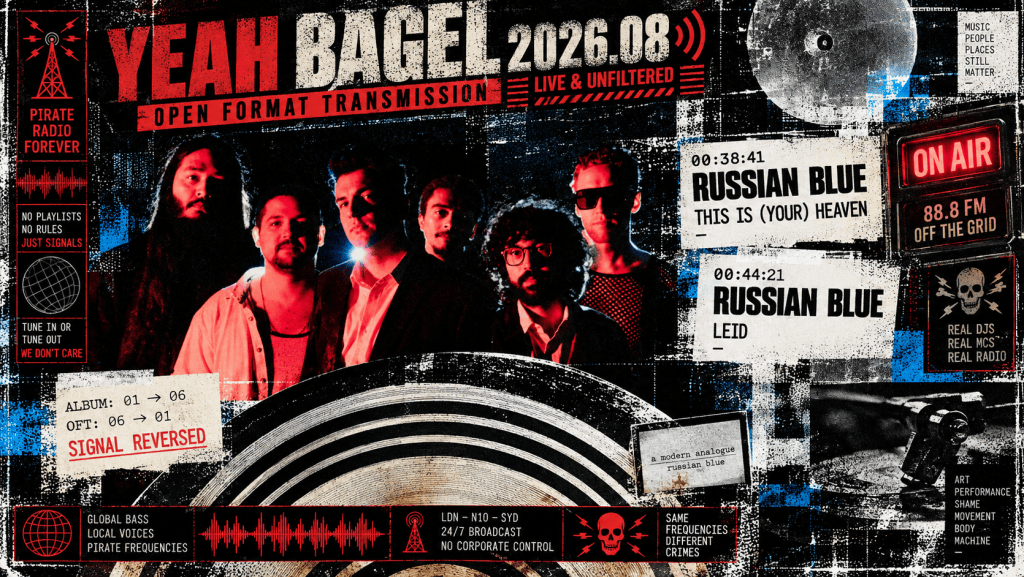
Which brings Russian Blue into Open Format Transmission 2026.08 twice.
First comes “This Is (Your) Heaven” at 00:38:41.
Then, at 00:44:21, “Leid”.
It reverses their order on A Modern Analogue, where “Leid” opens the album and “This Is (Your) Heaven” arrives as track six.
And in an open-format mix, that reversal changes their function.
“This Is (Your) Heaven” arrives first as the invitation: nearly six minutes of nervous propulsion, self-consciousness and movement. It opens the door.
Then “Leid” follows it through.
Two tracks from the same record, but two slightly different versions of Russian Blue: one stretching outward into dance-punk repetition, the other compressing the band’s emotional unease into something shorter and more jagged.
Together they occupy a little under ten minutes of the transmission.
Long enough to stop being a cameo.
Long enough to become a room.
And that feels right for Russian Blue.
Because somewhere between Bremerton High School in 2015 and A Modern Analogue in 2026, a band that once worried about whether anyone outside its hometown would care discovered a remarkably effective response.
Keep changing.
Keep making the room bigger.
And if the walls start coming down, make sure there’s still a beat playing when they hit the floor.
