

Three albums into a career built on black dogs, unkillable roaches and whole invented worlds, Genesis Owusu has stopped hiding reality behind characters. On REDSTAR WU & THE WORLDWIDE SCOURGE, the signal is direct, overloaded and very deliberately difficult to ignore.
The transmission begins already in the red.
A voice repeats. The rhythm feels less assembled than activated. Then Genesis Owusu arrives as if somebody has kicked open the studio door and handed him control of a transmitter nobody has worked out how to shut down.
That is “PIRATE RADIO”, the opening track of REDSTAR WU & THE WORLDWIDE SCOURGE, Owusu’s third album, released through Ourness on 15 May 2026. The song itself arrived earlier, on 10 September 2025, the first broadcast from a record that would eventually turn its attention toward misinformation, online paranoia, political division, wealth, racism, social media and the strange feedback loop of living through all of them simultaneously.
For an artist who has always built elaborate worlds around difficult things, the significant development is not that Genesis Owusu has suddenly become interested in the state of the world.
It is that this time he has stopped disguising it.
FROM GHANA TO CANBERRA
Genesis Owusu was born Kofi Owusu-Ansah in Ghana and moved with his family to Canberra as a young child. He has spoken about growing up with Ghanaian highlife playing at home, his mother leading a church gospel choir and his father maintaining an eclectic record collection. Before songwriting there were stories and poetry, an instinct for turning experience into narrative that would later become central to his records.
Canberra provided another part of that education. Owusu has described growing up as a Black child in predominantly white surroundings and learning early how race could change the way a room behaved around him. Those experiences would eventually feed directly into his first album rather than simply sitting somewhere outside the music as biography.

And that distinction matters with Genesis Owusu.
The life and the record are rarely separate objects.
They collide, put costumes on each other, then start arguing.
TWO BLACK DOGS
Released in 2021, Smiling With No Teeth transformed two of Owusu’s recurring experiences into characters.
One black dog represented depression. The other came from the racist slur he had experienced himself. Owusu has explained that personifying them allowed him to explore the relationship between racism and mental health without reducing either subject to exposition. The musical possibilities expanded with the metaphor: seduction and funk for one dog, confrontation and abrasion for the other.
The resulting record refused to sit neatly inside hip-hop. Soul, funk, post-punk, rock and pop crowded into the same building, with Kirin J Callinan, Michael Di Francesco of Touch Sensitive, Julian Sudek and Andrew Klippel among the musicians involved in its creation.
Recognition followed quickly. Smiling With No Teeth won Album of the Year, Best Hip Hop Release, Best Independent Release and Best Cover Art at the 2021 ARIA Awards. It also won triple j’s Australian Album of the Year and, in March 2022, the Australian Music Prize.

The strange thing was that success did not make Owusu’s fictional universe smaller.
It gave him room to build another one.
ENTER THE ROACH
For 2023’s STRUGGLER, the dogs disappeared and a cockroach took their place.
Owusu drew partly from absurdist literature including Kafka and Beckett, imagining the struggler as a roach attempting to survive while forces enormously more powerful than itself try to crush it. He described the creature as insignificant but almost impossible to eradicate: even after one is destroyed, another emerges.
The allegory proved elastic enough to hold questions about survival, power and how much control anybody really has over the forces shaping their lives. STRUGGLER subsequently won three ARIAs in 2023: Album of the Year, Best Hip Hop/Rap Release and Best Independent Release, bringing Owusu’s total from those two album campaigns to seven ARIA Awards.
Black dogs.
A roach.
Entire mythologies between the artist and the thing he wanted to say.
Then the world became too loud for metaphor.

NO MORE COSTUMES
Owusu began making REDSTAR WU & THE WORLDWIDE SCOURGE in 2024 with producer Dann Hume, working for roughly two months inside a converted church in Barry, Wales. He has recalled that the location offered an unusually isolated place to work, even as racial unrest was occurring elsewhere in the UK during the recording period.
The album grew out of that collision between sanctuary and incoming information.
Owusu told DRAFT that he no longer felt he had the luxury of remaining ambiguous. Rather than create another creature to carry the argument for him, he wanted the new record to address contemporary events directly, while ultimately returning to questions of community and recognising humanity in other people.
Even Redstar Wu is less a character than an alias. Owusu told Apple Music that this was his least fantastical album, rooted deliberately in the present rather than an invented universe. The “worldwide scourge” of the title refers, in his explanation, to the hatred, greed and prejudice he believes have intensified through the 2020s.

The official release describes the 14-track album as a response to political, social and economic turmoil, and the music refuses a single genre in much the same way the subject matter refuses a single villain. Neo-soul, alt-pop, synth-punk, funk and other forms keep bleeding into one another.
The method is important.
This isn’t chaos added as decoration.
The chaos is the subject.
PIRATE RADIO
That is why “PIRATE RADIO” has to open the record.
The track was written by Owusu and Dann Hume, with Hume also handling production. Its lyrics move through mass hysteria, social-media fixation, online grievance and contemporary public figures at a speed that makes the information itself feel unstable.
Pitchfork heard rave-rock and post-industrial abrasion in it; NME noted the claustrophobic beat and its deliberate lyrical reference to The Prodigy’s “Breathe”. Both readings make sense of a song structured less like an argument and more like someone flicking rapidly between stations and discovering that every frequency is shouting.
And there is the title.
Pirate radio traditionally suggests transmission from outside sanctioned channels. Owusu turns that image inward. The pirate station here feels less like a physical tower than consciousness itself: competing voices, feeds, opinions, grievances, personalities and information all attempting to occupy the same bandwidth.
He isn’t standing outside the noise describing it.
He is transmitting from inside it.
🔴 PSYCHOSEMANTIC / SIGNAL OVERLOAD / NO CLEAR FREQUENCY
MISSING INFORMATION
Eight tracks into REDSTAR WU & THE WORLDWIDE SCOURGE comes “MOST NORMAL AMERICAN VOTER:”.
The colon in the title almost makes it look like a label awaiting evidence.
What follows is character writing of a different kind from the black dogs or the Roach. Owusu told Apple Music that he wrote the song while watching a US presidential election and observing the paranoia, misinformation and conspiracy culture surrounding it, particularly QAnon. Rather than writing about that worldview from outside, the song adopts the perspective of somebody consumed by it.
The narrator sees conspiracies multiplying everywhere and repeatedly returns to the idea of “missing information” while remaining completely certain of his conclusions. Owusu’s own Bandcamp notes confirm Hume supplied drums and programming, bass synth, synth and electric guitar, with Owusu on lead and backing vocals.
That combination gives the track one of the album’s nastier little tricks.
Its protagonist believes he is uncovering reality while the song keeps revealing how unstable his reality has become.
The title is not a demographic claim about American voters generally. It is satire aimed at one paranoid fictional perspective, with Owusu explicitly identifying the conspiratorial environment that inspired it.
And in the wider album sequence, that matters because REDSTAR WU is not merely interested in bad information.
It is interested in what happens to people after they live inside it long enough.

THE EXIT IS OTHER PEOPLE
For all the fury around REDSTAR WU & THE WORLDWIDE SCOURGE, Owusu has repeatedly described the record as ultimately concerned with community.
Pitchfork noted that the album moves from dystopian anger toward something more cautiously hopeful, particularly as later songs begin considering coalition and solidarity rather than simply confrontation. Owusu similarly told Apple Music that disagreement does not erase the possibility of people working together on shared problems.
That feels like the significant evolutionary step.
Smiling With No Teeth externalised pain as dogs.
STRUGGLER turned survival into a roach running beneath the boot.
REDSTAR WU finally looks straight through the fourth wall.
No creature.
No fable.
No protective glass.
Just the signal.
OPEN FORMAT TRANSMISSION 2026.08
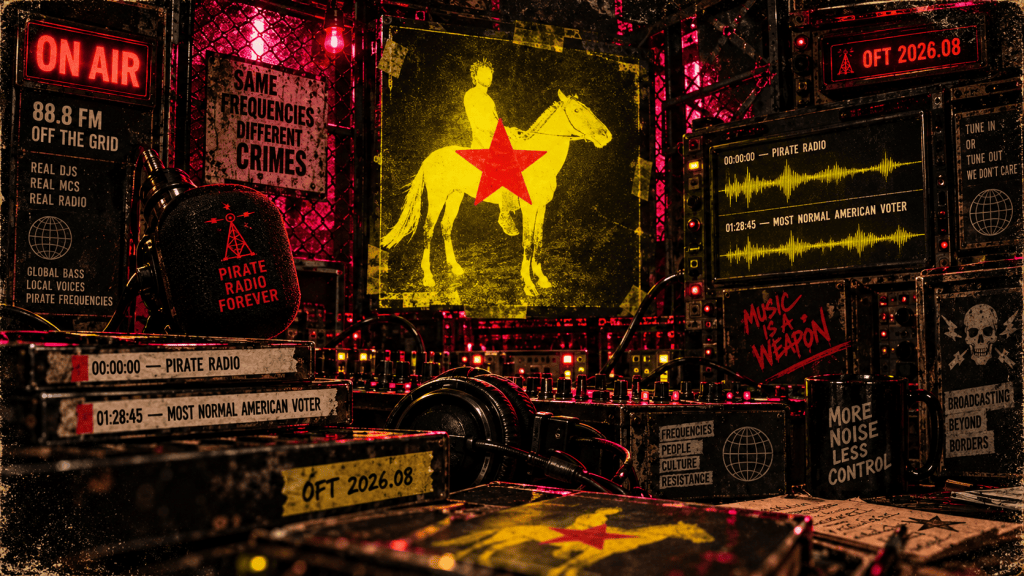
And so Open Format Transmission 2026.08 begins exactly where REDSTAR WU & THE WORLDWIDE SCOURGE begins.
00:00:00. Genesis Owusu. “PIRATE RADIO”.
Not twenty minutes in. Not after the room has warmed up. The first sound out of the gate.
It turns the opening of the transmission into a declaration of intent: this one starts with the dial already spinning.
Then, almost ninety minutes later, Owusu returns.
01:28:45. “MOST NORMAL AMERICAN VOTER:”
The placement creates an accidental little circuit between the two tracks. “PIRATE RADIO” begins with information attacking from every direction. “MOST NORMAL AMERICAN VOTER:” returns later from inside the head of somebody who has tried to make sense of that information and disappeared down the hole.
Broadcast.
Reception.
Distortion.
Certainty.
Back to broadcast.
Two tracks from the same record, separated by nearly an hour and a half of OFT 2026.08, behaving almost like opposite ends of the same damaged antenna.
Genesis Owusu begins the transmission by asking what happens when everybody gets a frequency.
He returns at 01:28:45 with one possible answer.
Sometimes the signal gets through.
Sometimes the signal becomes the person listening to it.
