There is a particular kind of music made for the point where the night stops behaving properly.
Not peak time. Not afters exactly. Somewhere less measurable. The room has thinned out, daylight is beginning to threaten the edges, and a record arrives that seems to contain several different times at once.
Birds Of Pandæmonium make music for that place.
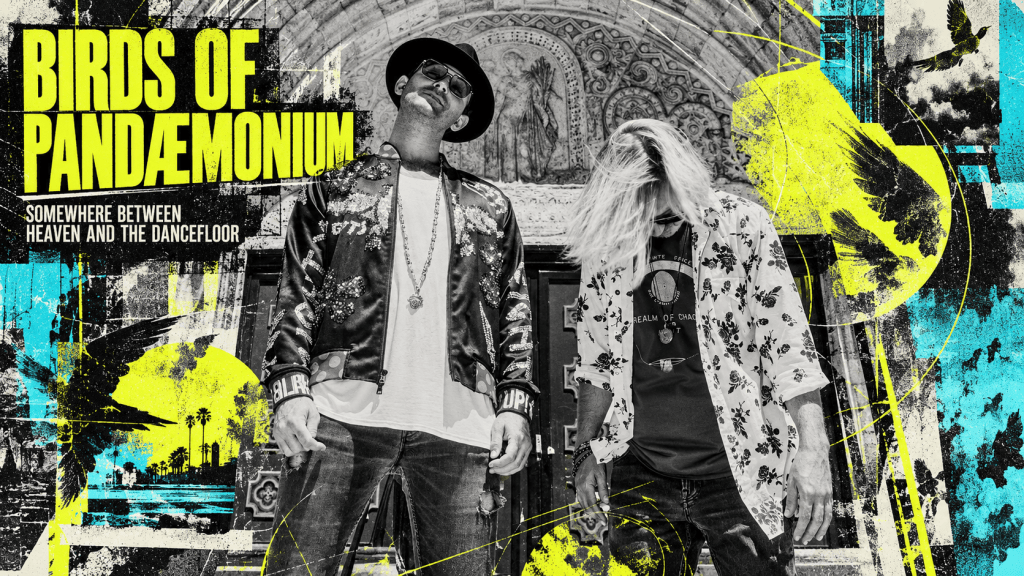
The Brooklyn duo of James “Hazy James” Armstrong and Tim Wagner emerged from a friendship stretching back nearly two decades, having met through New York’s DJ and club scene. Their musical backgrounds are unusually broad: folk and guitar music on one side of the room, synths, drum machines, disco, jazz and rhythm-heavy club music on the other. Their own description of the project is beautifully economical: “exploring the darkness while pursuing light.”
That tension is important.
Because although Birds Of Pandæmonium can comfortably occupy the fuzzy territory where Balearic, psychedelic music, dream pop and indie-dance exchange phone numbers, there is something more deliberate happening underneath. These aren’t simply records designed to sound good when the sun comes up. They are frequently about transformation: what survives, what disappears, and what familiar things might become when viewed from somewhere else.
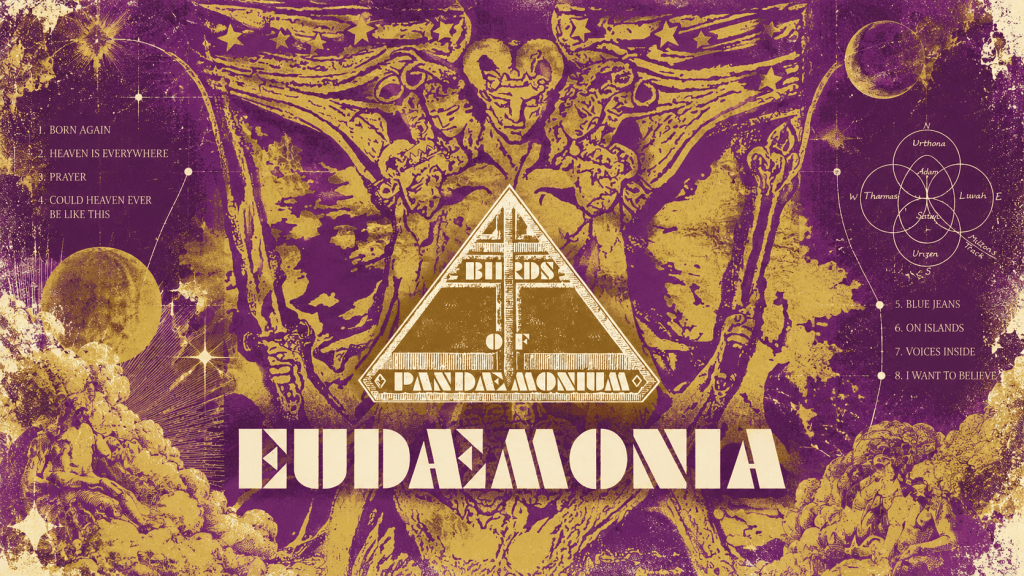
Their debut album Eudæmonia, released by Manchester label Sprechen on 18 September 2026, makes that idea feel almost like a manifesto. Across eight tracks it places original material alongside reinterpretations of Idris Muhammad, Underworld and New Musik, while the label describes the originals as drawing upon reflections on life, grief and love.
The past is everywhere.
But nostalgia isn’t really the point.
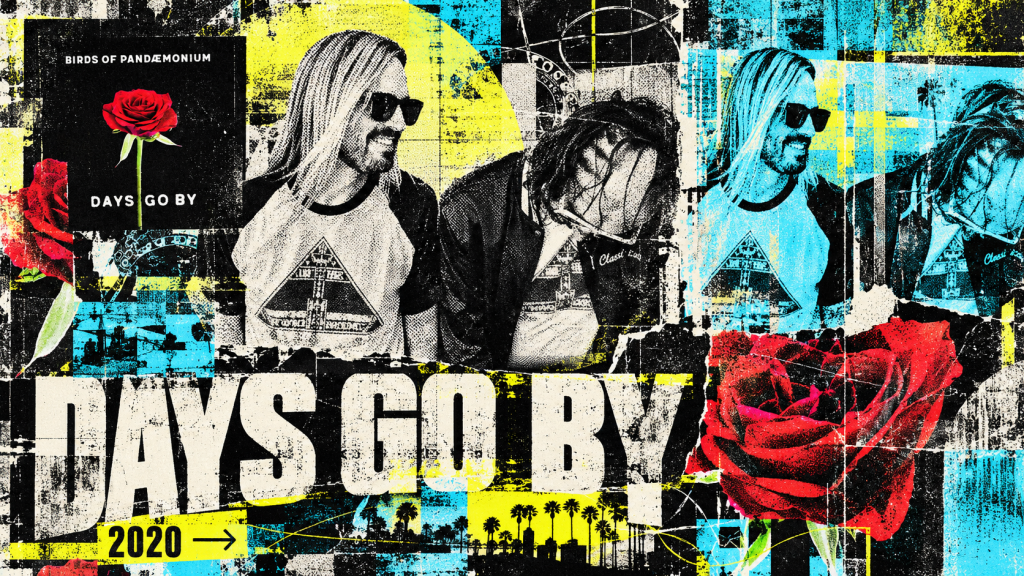
DAYS GO BY
Birds Of Pandæmonium first surfaced on record with Days Go By in July 2020, released through Our Starry Universe. The original release described the track as “optimistic, astral dream-pop”, while Armstrong explained its subject in considerably more personal terms: confronting ego, recognising its destructive influence and consciously choosing to move towards something more positive.
Already, the coordinates were being plotted.
Guitars without straightforward rock music. Dance rhythms without straightforward dance music. Darkness that keeps looking for an exit.
The project returned in 2021 with The Night and the Out For You EP. The latter paired guitars, arpeggiated bass, 808s and Armstrong’s falsetto on its title track, while The Night pushed towards colder territory, combining goth-punk atmosphere with acid-house propulsion. Juan MacLean remixed The Night, while Each Other, the duo of Justin Strauss and Max Pask, tackled Out For You.
Then things went quiet.
By 2026, however, Birds Of Pandæmonium had found another home.
An introduction from Shane Watson of Causeway connected Armstrong and Wagner with Manchester’s Sprechen, a label explicitly interested in joining club music to more abstract forms of electronic listening. The relationship ultimately produced three EPs and the duo’s first album.
And this is where the Birds really start flying sideways.
OLD SONGS, NEW WEATHER
The road towards Eudæmonia included a return to Days Go By, this time subjected to a set of Richard Norris versions in June 2026. Norris produced four interpretations, including vocal and instrumental Rooms Of Percussion versions and Stripped mixes.
Then came On Islands.
The source was New Musik’s 1980 song of the same name, but Birds Of Pandæmonium recast it within their own psychedelic/Balearic vocabulary. The July 2026 Sprechen release was accompanied by three Hardway Bros versions.
There is a pattern emerging here.
Birds Of Pandæmonium don’t treat the cover version as karaoke with better equipment. They seem interested in the memory embedded inside a piece of music. The original remains visible, but the atmosphere around it changes.

Which brings us to heaven.
COULD HEAVEN EVER BE LIKE THIS
Idris Muhammad’s Could Heaven Ever Be Like This carries substantial cultural baggage. Sprechen describes the original as a disco-era jazz-funk favourite at David Mancuso’s legendary Loft parties in New York. Taking it on is therefore not a neutral act. You are entering a song already carrying the fingerprints of dancefloor history.
Birds Of Pandæmonium slow everything down.
Their full version runs for 9:43. Sprechen describes warped guitars and synths, piano, reverberant horns and an ethereal vocal from Armstrong, with the original’s jazz-funk architecture transformed into something closer to psychedelic cosmic disco. The recording was produced by Wagner and Armstrong, with Armstrong on vocals.
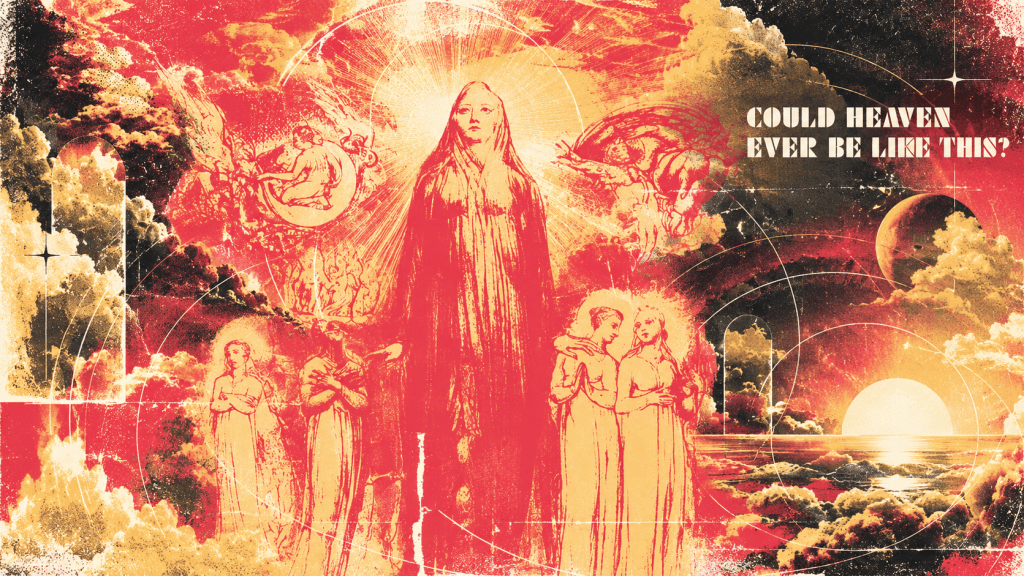
It feels less like covering a record than remembering one after waking from a dream.
The accompanying EP, released on 21 August 2026, expands that idea across seven versions. Hifi Sean contributes a remix and dub; Birds Of Pandæmonium provide their own remix and a Dub Poem Version; and instrumental and radio edits complete the release.
The latter is important for us.
We will come back to it.
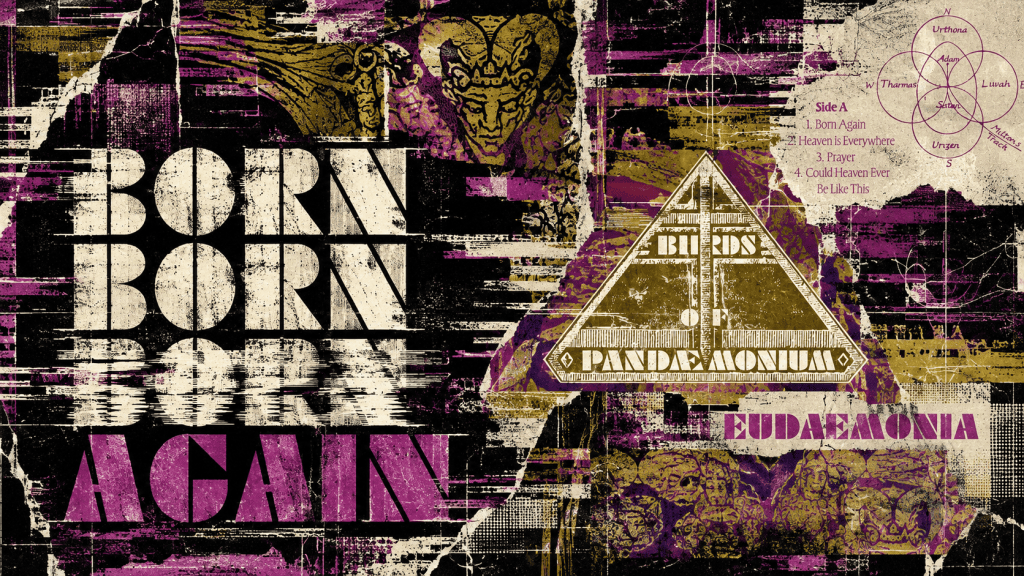
BORN AGAIN
If Could Heaven Ever Be Like This looks towards the spiritual possibilities of the 1970s New York dancefloor, Born Again reaches into another sacred text of club culture.
Underworld.
Sprechen’s notes for Eudæmonia explicitly identify one of the album’s reinterpretations as Underworld’s Born Slippy. On the finished album, its opening track is titled Born Again, running 4:45.
The title change is almost suspiciously perfect for Birds Of Pandæmonium.
Take something known.
Let it die a little.
Bring it back differently.
Within Eudæmonia, it sits beside two other acts of musical reassembly: Idris Muhammad’s Could Heaven Ever Be Like This and New Musik’s On Islands. Around them are original Birds Of Pandæmonium compositions including Heaven Is Everywhere, Prayer, Blue Jeans, Voices Inside and the album-closing I Want To Believe.
Even the titles seem to be looking upward.
Heaven. Prayer. Voices. Belief. Rebirth.
That doesn’t make Eudæmonia a religious record. It does make transcendence a useful way of hearing it.
The album’s name helps. Eudæmonia is the Greek philosophical idea associated with living or flourishing well, rather than simply experiencing momentary pleasure. The album itself moves between dream pop, shoegaze, gothic pop, psychedelic music and club rhythms, with Sprechen describing the result as deliberately resistant to easy genre classification.
Which might explain why “Balearic” feels simultaneously right and insufficient.
Birds Of Pandæmonium understand the Balearic permission slip: that a dancefloor can contain guitars, strange records, pop music, dub, psychedelia and things that weren’t ostensibly made for clubs at all.
But their records are darker around the edges.
Sunset music with the night already inside it.
TWO BIRDS IN THE TRANSMISSION
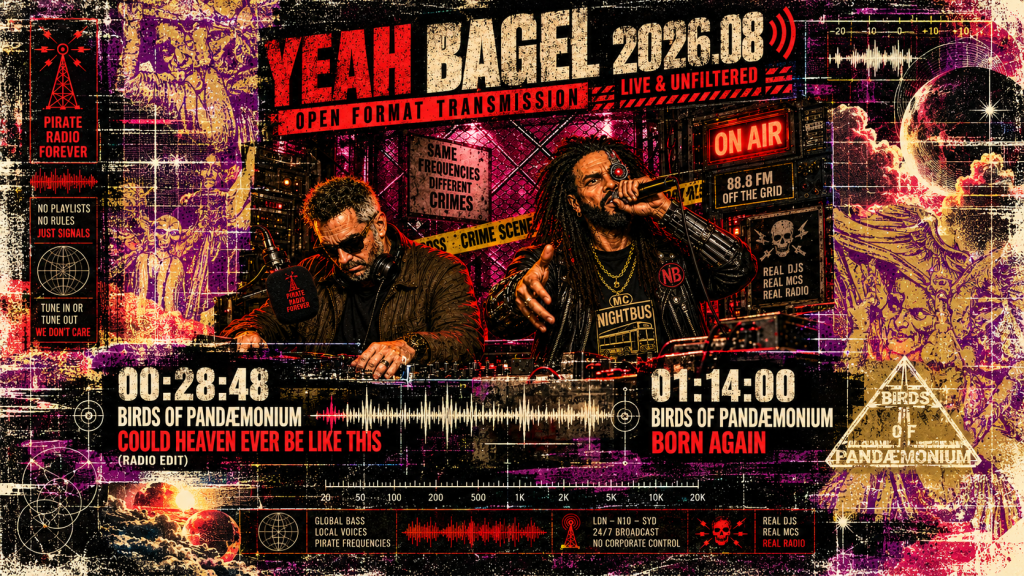
And that is how Birds Of Pandæmonium end up appearing twice on Open Format Transmission 2026.08.
The first arrival comes at 00:28:48 with Birds Of Pandæmonium – Could Heaven Ever Be Like This (Radio Edit).
It is the 4:36 edit included on the August Sprechen EP, compressing the architecture of the full 9:43 version into something considerably tighter.
Inside OFT 2026.08, it functions almost like a portal.
A 1970s composition associated with Mancuso’s Loft, reconstructed by two musicians who met through Brooklyn club culture decades later, released by a Manchester electronic label in 2026, then dropped into a Yeah Bagel transmission.
Open format indeed.
But the Birds aren’t finished.
At 01:14:00, they return with Born Again.
By this point the connection becomes clearer. The two selections aren’t merely two tracks by the same artist. They are two examples of the same impulse.
One begins with Idris Muhammad.
The other begins with Underworld.
Neither is interested in simply preserving the original in glass.
Birds Of Pandæmonium take records that already possess histories, memories and dancefloors of their own and allow those histories to leak into something new. Across Eudæmonia, those transformations sit alongside songs concerned with life, grief, love and the possibility of becoming something different.
Which makes their double appearance on OFT 2026.08 feel particularly appropriate.
This transmission spends plenty of time moving between decades, genres and competing ideas of what a dance record is supposed to be. Birds Of Pandæmonium perform the same trick inside the records themselves.
At 00:28:48, heaven is remembered.
At 01:14:00, something is born again.
Same birds.
Different sky.